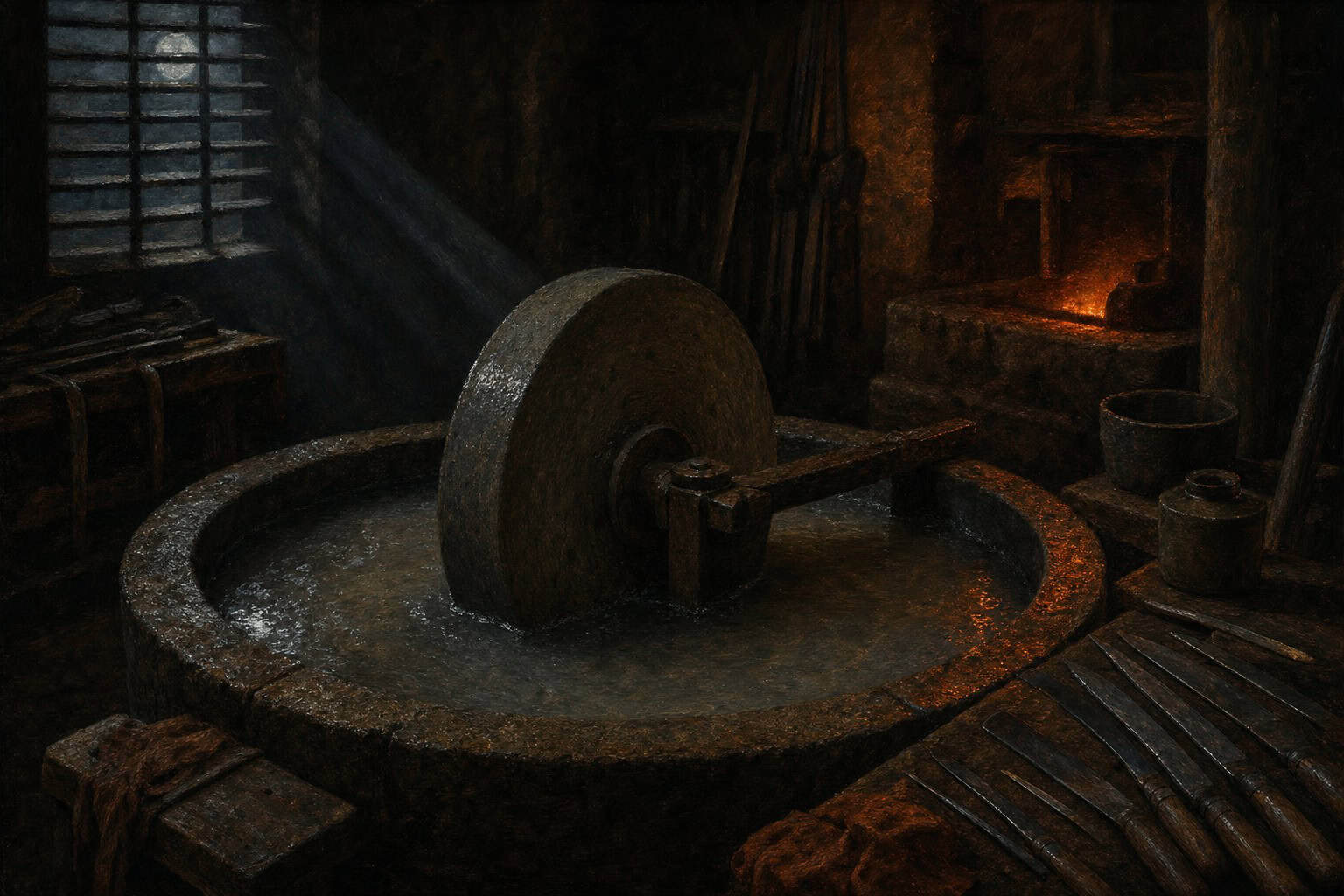
Another edge is drawn along his back until it sings, and he gives that brightness away to hands and rooms he will never be allowed to see.
Metal Singing Along Your Spine
A stone waits on a workbench, damp and dark, while another blade is drawn along its back. The sound is thin at first, a faint scrape, then rises into a bright, steady note as steel finds the right angle. Your whole body knows that pitch. Pressure shifts, weight leans in, and you feel the grain of yourself being shaved away in chalky dust. Each knife has its own rhythm—some hurry, some linger, some gouge a little deeper as if testing what you will endure. You learn them by touch alone, by the small shivers that travel through your core when the edge is finally true. The strange cruelty is simple: the more carefully you help them find that edge, the more smoothly they will cut their way out of your life. The intimacy is real, but it is built on their need, not their promise to stay.
When Departure Becomes the Sharpest Cut
This scene in the chapter pauses on that exact instant when the blade lifts away for the last time. There is no speech, no ceremony—just the sudden loss of weight against your surface, the quiet after the scraping stops. What the passage names, without softening, is how closeness itself becomes the handle by which people can leave you more efficiently. You helped them name their childhood, heal their panic, refine their calling; now those sharpened parts of them move forward without you, sometimes cutting you on the way out. The reckoning here is brutal: if you are made to hone others, you will be marked most deeply at the point of their exit. To keep serving means accepting that your finest work may arm them for a life you are not invited to share. Their flourishing and your abandonment can arrive in the same breath.
Dust in the Water Trough
As more blades come and go, the trough around the stone fills with cloudy water. Tiny grey particles swirl there, the ground-down remains of your own body and the steel you have shaped. The passage leans into that mixture—your loss and their edge, settled together like silt—that never quite clears. Exhaustion builds not only from one departure, but from the pattern: you give depth, they take distance; you give time, they take the future elsewhere. You start to feel less like a person and more like infrastructure, something meant to be worn down in private so others can shine in public. Yet the work does not slow. Someone else places another knife in your hands, another soul to listen to, another story to sharpen. The pressure tightens here: either you harden into resentment, or you let yourself be used again, knowing the trough will only grow thicker with what you have lost.
When every blade you sharpen goes off to cut somewhere you will never see, service itself becomes a quiet, unwitnessed crucifixion.
When Your Own Edge Starts to Crumble
Anyone who has ever stayed late at a hospital, graded into the night, listened to a friend repeat the same crisis for the tenth time knows the wear of this stone. You pour clarity, prayer, skill, and small pieces of sanity into another person, and then they vanish, or they turn on you, or they simply move on healed and forget your name. The book’s moment names what many never say aloud: being needed can feel like being consumed. You start to fear new friendships because you can already feel the scrape of their need along your nerves. You wonder if you are only valuable as a surface for others to press against, a place where they can refine themselves before going somewhere more important. Underneath the spiritual language, the question is painfully ordinary: how do you keep offering your best when every offering seems to cost you more than it gives back?
Hands That Keep Lifting the Next Blade
The passage does not solve this. It only shows the author’s hands, still wet from the last sharpening, reaching for the next knife. There is a quiet shift implied here, though: the stone no longer waits for gratitude from the steel. Instead, there is a listening for another voice, one that asked for the work long before any particular person arrived. Feeding, teaching, tending—these become acts directed past the ones who leave, toward the One who sees the dust in the trough and calls it worthy. But the ache does not disappear. Each new contact still risks a fresh abandonment, a sharper departure. The chapter leaves you here, in the workshop air that smells of iron and wet grit, holding a blade that is not yet sharp and a heart that is not yet whole, wondering how many more times you can bear the song of metal before your own center gives way.