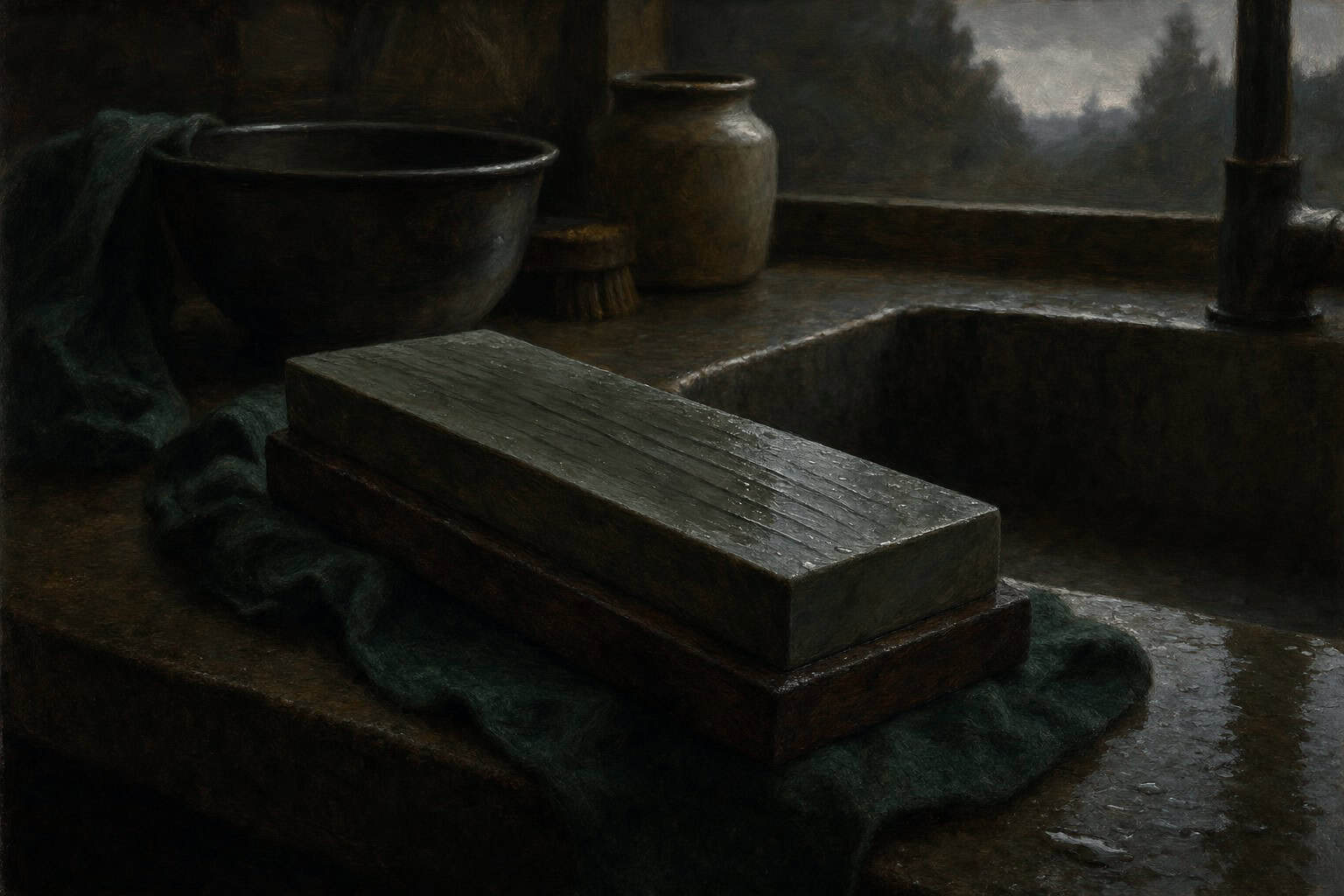
His hand sets one more dull blade against the stone, and the thin steady rasp is the whole of it — a gift that reaches him as fatigue, giving depth and taking only surfaces.
The Hand That Holds the Blade
Picture the smallest movement: your hand lifting yet another dull knife, setting its edge against the stone. That scrape—that thin, steady rasp—is the sound this passage lives inside. It is not about metal and rock, not really, but about the way your chest tightens each time someone leans on you, expecting clarity, comfort, direction. In this section of the memoir, the narrator recognizes that he has not been chosen to swing the weapon but to bear its edge, again and again, as it drags across him. Others arrive with their needs like unsharpened steel, heavy and awkward, and place them into his already tired grip. The chosen image is simple, domestic even, but it hides a terrible knowledge: every stroke that makes another person more ready for their battles removes something from him that he can never put back. To be trusted with that task feels less like honor and more like a sentence carried out in the muscles of his forearm.
Edges Borrowed from Your Flesh
This moment forces a reckoning: if the blade wakes up sharper, it is because some small part of you has been spent. The passage does not soften that fact. The narrator names how divine choice first appears not as joy but as weariness, an assignment that keeps arriving in human form—friends, strangers, family—each placing their troubles in his hands. They want comfort, distraction, a pleasant nearness; they do not come asking to be drawn into his hard-won wisdom. Yet wisdom is the only honest thing he has to give. He finds himself offering insight no one requested, asking harder questions than they intended to face. Their edges brighten; his body slumps a little more. This is the reckoning: that a gift from God can feel, in its daily practice, like losing ground inch by inch. To withdraw would be to betray the One who placed the stone in his palm. To continue is to let others walk away carrying edges honed by his quiet depletion.
When the Stone Starts to Throb
The pressure here is not loud; it is a deep, steady throb in the wrist that has been overused. The narrator feels it as relational fatigue—conversations that begin with lightness and end with blood on his inner life, even when no one has raised their voice. People seek relief; he ends up opening old bruises inside himself to meet them. Their questions press against the same fault lines that once split him. That is the cruel symmetry this passage exposes: you can only sharpen others where you have already bled. Every time he steadies another trembling story, old fractures within him ache with fresh insistence. The scar tissue that once felt like survival now becomes his only credential, the roughness that makes the blade catch and transform. There is no promise that this will ease. The stone does not harden into numbness; it stays sensitive, even as its surface changes shape with every pass of someone else’s fear and need.
When your giftedness arrives as exhaustion rather than glory, every encounter becomes a bargain where you give depth and receive only surfaces.
Midnight Calls and Empty Calories
An ordinary reader may recognize themselves not in the stone but in the tired arm that never quite rests. This passage speaks to the one whose phone lights up at impossible hours, whose days are dotted with whispered disclosures in parked cars, stairwells, office corners. You give depth because you do not know how to stay on small talk when someone’s eyes are clouded. In return, people offer what they think is generous—presence, a drink, a laugh—thin calories when your hunger is for someone to step into the same hard questions you carry. You walk away from many encounters both emptied and underfed. The text names that strange mix of duty and resentment: the sense that you have been fashioned for this, and the quiet anger that no one seems built for you in the same way. It suggests that your past sorrows are not disqualifiers but the very grit that allows you to steady others. But it does not pretend that makes the exhaustion any less real.
The Stone in the Sink After Everyone Has Left
At the edge of this passage, nothing is fixed or neatly blessed. The image that remains is simple: the stone left alone after the knives have been wiped dry and put away in their drawer. Your chest knows that feeling. The work is done for the moment; the world around you looks calm, even orderly. But you can feel the new grooves under the skin of your own life, faint as hairline cracks, where yet another story pressed hard and took what it needed. The narrative does not yet tell you what God intends to do with that loss, or whether the whetstone will be restored, replaced, or simply spent. It leaves you in that kitchen-sink stillness, hand resting beside the tool that has no language of its own. Somewhere in that quiet, a question waits—not shouted, not answered—about what kind of goodness could possibly be large enough to account for so much hidden wearing-down.