Does talking about trauma make it worse? A hard, honest answer through the pages of Fractions of the Soul – and why speech is not the danger.
The Buried Coin and the Cold It Keeps
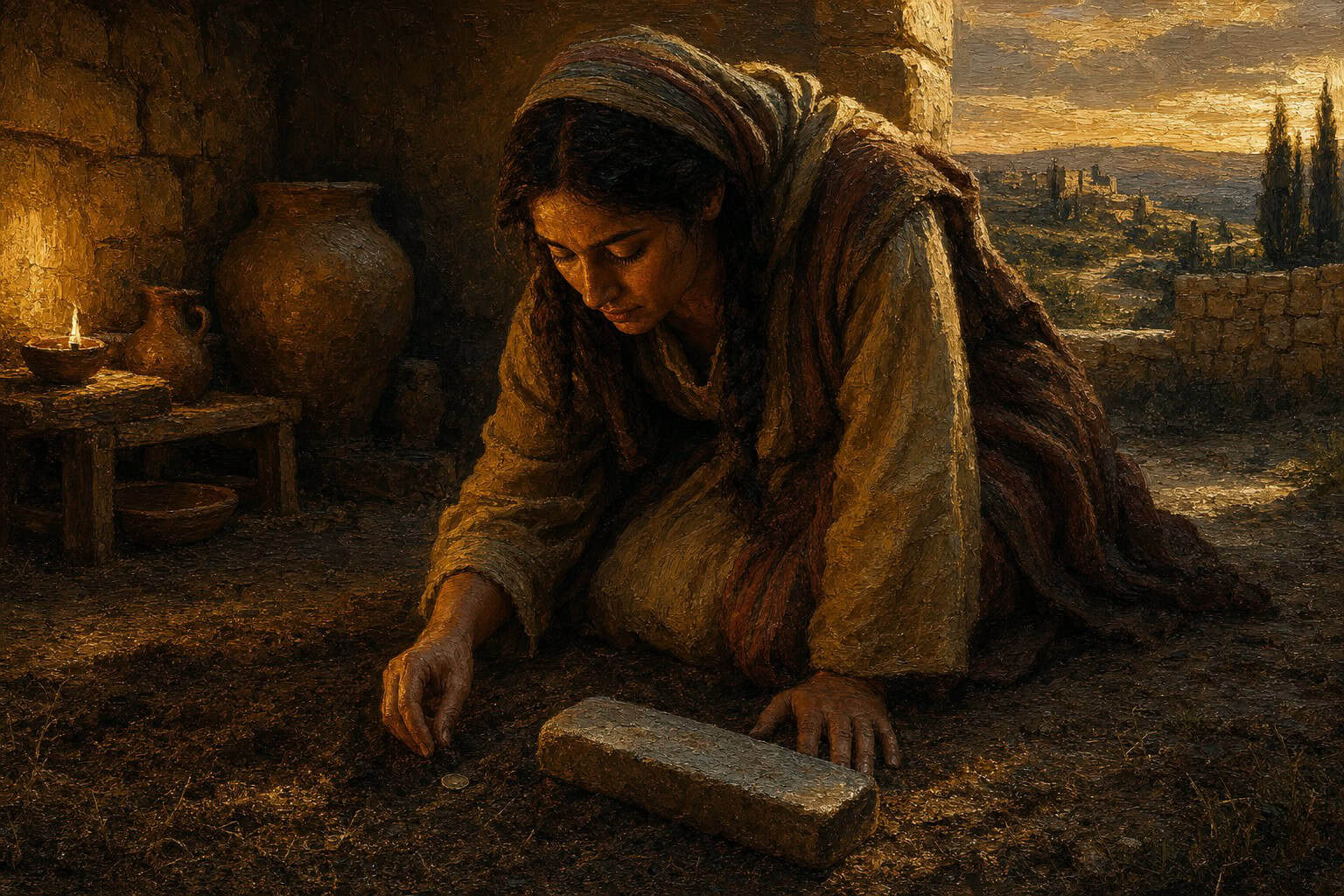
You are afraid that saying it out loud will tear the stitches. I know the fear from the inside. I lived a long time folded around it, the way a man folds around a stomach cramp so no one can see where it hurts. In the fifth chapter of Fractions of the Soul I sat with an old story about a servant who was handed something valuable and, out of terror, dug a hole and pushed it down into the dirt. He was not lazy in the way we usually mean the word. He was scared. He looked at the one who gave him the gift, decided the man was hard and grasping, and chose the safest thing he could imagine: to hide what he had been given, to keep it dark and unmoved and unspoken. That is precisely what the fear of speaking does inside a wounded person. You take the thing that happened to you and you press it down into the ground and you call the burial protection. You tell yourself that if you never lift it back into the light, it cannot cut you a second time. I believed exactly this. I trained myself into a quiet so complete that the memory seemed unable to reach me across it. But here is what the frightened younger man did not grasp and the older one now cannot unsee: the buried thing does not stay buried. It works its way up through the soil of every ordinary day. It decides how my shoulders climb toward my ears when a voice rises in the next room. It decides who I distrust before they have finished their first sentence. The servant believed he was keeping the coin safe. He was really keeping himself at a distance from his own life, standing guard over a hole while everything real happened somewhere behind him. The fear that talking makes it worse is not a lie, exactly. It is a half-truth wearing the face of prudence. Speech done carelessly, in the wrong room, to the wrong face, can absolutely rip a thing back open. I have felt that tearing. But silence is not the neutral, harmless thing it pretends to be. Silence is a decision made again every morning, a small daily burial, and the ground I chose to hide mine in was my own body. That is where the coin sat. That is where it stayed cold to the touch, year after year, while I told visitors the house was warm. The question was never whether to speak. The real question was whether I could bear to dig, and whether anyone standing near me would not flinch at what came up out of the dirt.
When the Telling Lands on a Face That Cannot Hold It
The real damage is not in the words. It is in the room where the words come to rest. I have said hard things to people who offered me only their bodies in the chair, their physical presence and nothing beneath it. They nodded at the right moments. They made the small sympathetic sounds a person makes over a spilled drink. And I walked away emptier than I had arrived, because I had poured something with a bottom to it into a surface that had none, and the surface gave nothing back up. This is the exhaustion I was circling in that fifth chapter before I had a clean name for it. You bring your deepest bruise to someone, you invite them into a search they never asked to join and would not have chosen, and they receive the whole of it the way a person receives a weather report over breakfast. That is when talking does make it worse. Not because the wound resents daylight, but because the wrong witness turns a confession into a monologue delivered to an empty theater, the seats folded up, the lights already going out. I think of the servant again, standing in front of the master, holding out the dirt-crusted coin, saying here, it was always yours, take it back. He wanted his fear to be understood as fear. Instead he met a face that read the burial as betrayal, that saw cowardice where he had felt only self-protection. The wound in that moment is not merely the losing of the coin. It is being seen wrongly, being called wicked in the exact second you felt most frightened and small. So many of us asking whether we should speak are really asking a different question underneath: can anyone be trusted to hold what I say without dropping it, or turning it, or using it. That is a fair fear and I will not talk you out of it. Some people genuinely cannot hold it. Some will hear your worst hour and shelve it as ammunition. Some will hear it and be bored. Some will hear it and, within a breath, make the whole of it about themselves. When your story keeps coming down on faces like these, of course you conclude that speaking harms you. But you have confused the listener with the act itself. The problem was never that your mouth opened. The problem was who happened to be sitting across from you when it did. I learned this slowly, and at cost. The choice was never silence or exposure. The choice was to whom, and when, and how much. To offer the coin only to hands that would not sneer at the dirt still clinging to its edges. That single distinction took me years, and it emptied more chairs than I can bring myself to count.
The Grinding That Took Time and a Certain Tenderness
Here is the turn I could not see when I was young and afraid of my own mouth. The very thing I most wanted buried was the thing I was eventually meant to give away. In that chapter I described myself as a kind of whetstone, a stone whose entire purpose is to grind the weakness off a blade until the blade can hold an edge. And a stone does not learn to sharpen by staying smooth and unmarked. It learns by being ground itself, by the slow scraping that leaves it rough enough to catch and shape the metal laid against it. I did not choose this and I did not want it. I resented it for the better part of a decade. I wanted to be the blade, the thing admired and carried and put to elegant work in someone’s hand. Instead I was the stone left in the drawer, the object that only exists by wearing itself down against other, sharper things. But the man writing this now sees what the frightened one could not. My scars are not evidence that I am broken past use. They are the exact roughness that lets me draw an edge onto someone else. I cannot prepare a person for a battle I have never bled through. My integrated bruises, the ones I finally lifted out of the ground and turned over in the light, became the only credential I have ever actually owned. The grinding of my own life took time it seemed to have no reason to take. It took a certain delicacy, a slowness I could not appreciate while it was happening to me. It did not feel, in the moment, like being prepared for anything. It felt like being worn thin for no purpose, sanded down by hands I could not see and did not trust. But reading backward across many years and many relationships, I can finally make out the pattern that only reflection would surrender. Every worst hour was quietly teaching me a language I would one day need to speak to someone drowning in their own worst hour, someone who would look at me and know, without my saying it, that I had been under the same water. The gift never felt like a gift while it was being given. It felt like exhaustion. It felt like obligation. It felt like being asked, again and again, to spend what I had barely managed to keep.
You do not sharpen anyone on a stone that has never been ground; the scar is the credential.
Scar Tissue Is Not the Same as a Cold Heart
After the grinding comes a strange, quiet strength, and it is the easiest thing in the world to mistake it for hardness. People looked at my composure and decided I had gone cold. They saw a man who could sit inside another person’s collapse without visibly flinching and concluded that I had simply stopped feeling anything at all. That is not what had happened to me. What they were reading as coldness was scar tissue, and scar tissue is only the body’s way of staying whole over a place that once split all the way open. I had not stopped feeling the cut. I had stopped bleeding from it every single time a stranger’s hand brushed against it. This is the fallout of speaking at last instead of burying: the wound closes into something tougher and stranger than the skin around it, and that very toughness is what lets you press against another person’s raw place without both of you coming apart on the floor. But I will not pretend the settling was clean, or that it felt like an arrival. The grief did not pack up and leave. God did not reach down and lift the thing away and hand me back a tidy, healed life with the seams hidden. What He did was quieter than that and far harder to put into a sentence. He stayed near while I dug. He was in the room where the burial had happened, and down in the dirt of it, and in the shaking hands that finally lifted the coin back into the air. I did not feel rescued. I felt accompanied, and there is a real and stubborn difference between the two. A rescue lifts you up out of the dark and sets you somewhere dry. Accompaniment sits down in the dark beside you and refuses to leave, and lets the dark go on being dark. When I finally spoke my worst things to the few faces that could hold them, God was not the reward waiting for me on the far shore of the confession. He was already there in the middle of the water, present in the tears, present even in the shame that kept trying to close my throat and stop the telling halfway. That nearness did not make the speaking painless. It made the pain something I could carry to the end of the sentence, which is not the same as painlessness and is, in some way I still cannot fully explain, more than it. So no, speaking did not spare me anything. It reopened old ground that had gone hard on top. But the ground was reopened in company this time, kneeling beside Someone who did not look away, and that changed everything about what finally came up out of it.
What the Empty Chair Was Really Waiting For
I no longer believe that talking about trauma makes it worse. I believe that talking to the wrong witness makes it worse, and that silence makes it worse in a slower way you stop noticing, the way you stop noticing a room going cold when you have been sitting in it the whole afternoon. The servant’s true failure was never that he handled the coin clumsily. It was that he never handed it to anyone at all. He kept it in the ground where it could earn nothing and heal nothing and reach no one, guarding a hole and calling the guarding faithfulness. The gift of your own hard experience is not meant to be preserved down in the dark like something wrapped for a grave. It is meant to be spent, set into the living current that runs between you and another person, where it can grow into something that outlasts the injury that first shaped it. I keep returning to these matters because I sat with an empty chair long enough to learn at last what the chair was actually for. It was never placed there to receive a burial. It was placed there to receive a voice, even a shaking and half-stopped one, and to teach me over years that the act of speaking was never the true danger. The danger is speaking to no one, or to someone who cannot hold it, and calling that the safe choice forever. If you are standing over your own buried coin right now, the spade heavy in your hand, afraid to lift it, I will not lie and tell you it will not hurt. It will. The dirt still clings to everything you pull up. The scraping is real and it does not announce in advance how long it will last. But the exile you are already living in, cut off from the self you used to be and from the people who might have received you gently, is a heavier country to inhabit than the passing pain of speech. There is a difference between a wound being ground slowly toward usefulness and a wound left in the ground to rot in silence. I could not tell those two apart for most of my life, and I called the rotting one peace. Learning to tell them apart is very nearly the whole subject of that book, and it is the reason I keep the chair, even now, even empty, drawn close to where I sit and write these words to you.