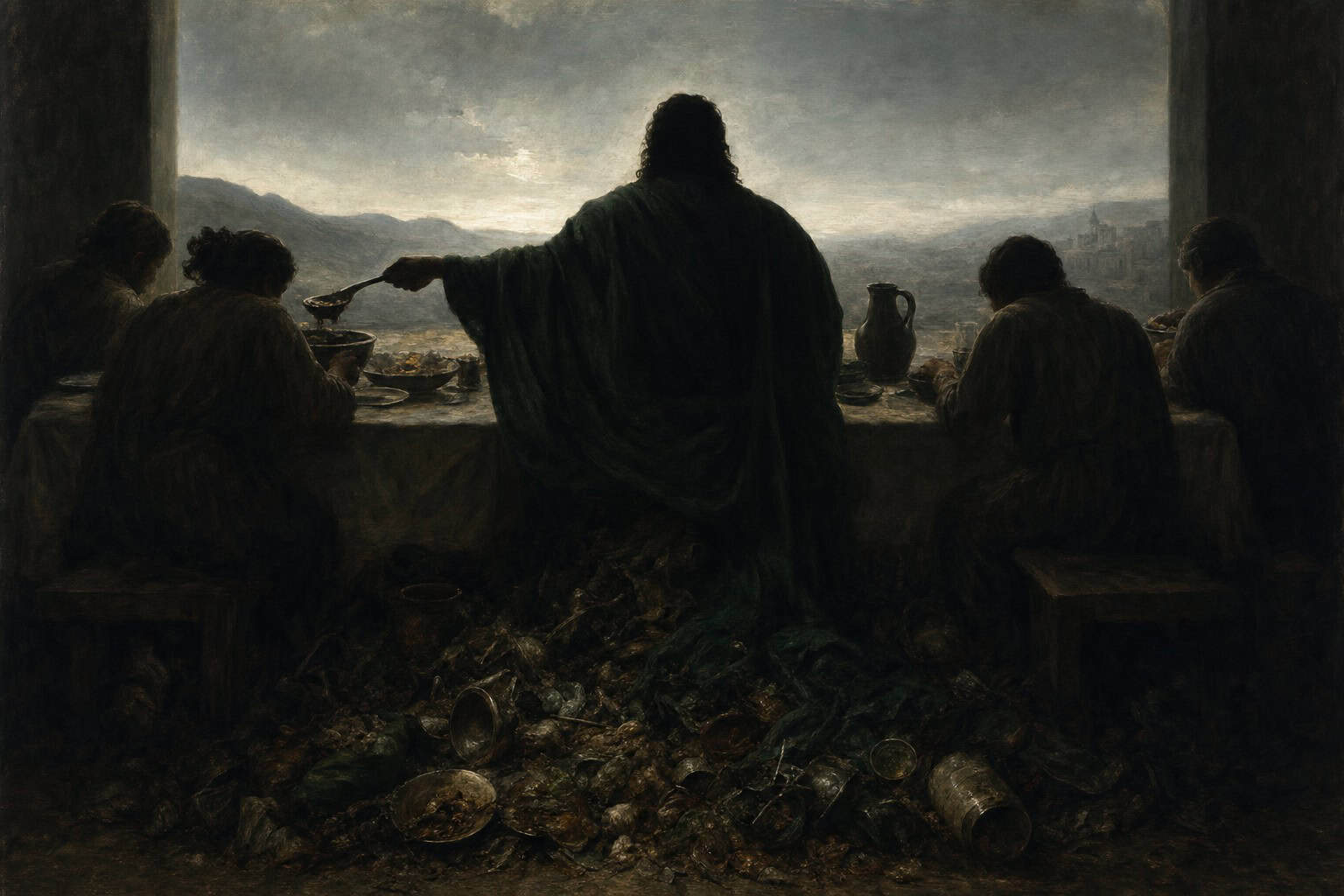
He feeds them with one hand and teaches with the other, and cannot yet feel how a later betrayal will reach back to sour even this — even the bread, even the being known.
What Goes In Their Mouths
He stands close enough to see their jaws move. Bread in one hand, teaching in the other, he feeds them both at once. His own nights of agony, the hours bent over texts and prayer and memory, arrive here as simple food and simple words. Teeth tear, tongues roll, throats swallow. He knows exactly where this offering is headed: through acid and muscle, into the pipes that will carry it out of their bodies before sunrise. The passage keeps the image stubbornly material, almost crude. Wisdom does not hover in the air as light; it rides down the same slick chute as every cheap meal. Yet the command on him is clear and does not blush. He must keep handing over what cost him everything, knowing it will become the same soft waste on the other end. The humiliation is not a side effect of his work. It is the form his work takes.
When the One You Chose Walks Away
Inside this scene, one face among the fed is not like the others. The teacher has set this student apart in his mind, read a deeper line in the eyes, trusted a quiet hunger there. So when that chosen one rises and leaves, it is not just a body moving toward an exit. The teacher feels something snap behind his own eyes. Every remembered glance between them turns sour at once. The past does not stay put; it gets rewritten by the sound of retreating footsteps. He replays earlier moments and can no longer tell if he ever saw what he thought he saw. This is where death draws closest in the chapter, not as a man with a scythe but as a thick doubt that settles over his sight. If he was wrong about this one, maybe he has been wrong about everyone, all along. His vocation as a seer, not just his affection, is under judgment now.
The Same Pile of Ash
As the teacher watches what he gives slide toward waste, another knowing presses against his ribs. He realizes his own body is running the same course. His careful self-denial, his sharpened attention, his attempt to live awake—these, too, are feeding a slow furnace that will end in ash. The stomach that tightens when a student leaves, the lungs that once filled with hope, will one day empty and match the trash heap outside. The text brings the image down to the same ground as his students’ digestion. Their careless intake and his disciplined offering generate an identical final product: matter that will be burned, buried, or washed away. This is the pressure point of the passage. If both the corrupt and the careful become the same dust, and if both the teacher’s wisdom and their laziness become the same waste, what separates any of it? The question does not get answered here. It only grows heavier in his chest as he keeps passing the bread.
The cruelest betrayal reaches backward, turning even the moments of true recognition to poison, until the sacred labor you gave feels wasted.
When Your Effort Becomes Tomorrow’s Flush
It is not hard to step from his body into your own. You remember the late-night talks with a child who shrugged the next day, the long emails to a friend who never changed, the years of patient work under a supervisor who treated it as disposable. You know the sick feeling of realizing what cost you blood became, in their life, something they barely chewed before spitting out. This passage names that sick feeling without softening it. It says plainly: sometimes the holiest work in you will end up as someone else’s waste. And betrayal, when it comes, will not only break the bond; it will make you question the part of you that ever dared to see promise. That is the knife under the teacher’s ribs: not only loss, but self-doubt. For an ordinary life, the stakes are this sharp—whether you will let such moments convince you that your effort is a joke, your perception a flaw, your call a misreading.
Holding the Ladle Over the Bucket
By the end of this passage, the teacher stands in a strange double awareness. In his hands, the ladle of food and speech; under his feet, the knowledge that much of it will mingle with sewage and ash. Around him, faces that may stay or may rise and vanish, taking his trust in his own seeing with them. Inside him grows the certainty that death will not sort his life by effort, that his dust will not shine brighter than that of the most indifferent eater in the room. Yet the command does not loosen its grip. He is not offered a clear promise of fruit, only the order to keep serving what will likely pass through untouched. The scene does not comfort him with hidden success or secret legacy. It leaves him where many of us actually live: ladle in hand, stomach tight, still pouring into bowls we suspect will be emptied into the same waiting drain.