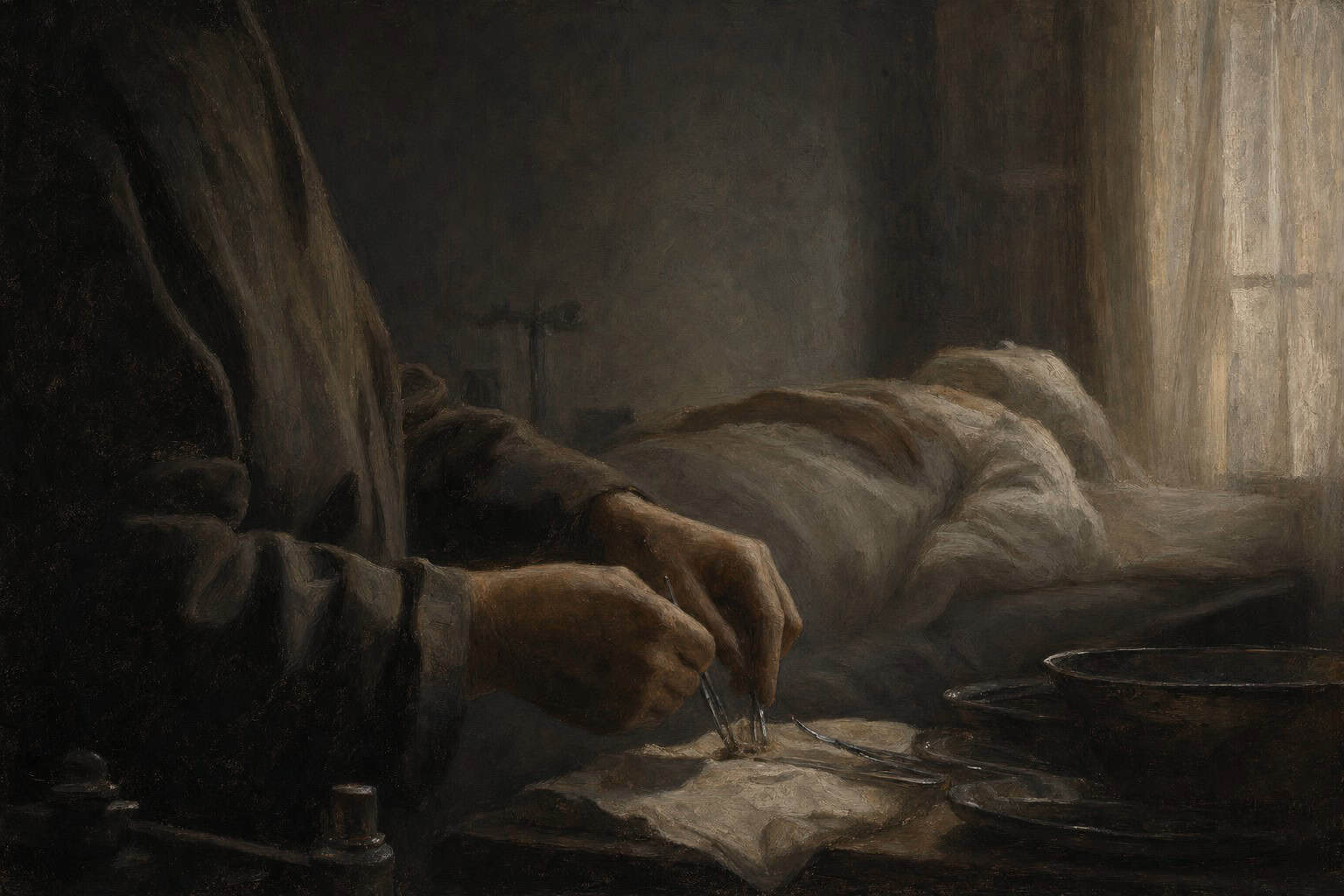
Under the hard lamp he sits across from the woman whose mind was once a country he could live in, and begins to cut into his own flesh, watching her eyes for the verdict.
Hands Poised Like Instruments Under Harsh Light
A table, two chairs, and the hard brightness of a lamp that shows everything it touches. He sits across from the woman whose mind once felt like a country he could move into, whose books and sentences seemed to promise a different life from the one that formed him. His fingers lace and unlatch on the tabletop, not in a nervous fidget but in the controlled motion of someone preparing for a precise cut. In his own imagination he is surgeon and subject, holding an invisible scalpel over his chest, about to slice through the practiced calm he has worn for years. Each word he is about to speak has weight and sharpness; he can almost feel them pressing against the back of his teeth like metal. The air between them tightens, not with shouted accusation, but with the silent awareness that once this opening begins, nothing they share will ever return to its previous shape.
When the Blade Slips and Finds the Old Scar
He did not come here to weep. He came armed with clean phrases, rehearsed explanations, and the cool distance of someone who believes he has mastered his own story. Yet as he begins describing the betrayal, as he names what he has done, her face shifts—not dramatically, but enough that something in his chest gives way. The practiced rationality he built in dark bedrooms and violent kitchens fractures when her pain appears, not as accusation, but as recognition. Her woundedness reflects his own, and suddenly the operation is no longer controlled. The scalpel in his hand, this sharp truth he meant to wield neatly, slips and drags across an older, deeper scar he has never let anyone see. In that instant, the old posture of observer collapses. He is not above the table, charting outcomes; he is on it, cut open, unable to pretend this is only about adulthood and not about the child who first learned to disappear.
The Surge of Joy That Already Knows Its Autopsy
Somewhere in this passage, the possibility of forgiveness enters like sudden oxygen into a starved room. It is not cheap or sentimental; it arrives with the same intensity as the confession itself, pressing against his ribs, threatening to undo him in a different way. He senses, even before any final word is spoken, what it would mean to be seen in the fullness of his failure and not immediately cast out. The body reacts before the mind can manage it—shoulders loosen, breath deepens, vision blurs at the edges. And yet inside that rush is a colder knowledge: he has never known how to let joy stay. Every previous moment of grace in his life has burned fast and then gone dark, teaching him to experience happiness as something already disappearing. Even here, as the warmth rises, another part of him stands back, measuring its half-life, bracing for the cut of its eventual end.
Honest confession is a kind of surgery, cutting into our own flesh while we watch the beloved’s eyes for the verdict of grace or rejection.
Sitting Beside Our Own Incision
Anyone who has dragged a hidden act into daylight before someone they love will recognize the strange doubleness of this scene. On one hand, you are the one confessing, feeling your throat ache as words finally come through, feeling your stomach clench as you watch their features absorb the impact. On the other, you hover just above yourself, cool and watchful, studying the beloved’s jaw, eyes, hands for any sign that the artery of trust has been severed. This passage names that split without softening it. It shows how our carefully built armor—sarcasm, analysis, emotional distance—can feel suddenly like glass the moment another’s hurt lines up with our own buried shame. To live through such an exposure is to sit beside your own incision, both holding the gauze and causing the bleeding. The text does not offer technique or comfort; it simply refuses to look away from how much it costs to let someone see the part of you you most want to keep stitched shut.
Words Laid On the Table Between Two Beating Hearts
By the time his confession is fully spoken, the words feel less like sounds and more like solid objects set down between them. They take up space on the invisible tray of the table, crowding the distance where once there was only banter and admiration. The divine love he’s been circling for years is not offstage here; it presses through this human moment, insisting that cheap immunity is not the same as mercy. If grace is ever to become more than an idea to him, it will have to pass through this exact terrain: honesty that risks annihilation, love that stares at the injury instead of stepping around it. Yet nothing resolves cleanly in this passage. Instead, we are left in that charged stillness where two hearts continue their work—pumping, straining, refusing to stop—while the truth lies exposed on the wood between them, waiting to see whether it will be treated as evidence, offering, or something harder to name.