You keep asking God why He won’t heal you. Here is what the ache means when the cure never comes, and what may still be walking beside you in it.
The Cabinet Where Believer and Atheist Meet
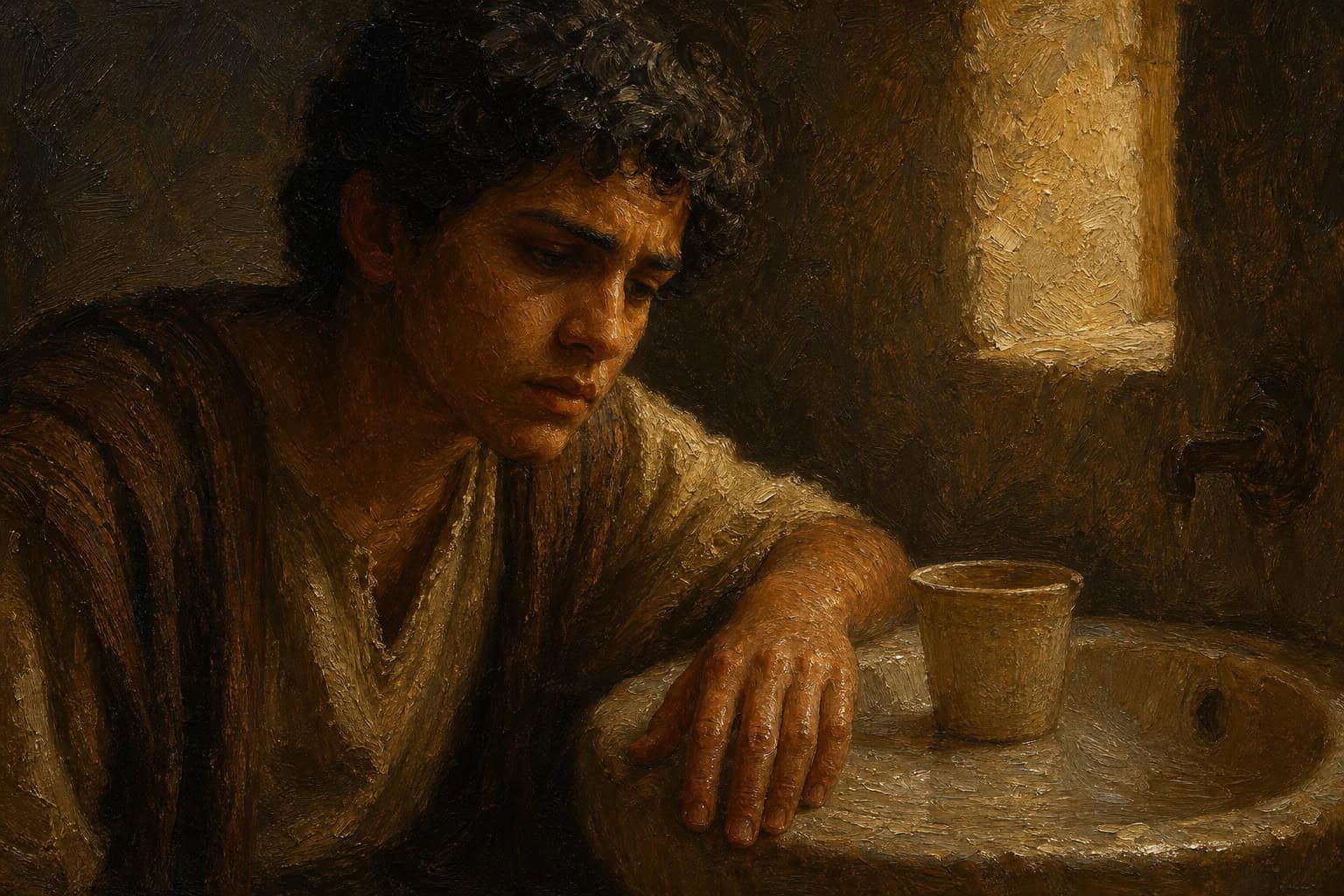
You have asked it in the dark, and you are not the first to ask it there. Somewhere in the middle stretch of Fractions of the Soul the narrator sets a strange and stubborn fact on the table, and it has not left me since I first sat with it. The believer and the atheist swallow the same pill. They stand at the same sink. They fill the same paper cup with the same lukewarm tap water. They wash down the same small tablet whose chemistry does not care at all what either of them believes. The pill knows nothing of prayer. It does not pause at the throat to ask whether a rosary hangs by the mirror. It moves through the blood, it touches the synapse, it shifts the chemistry, and for a while the pain retreats, or it does not. This is the plain floor the narrator refuses to hurry past, and I have come to admire him for the slowness. We do not experience the neurochemistry directly, he says; we experience its effect. That one word, effect, is where the whole ground begins to tilt underfoot. Because if the pill only reaches the effect, and the ache lives deeper than the effect ever reaches, then the pill was never going to touch the real thing. You knew this already, though you would not say it out loud. You wanted the cure and you got the correction. You got the leveling of the mood, the dulling of the sharpest edge, the small mercy of a quieter morning. And still the question stood in the room like an animal no one has fed. Why won’t You heal me. Not the symptom. Me. The narrator does not rush to answer that. He lets the two figures keep standing at the sink together, the one who prays and the one who does not, and he lets you notice that their flesh is the same flesh, their vulnerability the same vulnerability, their fear of the dark the same fear. The chemistry unites them completely. What divides them is only what they will make of it afterward, in the long hours the pill cannot fill. This is the first mercy I did not expect to find here, and it caught me off guard. The ache you feel is not a sign your faith failed some test it was quietly being graded on. It is the ordinary human ground on which every single person stands. The unbeliever aches too, and reaches for the same paper cup, and lies awake counting the same ceiling cracks. Your wound has not been singled out for punishment. It has been shared with the whole aching race of us, and there is a strange company in that.
When the Flesh Becomes the Lens
Here the narrator turns the argument, and it is the turn I keep circling back to on the worst nights. He will not let the body be a mere container, a box that carries a soul the way a jar carries water. He walks through a plain list of maladies, the way a doctor reciting a chart might, but there is nothing clinical in his hands as he does it. The paralyzed leg. The missing arm. The disfigured face that strangers cannot help but read. The damaged spine that measures every stairway in the world. The eyes that do not see, the ears that do not hear. He says something quiet and enormous about each of them, and he says it without a trace of pity, which is why it lands. The world does not simply arrive muffled or dimmed to these bodies. The world reveals itself differently to them. Not worse. Not better. Differently. The flesh is not the wall the light strikes and dies against; the flesh is the window through which the light comes at all, and the exact shape of the glass shapes the exact shape of the light that falls on the floor. I have read this passage on nights when my own body would not do what I asked of it, when it sat down in a doorway of itself and refused, and it undid something in me that I had bolted shut. Because if the flesh is the lens and not the cage, then the unhealed body is not simply the obstacle standing between you and the truth of things. It is the specific angle from which the truth reaches you, and reaches no one else in quite that way. The narrator does not hand you this as consolation, and I love him for withholding it. He is too honest to wrap a hurting man in a warm phrase. He knows a lens can also be a suffering that never lets up. He knows the man who cannot walk would trade the whole strange revelation in a heartbeat for one working leg, one ordinary flight of stairs taken without thought, and I will not pretend otherwise, and neither does the book. But he insists, gently and without retreat, on the strange dignity buried in it. Your wound is a way of knowing something. It teaches you a grammar of the world that the whole and the comfortable and the untroubled will never once be forced to learn. When you ask God why He will not heal you, part of what you are truly asking is why He will not simply hand back the ordinary lens, the one everyone else seems to see the world through without effort. The narrator’s answer, if it can even be called one, is that there is no ordinary lens waiting anywhere. Every body is its own particular window. Some are cracked. Some are darkened at the edges. And through even the cracked and darkened ones, something still comes. It did something harder than comfort for me. It told me my sight was not broken. It was mine.
The Choice You Were Never Given Clean
Then comes the sentence that broke the whole thing open for me, and it remains the hardest in the chapter to hold. The narrator says we make every choice inside a world already contaminated before we touched it. Not a world we alone spoiled by our own hand, though we have surely added to the ruin, but a world already spoiled before we arrived, before we drew a first breath, before we could choose anything at all. He reaches back to the garden, to the two who chose from real innocence, who stood in open ground that was still clean under their feet, and he sets us plainly against them. We do not stand where they stood. We were born into a room already dim with old smoke, handed a decision and told to choose freely in the dark, and even our clearest and best intentions carry the stain of everything that came and rotted before us. Freedom itself, he says without softening it, arrives already wounded. Sit with that pressed against your question and feel the floor move. You asked why God will not heal you, and you have been treating the illness as the one thing that needs the healing, the single broken part in an otherwise sound machine. But the narrator is pointing his finger under the illness to something far older and far deeper. The whole ground you are standing on is sick, down through every layer of it. The choices were sick before you ever made them, curdled in the water before you drank. The healing you keep begging for is not the simple repair of one broken limb or one dark mood. It is the reversal of a contamination you never once chose and cannot outrun by trying harder or praying louder or wanting it more. This is the exact moment the passage stops being about pills and synapses and quietly becomes about grace, though he does not name it yet. Because if the wound truly goes all the way down, all the way back before your birth, then no effort of yours will ever reach the bottom of it, no matter how you strain. You cannot pray your way clean out of a room you were born standing inside. You cannot will yourself pure of a stain that was already in the water when they first washed you. I turned this over for years and hated it before I understood it. And the strange thing is that this hard sentence, which sounds at first like the end of all hope, is where hope had to start, because it took the impossible task out of my exhausted hands entirely.
The body that will not mend is not the wall between you and God; it is the very window through which He learns to reach you.
What Did Not Get Erased
So then, what happens after that sentence finally lands and stops ringing. I will tell you plainly what happened to me, reading it now as an older man who has long since stopped expecting the tidy rescue at the end of the chapter. The despair did not lift. The narrator does not lift it for you, and I have come to trust him more, not less, for the flat refusal. He does not promise that the pill will finally start to work, or that the leg will one morning walk, or that the grief will resolve itself into a clean lesson you can hang on the wall and point to. He leaves the wound exactly as wounded as he found it. And into that unresolved and unswept room something quieter enters, something I could not name for a very long stretch of years. It is not the removal of the dark. Nothing turns on the light. It is a presence within the dark, sitting down in it as if it belonged there. The narrator keeps circling back to that word effect, to the plain fact that we do not touch God directly any more than we touch the raw chemistry of our own brains directly, that we know Him only by what He does among us. And what He does, in this chapter, is not to heal. It is to stay. He is in the tear the pill could not dry, still standing on the cheek. He is in the paralyzed limb, seeing the world through that particular cracked and darkened window right alongside the man who has to live behind it every day. This is the grace I did not deserve and could not even ask for correctly, because I was asking flatly to be fixed and He was quietly offering to be near. I turn the lens back on myself here, the way the narrator taught me to do without flinching. Did I actually want God, or did I want the cure, and would I have taken the cure and walked straight out of the room the very moment it worked, whistling, forgetting? I think I wanted the cure. I think I would have gone. I confess it here as plainly as he taught me to. And the terrible, unbearable mercy of it is that He did not give me the cure that would have let me leave and forget Him. He gave me the dark and Himself seated inside it, and I resented the whole gift bitterly for years before I understood what had actually been placed in my hands. The healing I begged for on my knees would have sent me away whole and forgetful and alone. What I got instead was worse, and it was better. I got kept.
Held in the Room That Would Not Open
Where does all of this finally settle, then, for the one still awake and still asking the question tonight. It settles somewhere I would never have chosen for myself and cannot now imagine trading away. The narrator of this book does not answer your question the way you want it answered, and you should know that going in. He will not tell you that God is going to heal you. He is too honest for that, and I have learned the slow way that honesty is the only comfort that does not curdle by morning. What he does instead is quietly refuse to let your unhealed body mean the thing you have been most afraid it means. It does not mean you failed some hidden test. It does not mean you were overlooked or forgotten in the count. It does not mean the prayer rose to the ceiling and bounced flatly back down onto the blanket. It means you are standing on the same contaminated ground as every other living soul, swallowing the same small pills, seeing through your own particular cracked window, and that even here, even in this, something walks beside you that the chemistry cannot explain away and the illness cannot drive out of the room. The past that first wounded you does not stay politely behind you. The narrator knows it presses forward into every present hour, that a whole body can be dragged back into an old and airless room by nothing more than a smell drifting through a kitchen or a certain slant of afternoon light. He does not pretend that time scrubs it clean. Time only carries it forward, the way a river carries what fell in upstream. And the astonishing claim of this chapter, the line I keep pressing my thumb against, is that grace does not wait for you to deserve it or to finally get well before it comes. It arrives ahead of the cure. It arrives in place of the cure. It is mercy poured out into the very hours you spend on the floor begging for a different mercy entirely. I cannot promise you the healing you searched for tonight with those tired words in the little box. Neither can this book, and it is far more honest than I am. But it can tell you the truer thing underneath. Your wound is not the absence of God. It may be, God help us all, the very place He has chosen to be found. Read the chapter slowly, on a bad night, with the lamp low. It will not fix you. It will do the harder and rarer work of pulling a chair up close and sitting there beside you until the tap water goes still in the cup, which is, I have come to believe, the thing you were really asking for all along.