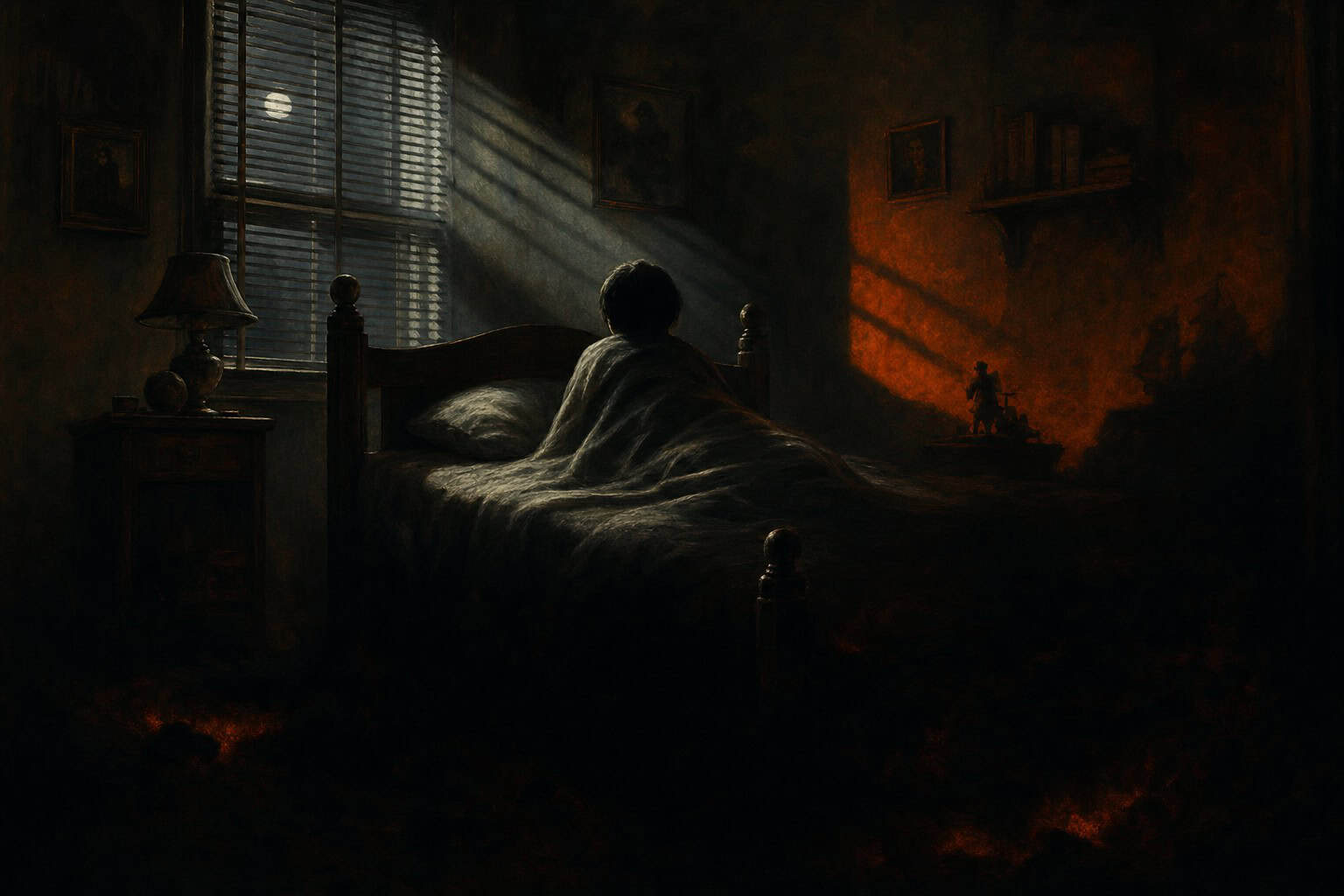
Seven years old and locked rigid as if the mattress had turned to ice, a strange wetness drying on his skin, he receives the kind of visitation that never fully leaves — a mark pressed into a child that becomes the ache by which he will always find the dark.
Frost on the Sheet
He lies on his back, seven years old, every muscle locked as if the mattress has turned to ice. The babysitter’s sticky ritual still clings to his skin, a strange wetness drying in patches he is too young to name. The air around the bed drops without warning, not a gentle draft but a sudden, biting cold that presses through the blanket and into bone. At the foot of the mattress, something gathers—no shape the eye can fix, only a weight in the air, a density that thickens each breath. His body understands first: this is intrusion, not dream. The sheet becomes more than cotton; it is the thin, trembling border between his child’s flesh and a hunger that does not belong in a bedroom. In that cold, the skin itself is drafted into service, turned into a kind of receiver that will, from this night on, pick up signals from a realm no one ever warned him about, and from which there is no obvious exit.
A Wet, Cruel Sound
When the fear tightens enough to choke, the presence does not roar or speak in riddles. It leans into absurdity. From the darkness at the edge of the bed comes a sloppy, childish raspberry, the kind of wet, mocking sound kids make to humiliate each other on a playground. That noise, stupid and obscene, lands harder than any grand display of power. It does not argue with God or preach despair; it sneers. In that moment, evil shows its favorite trick: not noble opposition, but defacement—turning a terrified boy into an object of its joke. The holy is not refuted; it is spat on. Years later, that dumb sound will have more staying power than any theology class, reappearing in prayer, in the quiet after Communion, in attempts to rest. The battlefield of his soul is marked not just by fear, but by the memory that at the center of his terror, wickedness chose to laugh in his face.
Breath Held While the House Sleeps
Down the hall, the steady rhythm of his parents’ sleep goes on, soft and ignorant, like a metronome in another world. He hears the faint hum of an appliance, the tick of a clock, the ordinary sounds that say, everything is fine here. Inside his small body, everything is not fine. He does not scream, does not call out, because some buried knowing has already formed: no one else can feel this cold, or hear this particular wet ridicule at his bedside. He holds his breath, as if even the sound of air leaving his lungs might give the presence more to feed on. This is where the split begins, the gap between the calm hallway and the frozen chest under the sheet. From now on, he will measure every safe room against this night, aware that walls and doors and parental love can do nothing against what has already climbed onto the mattress of his life and claimed space there without asking.
Some visitations never fully leave; the mark they press into a child becomes the lifelong ache that teaches him where the darkness hides.
Wearing Calm Like a Borrowed Jacket
Years later, the bed is different, the house is different, but the body still remembers that first cold. He watches other people sit in pews, shoulders loose, faces soft, as if rest fits them like their own skin. For him, calm arrives like a jacket someone else forgot at a party—useful, maybe, but always a size off. He can put it on, say the right prayers, smile at the right moments, and yet inside, the muscles never fully unclench. That night’s visit rewired his baseline: vigilance is now the default setting, not ease. This passage does not offer him a clean escape or a sudden cure; it names the permanent tilt in his nervous system, the way peace will always ride over a humming undercurrent of watchfulness. For any reader who has tried to wear serenity and felt it pinch, this scene says plainly: you are not defective. You were conscripted early, and your body still stands guard, even in the softest rooms.
Bread Baked from a Night No One Saw
Decades after the sheet went rigid around his small frame, he carries that bed with him into a chapel and finally into print. The cold, the sticky ritual, the stupid, vicious raspberry—none of it is offered as spectacle or catharsis. He lays it out because he knows there are others who have felt an unseen weight sit at the edge of their own mattress and have never heard it named without being dismissed. The groans once swallowed in empty churches become sentences, not to close the wound, but to place it on the table like a rough loaf. If there is any mercy here, it is this: the very mark that made peace feel foreign can become nourishment for those starving for someone to say, “Yes, this kind of night exists.” The question that lingers is not whether the darkness will vanish, but how a soul can let love enter the same body that still tenses whenever the blanket brushes its ankles.