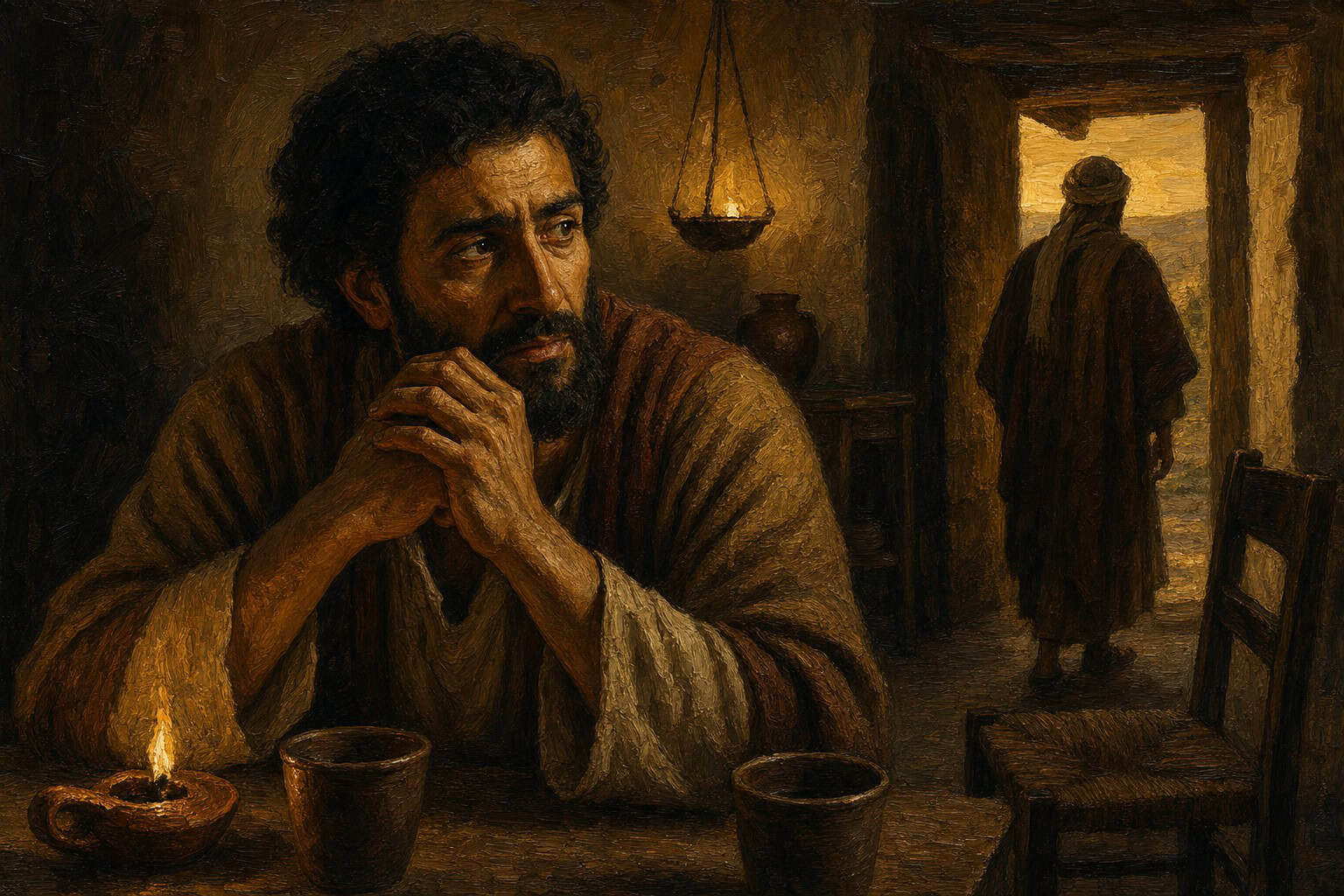
Saying goodbye to a part of speech: how the word ‘us’ dies not in drama but in one small, reasonable question. A reflection on love and calling.
The Small Word You Keep Reaching For
There is a word you say without noticing, and one day it starts to hurt. You are at a kitchen table, maybe, the coffee gone cold and skinned over, and the two of you talk about years you have not lived yet. You say we. You say us. It slides out of your mouth like breath, no weight to it, a word you assumed the way you assume the floor under your chair, the way you assume the next morning. It is only two letters, or three, small enough to hide inside a sentence about groceries or Sunday plans or what happens after graduation. You have said it a thousand times and never once turned to look at it. Then, in the middle of an ordinary conversation, someone asks a question that puts a hard light on that little word, and suddenly you see it standing there in the open, exposed, undefended, and you understand it might not be permanent. That is the strange grief of this moment: not a fight, not a slammed cabinet, but the slow recognition that a part of speech you leaned your whole body against is about to leave the language. You feel it in your chest first, before your mind agrees to it. Your hand tightens around the mug without your telling it to. The room does not change its furniture, but the space inside it does; the person across from you seems both very near and already somewhere far off, half a step into a future where the word does not fit their mouth anymore. You want to keep saying it. You want it to stay a small word, a nothing word, a word that requires no defense and asks no permission. But it has quietly become a claim now, and claims can be denied, can be examined, can be set down and walked away from. What is asked of you in this instant is cruel in its ordinariness: to keep talking as if nothing is dissolving, to hold the pronoun steady while it drains of certainty in your hands. This is where the ache begins, quiet and physical, a low pressure gathering behind the eyes. You have not lost anything yet. You have only seen, for the first time, that a word can carry the entire shape of a life, and that shapes made of two letters can be broken as easily as a cup left too near the edge of a counter. The smallness of it is the cruelty of it. Nobody warns you that goodbye can wear the face of a pronoun, or that it can arrive wearing an apron, in the middle of an afternoon, with the light still ordinary on the table.
When the Practical Voice Turns to Iron
The danger never announces itself as danger. It comes dressed in reasonableness, in the flat sensible tone of someone asking about the calendar. What about the schooling. What about the years apart. What about us. The voice stays small and even, laced with concern rather than anger, and that evenness is exactly what makes it unanswerable. You can argue with a shout; a shout gives you something to push against. You cannot argue with someone counting up the plain facts of a future. When love turns practical, it stops asking what you feel and starts asking what will happen, and the future has no mercy left over for feelings. You sit there and feel the ground under your certainty begin to shift, grain by grain, the way sand slides out from under a bare foot at the tide line while you are looking somewhere else. Everything you love about this person is still in the room with you. Their patience. Their care. The way they think ahead so that you do not have to, the way they hold the calendar you keep forgetting. And that same tenderness is now the thing quietly dismantling the life you had pictured, not out of any cruelty, but out of the simple honesty of someone who needs to know where they are standing before they lose their footing too. This is the tension no one prepares you for: that the very qualities that make a person worth loving are the qualities that force the reckoning. Their level-headedness is not a betrayal. It is love doing its accounting, out loud, in a kind voice. And you, sitting across from them, feel two things tear against each other inside your ribs. There is the pull toward the person, warm and real and present, their hand resting near yours on the wood of the table where you could reach it. And there is the pull toward something larger, quieter, older than this relationship, a thing you have carried in you since before you learned their name or the shape of their sleeping face. You cannot hold both without lying to one of them, and you can feel which lie is easier. You feel the lie forming even as you speak it, the easy dismissal, the not yet, the we will figure it out somehow. You hear how thin it sounds leaving your teeth. The mind wants to retreat here, to fold the whole ache into a problem to be solved, a timeline to be negotiated, a spreadsheet of years, because thinking is so much safer than sitting inside the loss. But the question keeps coming back, small and cold as iron: what about us. And you begin to understand that the word you leaned on has quietly become a debt, and you are not certain you have anything in you to pay it. The practical voice is not the enemy across the table. It is only telling you the truth you were hoping no one would count aloud.
The Pronoun Becomes a Universe
Then the moment lands, and it lands so quietly you almost miss the size of it. The question comes once more, smaller now, the voice gone soft, nearly a whisper you have to lean in to catch: and what about us. And in that instant the little word cracks open along a seam you never knew it had, and you see what was folded inside it all along. It was never small. It held a house you had furnished in your mind without permission, mornings you had already lived in advance, a whole architecture of the future raised silently while you thought you were only speaking about nothing much. The pronoun was a universe, packed tight, and one gentle question just showed you where its edges were. You feel the vertigo of it in your stomach, the sudden drop, the floor of meaning giving way beneath a word you never once stopped to examine. This is the turn, and it turns on almost nothing. You understand, all at once, that you have been living inside an assumption, and the assumption has a wall, and you have just walked your whole face into it in the middle of an ordinary sentence. Everything goes very still. You can hear your own pulse in your ears, loud in the quiet kitchen. You want to cover the moment with your hands, to change the subject, to make the word small and harmless again so it will stop accusing you of what you meant by it. But you cannot un-see what you have seen. You have been found out, and not by them, not really. You have been found out by the plain shape of your own life laid bare on the table between the cold cups, exposed in a light that shows you exactly what you are and how little of it you can keep. Two callings sit inside your one body and only one of them can stand up and walk out the door. That is the shame of it, and it is not a moral failing exactly, or not only that. It is the raw exposure of wanting something you were never going to be allowed to fully have, of having made warm promises to two whole futures with the very same tender, careless words.
The word that ends you is never the loud one; it is the small, reasonable question that leaves nothing left to argue.
The Long Fallout of a Quiet Yes
What follows is not a scene. There is no music, no door slamming, nothing you could point to and call the moment it ended. It is a slow bleeding you carry for a long time afterward, into rooms that have nothing to do with that first table. The conversation ends. The dishes get washed. Life goes on in its ordinary way, and yet something in you has been quietly lowered into the ground while you were rinsing a cup. You did not fight for it. That is the part that comes back to haunt you later, in the dark, when there is no one to perform for. You let the word stay unanswered, or you answered it too easily, and by never defending the thing you loved you let it die of plain neglect rather than of any grand and honorable refusal. The dreams that matter most rarely die in open battle where you could at least respect the fight. They die in the small hours, in the reasonable compromise, in the yes you gave to keep the peace and to keep the near warmth of a body seated across from you. You built the future you chose on the buried thing you did not choose, and you tell yourself it was necessary, that love required it of you, that a real and present need outweighs a calling that lived, after all, only inside your own head. Maybe that is true. Maybe it is only the story you tell yourself to make the loss lie flat enough to sleep on. You turn it over and over in the dark. Who were they, really, in that moment across the table. Not a villain. Someone who loved you enough to say the hard thing out loud instead of swallowing it, someone whose need was legitimate, whose fear of losing you was as real and as bodily as your own fear of losing the other thing. And who were you. A person who reached for two lives at once and could not bring himself to admit that the reaching itself was already a kind of dishonesty toward both. The shame does not pack up and leave when the conversation does. It settles down into the body and stays, a low ache you carry into rooms years and miles away from that kitchen. You wonder what you refused to let yourself see. You wonder whether you truly chose or merely drifted, and whether the drift was cowardice wearing the clothes of tenderness so you would not recognize it. There is no clean answer waiting at the bottom of this. God does not hand you one wrapped and finished. What you get instead, if you can bear to be honest, is the company of the ache itself, the strange sense that you were seen the whole time, even in the small betrayal, even in the easy yes that cost so much more than you knew when you spent it. The presence does not undo the choice. It simply refuses to let you sit alone inside it.
Living in the Language That Remains
You go on speaking. That is the quiet miracle of it and the quiet burden of it, both at once. The word that broke does not stay broken forever; a different grammar grows up slowly around the wound, more careful than the old one, purchased at a price you keep paying in small installments. You learn to say I where you once said we, and the singular pronoun feels bare on the tongue for a long while, a thing too thin to keep out the cold, a word you have to grip to say. But you also learn, over time, that a word can hold grief without collapsing under it, that language, like a body, carries the memory of what it once meant and keeps working anyway, keeps ordering coffee and answering the phone and saying goodnight. The person from that long-ago table is not erased from you. They live on in you as the one who asked the question that showed you the true size of your own life before you were ready to see it. You do not bless what the choice cost you; blessing it would be a lie and you have told enough of those. You refuse, though, to let the wisdom buried in it wither unexamined, because that would be the second death, the slow one, and that death is the only part still under your own hand. So you sit with it. You hold the two callings that could not both stand, and you let them ache in you honestly rather than pretending one of them was never real, never wanted, never warm. This is where faith does its strange and stubborn work, not by handing the years back, not by rewriting the yes you gave, but by walking beside you into the very room where the loss still lives and pulling up a chair and staying. The presence does not fix your grammar. It joins you in the harder, truer sentences, the ones that begin with I and carry the ghost of we running underneath them like a current. If you have ever felt a whole future die under a single reasonable question, if you have ever watched a pronoun you loved drain of certainty across a kitchen table while the light stayed ordinary, then you already know this ground from the inside, and you know it cannot be tidied or talked out of its ache. Anthony Adoré writes straight into this ground in Confessions to the Empty Chair, not to resolve it but to sit inside it honestly, to name the small quiet murders that shape a life and refuse to let them pass unwitnessed. The word goodbye, you come to understand, is not a part of speech at all. It is a whole way of standing in a room after someone has gone, still speaking, still counted, still seen.