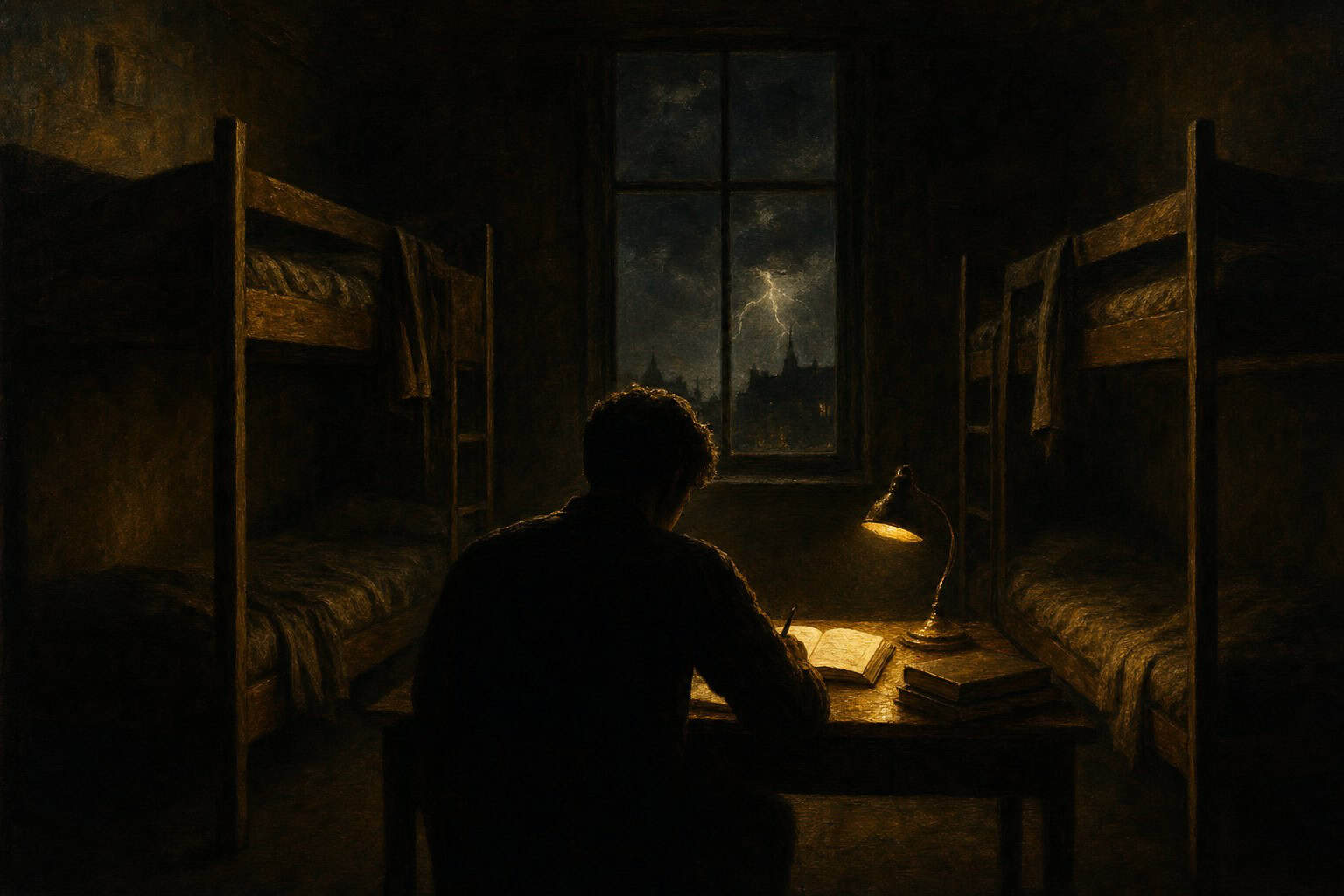
He drags a duffel into fluorescent light and the smell of old sweat, metal bunks creaking, posters curling — a young man carrying divine terror and private farce in the very same trembling hand.
A Bunk Bed Entrance
He arrives under fluorescent light and the smell of old sweat, dragging a duffel that already looks out of place. Metal frames creak as bodies shift on stacked bunks, posters curl at the corners, and someone’s cheap speaker hums with borrowed bravado. Into this crowded, joking world, he chooses his costume with care: the noodle, the boy who laughs at his own softness before anyone else can. Each shrug is loose on purpose, each self-deprecating line timed to land just before the jab that might have come. No one here knows about the sacred solitude that has just torn through him, the renunciation that has hollowed out his claim on Jeannètte. They only see the skinny kid calling himself harmless, harmless, harmless. In the scrape of bed springs and the rattle of pill bottles on a shared dresser, he writes his place in the room by making sure it will never be the center.
Jokes as a Loaded Fork
The reckoning in this cramped space does not happen in lofty words but in punchlines. He understands, almost instinctively, that to survive here he must control where the laughter points. So he serves his own body up first: weak, sexless, the butt of the story before anyone else can draft it. This is not mere shyness; it is strategy sharpened by terror. The God who has just rushed into his absence has left him shaking, unable to bear the risk of being seen as a man who wants anything. The noodle script becomes a fork he turns in his own direction, spearing his dignity before the others can taste blood. Each joke about his impotence funds a hidden vow: if they are laughing at the performance, they will not ask what happened to him in the quiet, or why his hands still tremble when the lights go out.
Laughter Piled Like Dirty Laundry
The Triple gathers around chipped desks and rumpled sheets, trading stories that grow louder and cruder as the night stretches. Vulgar lines fly across the room like balled-up socks, sticking where they land, then getting thrown again with added filth. He joins in, lets the profane rhythm carry him, because the roar of their laughter drowns out the echo of that other Voice that once split him open. Yet underneath the crosstalk, another pressure coils. His body plays along with the obscene jokes, but his spirit stays backed against an inner wall, refusing to step forward. When Kerri’s name surfaces, when some imagined scene with her becomes the next contest in one-upmanship, his cheeks burn for reasons no one in the room will guess. The pile of shared humor grows higher, like a heap of worn clothes no one has the courage to sort, and somewhere buried inside it lies the piece of him that still believes desire might ruin whatever it touches.
We are stranger than our confessions admit, holding together divine terror and private farce in the same trembling hand.
When Your Own Touch Feels Radioactive
For anyone who has walked into a new world late—poorer, quieter, already marked—this dorm is not just a college scene; it is a visible map of fear. The fear of wanting someone and believing that your want itself is poison. The fear of entering spaces where the talk of sex is easy, while your own history of darkness and God and absence turns every gesture heavy. His joke-name, noodle, is a script many know by another word: the act of making yourself smaller so no one pays the price of knowing you. Here the passage presses a simple, brutal insight: you can hide behind humor for years and still feel your hands as dangerous. His body knows before his mind admits it: he will withdraw, renounce, cancel his own presence, if that is what it takes to keep their light from brushing against what he carries.
Ink Spilled Between the Bunks
When the Triple’s noise finally thins and the last crude quip dissolves into snores, he reaches for the only thing in the room that does not demand a persona: the pen. The notebook lies open on a mattress that sags in the middle, its pages already warped from the press of his hand. Here the noodle drops; the ink records a different boy, one carved by divine intrusion and haunted by the girl whose world he has chosen to exit. He writes of being both claimed and terrified, both starving for touch and convinced his touch will scar. The words do not reconcile the split between flesh and spirit or solve the cold equation of how much of himself must vanish for Jeannètte to be safe. They simply stay on the page, dark and stubborn, like a small pool that keeps reflecting a sky no one else in the dorm has seen.