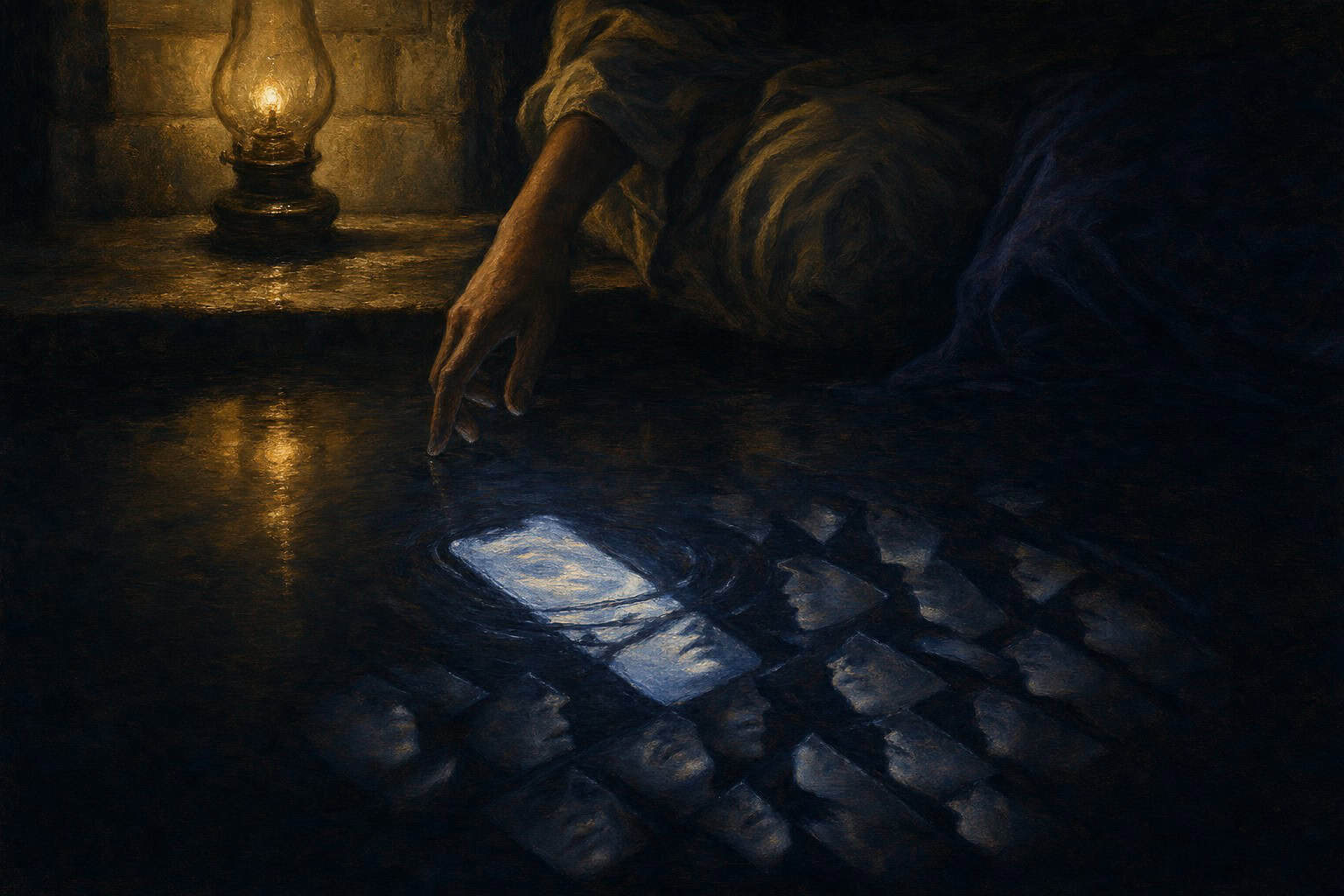
A righteous handmade sign hangs crooked on the wall while the sheet rides low on her hip, both true at once — a self so busy being its own mirror that every love only multiplies the crack.
Warning Ink on Skin
Black marker bites into cardboard: a handmade sign, loud and righteous, taped crooked to the bedroom wall. At the same time, the sheet rides low on her hip, the tank top an inch too short, the window shade not quite drawn. A phone flash catches collarbone, a bare shoulder, the edge of thigh, then gets uploaded under captions about privacy and boundaries. She knocks her own hand away from the hem while leaving the frame uncropped. Each gesture arrives with its own alibi: it slipped, it was hot, the camera angle surprised her. This is not simple flirtation; it is a ritual learned early, when open need went unanswered and only the sideways plea drew warmth. Now her body writes warnings and invitations in the same stroke, a living script where exposure pretends to be an accident and prohibition doubles as bait.
When Protection Becomes a Spotlight
This moment tightens around one blunt fact: the strategies meant to keep her safe are the same ones that keep splitting her apart. She posts about not wanting attention, then studies the view count like a pulse. She insists she values her privacy, then stages another half-covered photo, another near-miss in the hallway where the towel fails at just the right second. What began as armor against an untrustworthy world has become a spotlight she cannot admit she is standing under. The scene presses a hard naming: she no longer knows how to ask to be seen without folding the request inside denial. Her body has been drafted into double duty, carrying both the no and the please, until even she cannot tell which one she means more.
The Pond That Never Stays Still
Attention gathers around her like men around a fire, each one convinced he has stumbled on some rare unguarded glimpse. She watches their reactions the way Eve once watched her reflection in the still water, testing angles, learning which turn of the shoulder sends the larger ripple. Yet the pond will not hold; every look she draws also splits her, because no one sees the same woman twice. One man knows the thoughtful version who posts long captions about boundaries, another knows the flirt who always seems surprised by her own effect. The more precisely she calibrates each image, the less she can locate a center that is not performance. Underneath, a quieter pressure builds: if every look is won by a small betrayal of herself, what kind of unity could ever grow out of this scattered harvest of glances?
When the self becomes its own mirror, every relationship only multiplies the fracture, and we grow expert at hiding in the plainest sight of all.
Living as Curated Reflections
Anyone who has ever hovered over a post before hitting share can feel the drag of this passage. You know the small war between the part of you that wants to be witnessed and the part that rushes to swear it was never about that. You pick the safer photo, the half-truth caption, the joke that lets you retreat if someone takes you too seriously. At work, at home, online, you curate different reflections: strong here, soft there, broken only where it earns approval. The cost shows up in your body—tight jaw after a day of smiling, restless scrolling when the likes plateau, that hollow after an almost-confession you quickly cover with humor. This text names the spiritual fact under the digital habit: a heart trained to distrust love learns to survive by being partially knowable everywhere and fully knowable nowhere.
Catalogues in the Glow of a Screen
Night finds her lit by the cold blue of her phone, thumb moving in steady, practiced strokes. New follower, new message, new almost-friend added to the quiet catalogue she keeps behind her eyes. Each square on the screen holds a possibility: someone to want her damaged self, someone to want her desirable self, someone to want the capable one who never asks for help. She scrolls through faces the way a child once scanned a room for a mother’s returning gaze, hoping one of them might finally hold. Yet even as she fantasizes futures, she is already deciding which parts of herself each man will be allowed to see. The gallery of names grows longer while the space inside where they might actually meet her stays untouched, like a room no one has yet been invited to enter.