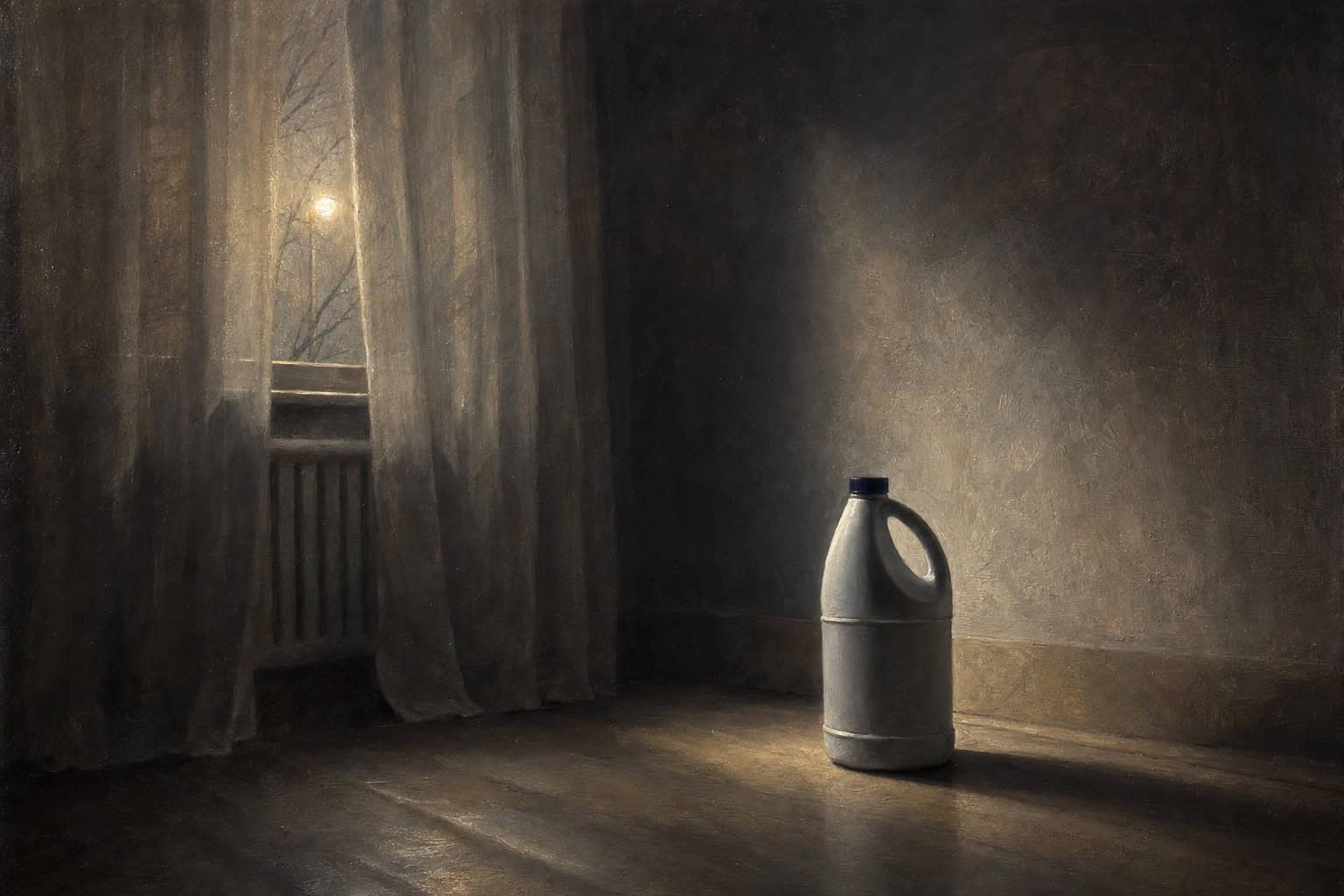
You stand over the tub at midnight with a bottle of bleach, eyes watering, chasing a smell out of the mattress seams, scrubbing hardest at the one surface that was never the thing in need of cleaning.
Bleach Fumes in the Midnight Bathroom
You stand over the tub with a bottle of bleach, nose burning, eyes watering, chasing a smell that refuses to die. His sweat is in the mattress seams, in the towel still damp on the rack, in the faint ring on the porcelain where his feet rested. You scrub until your forearms ache, until the grout roughens under the sponge, as if enough friction could erase the fact that another animal body lay against your own. The disgust that rises is sharper than the chemical sting; it has teeth, memory, an old shame that does not belong to him alone. You throw open the window to drag in winter air, lungs grasping for something clean, something that does not sweat or want or leave stains. But under the sharp chlorine is another smell you cannot outrun: your own skin, your own swamp, the knowledge that you too trail humidity and need through every room you cross. The bleach cannot reach that place.
The Drunk Ceiling and the Anchored Foot
Later, the room tilts. Too much cheap wine, too little food, the ceiling swinging like a slow, cruel pendulum above the bed you just stripped. No psalm will hold; the words slide off your tongue as the walls sway. Then Jimmy, with the same mouth that carried the smell you tried to scour away, says it like giving you a cigarette or a joke: plant one foot flat on the floor. You obey, half out of misery, half out of mockery, and feel it—the world hitch, then steady, as if the earth remembers you again. The anchoring is crude, almost ridiculous, but your nausea lessens. In this small trick passed along drunk-to-drunk, his body becomes your ballast. What your prayers and theories cannot manage, his practiced, low wisdom does: it gives your vertigo a hinge. You hate that you need it. You keep your foot there anyway.
Ink in Place of Incense
Morning comes gray, the apartment still faintly sour with bleach and stale wine, and you flee to the only temple that will not look back at you: the public library. Rows of spines rise like a forest, titles instead of stained glass. You pull down thinkers who argue about freedom and guilt, grace and will, and sit at a laminate table under buzzing fluorescent light that hums like a tired choir. Here, no one asks you to kneel, but every sentence bends you inward, toward the thought that perhaps what happened in that wet, reeking room is not just sin or mistake but a symptom of something deeper in the human mess. The stack beside you grows higher. You read about bodies and souls as if the right argument could purify yours, as if ink could perfume away the animal traces you spent the night attacking with chemicals. The page replaces the Eucharist; reading becomes transubstantiation.
We scrub hardest at the surfaces that cannot be cleaned, fleeing a corruption that has already made its home inside us.
The Shared Stench We Try to Name Away
Anyone who has ever washed the sheets twice in one day knows the sharp comfort of ritual cleaning, the lie that more detergent means more absolution. You might not have stood with bleach at midnight, but you have burned incense, sprayed air freshener, opened windows wide in winter to banish the residue of someone else’s closeness. The nausea is not only about them. It is about the mirror their presence forces on you: the sweat stain on your own collar, the way your hunger drags you into rooms you later pretend you never entered. And when the world tilts—after too much drink, or grief, or fear—you reach for whatever version of Jimmy’s trick you’ve been handed, some rough, bodily wisdom that cuts through your polished beliefs. The scene presses a blunt fact: our reactions to other people’s smell, weight, clutter are often just rehearsals for a deeper recoil from our own ungoverned lives. The swamp is mutual, and so is the shame.
Dry Pages, Damp Sheets
So you move between two reliquaries: the damp memory of the bed and the dry crackle of pages under your thumbs. One promises control by sterilizing, the other by understanding. Neither has yet taught you how to receive another person’s body without wanting to scrub something raw—either the sheets or your conscience. The library offers explanations for why you flinch, why you dream of a solitary, stainless life; the bathroom offers a bottle that claims to kill ninety-nine point nine percent of what you fear. Still, that fraction remains, invisible and undefeated. Jimmy’s grounded trick keeps working when the room whirls, but it does not tell you what to do when the world is steady and another humid body asks to stay awhile. Somewhere between the steam on the bathroom mirror and the dust on the library shelf, an answer waits, not yet shaped into words, not yet poured into any bottle you can buy.