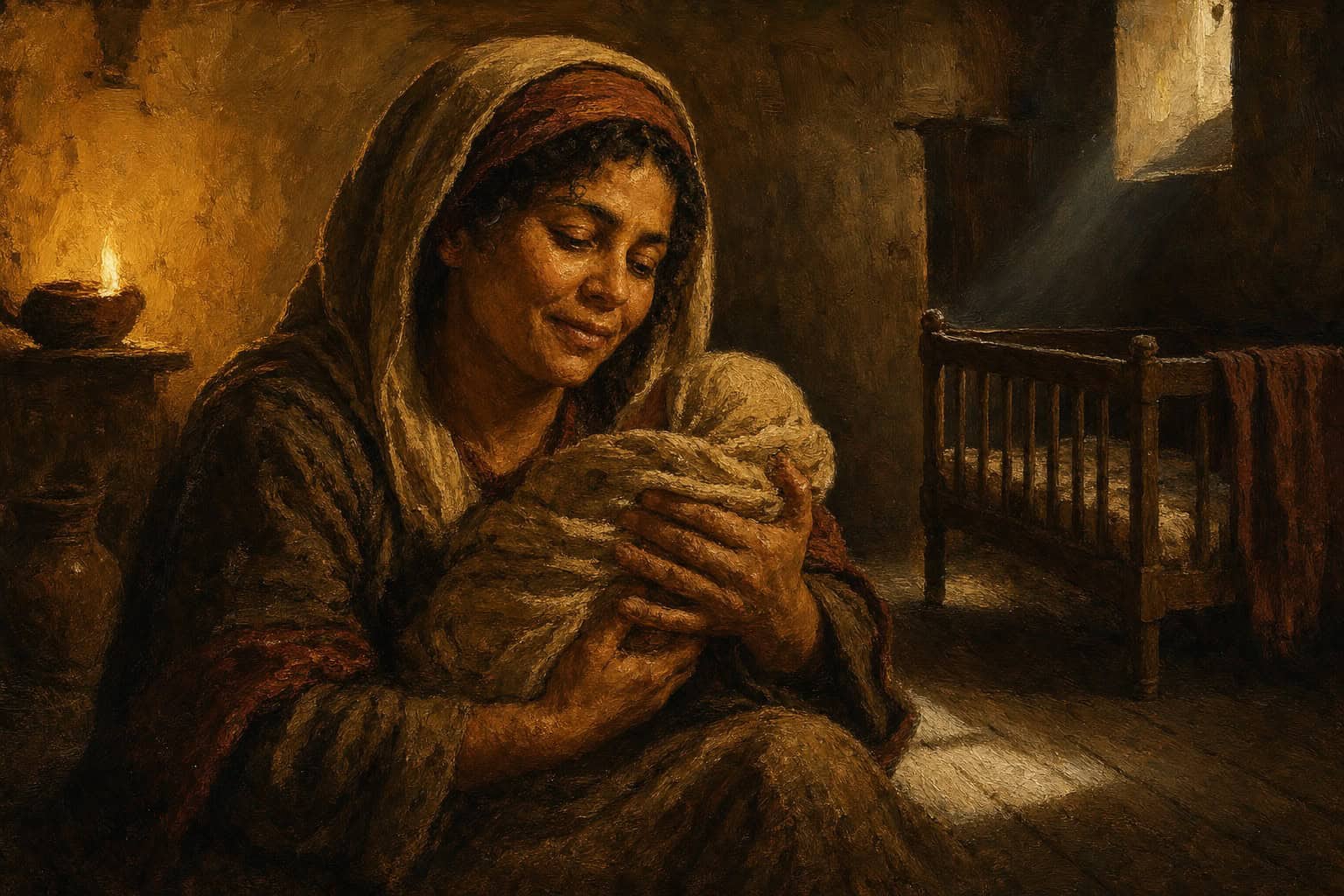
Living with a toxic mother? A hard, honest look at the wound beneath her cruelty – and why your love cannot negotiate it away.
Bracing Before the Knob Turns
Your hand hovers over the doorknob and does not touch it yet. You are reading the house through the door itself – the pitch of her breathing in the next room, the tone of the television, whether the dishes were done or left in an angry stack. You have learned to forecast her the way people who live near the sea learn to forecast a storm, from the smell of the air before the first cloud. This is the ordinary daily weather of anyone living under a mother who wounds by instinct, and it is exactly where the second chapter of Fractions of the Soul begins its coldest and most patient work. The narrator does not stand over such a woman to condemn her. He kneels down beside her infancy instead, and describes a baby left alone in a crib, staring into a dark that no one came to break. He tells of a child spanked too hard, handled too roughly, screamed at until the shrieking became the ordinary sound of a home. He describes a small body that reached up for warmth and closed its fingers on rough hands, a mouth that cried for milk and was answered only sometimes, and then not at all. What strikes you first is not pity. It is recognition. The woman who cannot love you now was once a child no one loved without condition. The scene refuses the flattering story where cruelty simply arrives full-grown from a bad heart. It insists the cruelty has a birthday, a room, a crib, a first long silence. And it presses a harder question against your chest: what do you owe a person whose wound came before her will could form? The narrator holds that tension without collapsing it into a slogan. He will not excuse the harm, and he will not pretend the harm has no root. He knows a wound can explain a person without clearing her, and that both truths have to breathe inside the same body at the same time. For anyone counting the small bruises of daily contact with a mother like this, this is the ground under the whole reflection. The past has not gone anywhere. It is inside her voice. It is in the way her hand reaches for you and shoves you off in the same motion, so that you never know which gesture to trust. She is living inside a time that never ended – the crib still around her, the dark still unbroken, the milk still not coming. When you speak to her you are speaking to a grown woman and to a starving infant at once, and you have been trying to answer both of them with one fragile heart. The chapter makes you feel how old the injury is, and how far below reasoning it lives.
Charting the Coast of Her Moods
You keep a private chart of her the way old sailors marked a coast littered with wrecks. Say this and she softens. Say that and the shrieking begins. You have built whole systems out of her small mercies, telling yourself that if you only learn the rules well enough, you will finally earn a steady stretch of peace. The chapter names this exhaustion with unnerving precision, though it turns the lens onto a different figure first. It describes a woman who moves through her world by manipulation and seduction, carrying scraps of information from one person to another – never the whole truth, only the fragments that serve her aim – spending her days chasing the wind under a cover of secrecy. She believes she is the author of her own fate. She never once stops to contemplate the hunger beneath the maneuvering, never traces her craving for acceptance and safety back to the pain and abandonment that made it. And here the narrator swings the lens back onto himself, and onto you, with a candor that stings. He confesses the tragic misuse of his own intelligence. He believed that if he mapped her coordinates, learned her rules, and laid his raw, bruised heart out on a silver platter, he could negotiate her love into being. He mistook her polite indifference for a puzzle he was clever enough to solve. This is the exact error of the child who grows up managing a wounded parent. You treat her cruelty as a code and yourself as the codebreaker. You decide love is a matter of sufficient effort. If you were only more patient, more useful, more finely tuned to her signals, surely the warmth would finally come. The chapter shows you the smudge on that lens. Her indifference may not be a prize she is withholding until you earn it. In her wounded seeing, you may never have fully arrived at all. The tension rises because the narrator refuses to let you keep the flattering version where your sacrifice is a currency she secretly tallies in your favor. He interrogates his own motives without mercy. Was he loving her, or was he still the boy trying to purchase safety with obedience? Was offering his heart an act of devotion, or a last desperate strategy dressed in devotion’s clothes? The dread of the scene gathers slowly, in the growing suspicion that all the mapping and managing was a way to dodge a grief he could not stand to feel. The strategies kept his hands busy so he would not have to sit still in the empty room and admit the milk was never coming. His busyness was a mercy he granted himself. You feel your own careful navigation start to tilt underfoot, and you cannot right it.
A Face That Never Receives Your Face
The turn, when it arrives, is quiet and terrible. The narrator suggests that severe early wounding can make a person who imitates the human form without registering the humanity in front of her. She looks whole. She talks, she gestures, she remembers your birthday and asks after your day. Yet in her field of seeing, the ones she harms do not fully exist. The chapter describes a partner who, to the wounded soul, simply is not there – not a rival she chooses to hurt, but a presence that never lands in her perception at all. This is not a villain savoring evil. It is something bleaker and colder: a person operating inside a reality where other souls never appear as souls. For anyone who has begged a mother to see them and watched the words dissolve against a face that would not receive them, this lands like a bell struck once in an empty church. You have been trying to reach someone across a distance you assumed she could cross if she only cared enough. The chapter proposes she may not be refusing to cross it. She may be unable. The infant left in the dark learned, before there were any words to learn it, that no face was safe to be seen by, and something in her closed the aperture and never opened it again. Her legion of strategies, her seductions, her manipulations, are the survival mechanisms of a self that never got to trust a single set of eyes. Any attention became better than the original nothing. So she reaches for whatever will consume her, mistaking the hunger itself for love, calling out for a mother’s milk and drawing only mouths that would feed on her. The narrator holds all of this without cruelty and without cheap comfort. He does not turn her into a monster he can hate, and he does not turn her into a project he can still rescue. He stands in the crack between what is and what cannot be known, refusing to let the mystery snap shut in either direction.
You cannot love someone into seeing you when she was taught, before words, that no one was safe to be seen by.
And here is where God enters the book – not as a rescue, but as company. There is no lightning that heals her, no miracle that dissolves the years and gives back the crib’s lost warmth. There is only a nearness in the dark, a sense that the tears themselves are witnessed, that the One who is present does not turn away from the empty crib or the unanswered cry. The revelation is not that the darkness lifts. The revelation is that you were never alone inside it, and that perhaps, once, neither was she.
You cannot love someone into seeing you when she was taught, before words, that no one was safe to be seen by.
Lifting the Offering Off the Altar
After a truth like that, something in you has to be set down. The narrator offers no clean release. He offers a reckoning, and reckoning weighs more than forgiveness because it forces you to count what is actually there instead of what you wished were there. If she cannot receive your face, then the years you spent perfecting your offering were spent kneeling at an altar that could not take it. That is a grief with no tidy end. You mourn not only what she did but what she could never do, and the gap between those two things is where most of the pain has been quietly living all along. The chapter lets this fallout arrive the way exhaustion arrives after a long fever finally breaks – not with relief, but with a heavy, sweat-soaked clarity. You start to see how much of your own life you organized around a negotiation that was never once open. The vigilance at the door. The sentences rehearsed and re-rehearsed. The strategies stacked like sandbags against her flood. All of it was labor spent trying to author an ending she was never able to give you. The narrator turns the hardest questions on himself here, and he will not let you slide off the hook either. What did he refuse to see because seeing it would kill the hope? How much of his devotion was fear wearing love’s face? He does not pretend he stayed only out of goodness. He admits the boy in him needed the fantasy that one more effort would work, because without the fantasy he would have to grieve, and grieving felt like agreeing to a second abandonment. This is the honest accounting the chapter demands. It will not let you be only the innocent victim of a toxic mother, and it will not let you be only her would-be savior. It makes you face what you did with the wound – how you built an entire way of being around managing her, how you may be choosing your own later loves by the same broken light without knowing it. The past presses forward into the present and shapes the hand that reaches for whoever you reach for now. That is the frightening inheritance the scene lays bare: the crib you never slept in may still be furnishing the rooms of your grown heart, arranging the furniture, dimming the lamps. Yet even here the dark is not sterile. The narrator finds that lifting the offering off the altar is not defeat but a strange, sorrowful freedom. To stop negotiating is to stop lying about what is possible between you. And in that honesty, plain and unglamorous, there is finally room for a grief that can move at last, because it is no longer being forced to pretend it can be argued away.
The Milk That Was Never Yours to Pour
You will not close this chapter fixed, and that is precisely why it can be trusted. It hands you no method for repairing your mother, no orderly steps for softening a heart that closed before you drew your first breath. What it gives instead is truer and much harder to hold – an accurate map of the terrain, drawn by someone who walked it without lying to himself about the drop-offs. The narrator lets you understand that the milk the infant cried for was never yours to pour. You cannot mother your own mother. You cannot answer, out of your grown and bruised heart, a hunger that tore open in a crib decades before you were even a possibility. Setting down that impossible job is not abandonment. It is the beginning of seeing her clearly, and clear sight is the only love that will not slowly eat you both alive. The chapter settles here without resolving the ache, and that refusal is its gift. It knows suffering does not tie off neatly, that the dark does not lift on any schedule you can set, that some chambers in the vast, wonderfully furnished house of memory simply stay cold no matter how long you keep the fire going. But it also carries the quiet conviction running through the whole book: that God draws nearest not when the pain is finally removed but when it is shared, walking at your side in the very place you feel most alone. This is where the second chapter of Fractions of the Soul leaves you and pulls you deeper at the same time. You want to know how the narrator goes on living with what he has just admitted out loud. You want to follow the reckoning further, to see whether an honest grief can become something more than mere survival, whether a person can inhabit the crack between what is and what cannot be known without going numb inside it. The book does not promise the mother changes. It promises the reader a companion who will not lie to them about the cost of loving her, or the cost of finally stopping. For anyone lying awake tonight rehearsing tomorrow’s careful sentences, that kind of company is worth more than any technique. You close the chapter and the door of the house looks exactly as it did. The knob is the same dull metal. But your hand resting on it has changed. You are no longer trying to solve her. You are learning, slowly and against everything the crib once taught you, to stand inside the truth and stay tender anyway. That is not an ending. It is where the rest of the book begins to carry you.