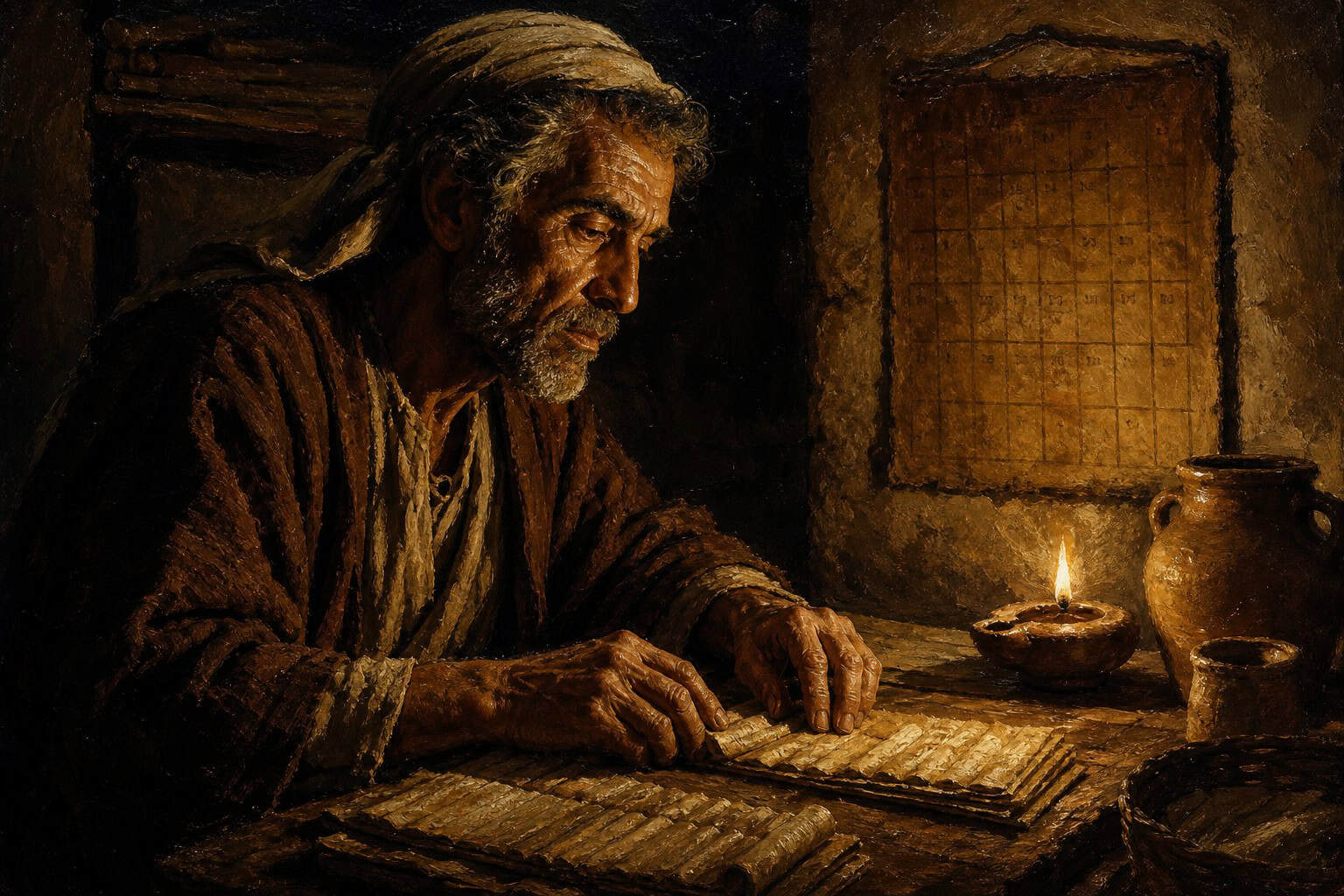
How many days are left in this year? A reflection on counting time, desire, and how fast the self we were dissolves into dates.
A Ledger of Songs With Dates Pressed Into Their Spines
You want a number, and the calendar will hand you one. So many days left in this year, small enough to hold in one palm by December, wide enough in spring to feel like a reprieve. But notice what the counting does to you the second you begin. In Confessions to the Empty Chair there is a place near the end where the pages stop telling a story and begin to list things: song titles, record labels, years stamped into vinyl like fingerprints. Thunderpuss, Streetheat, Transformer, a track named for a higher state of consciousness with its exact year set down beside it. A man in his late forties has become the keeper of his own inventory. He does not remember his youth so much as file it. Each dated entry is a small stubborn claim: I was here, in 1992, in 1995, before I knew who I would become. This is what counting always is underneath. When you type the number of days left, you are not asking about the calendar. You are asking whether the time you have will be enough, and enough for what. The mind that counts forward is the same mind that counts backward, and both directions frighten it. A record with a year on its spine is a coroner’s note as much as a memory. It says something ended here, and something began. The narrator sits with these fragments the way a grieving man sits with a drawer of a dead friend’s shirts, half tender, half sick with the distance. He knows these songs scored a body that wanted, that reached across a dark room toward another body, that lost itself in bass and strobe and the promise of not being alone. The desire was real. It was a young man’s whole appetite, loud and unashamed, the pulse of a track from a small basement label carrying him toward a night that felt endless. The counting is what came after, when the wanting cooled into arithmetic and the endless night turned out to have a date. You arrive at the calendar with the same divided heart. You want the days to be many. You also suspect that no number will quiet the thing gnawing beneath it. The list of songs does not comfort him. It proves he existed, and proof is a lonelier thing than love ever was. That is where any honest count of the days begins, with a man arranging the scattered evidence of a life he can no longer quite reach with his hands.
Six Days, Eleven Months, and a Body Falling Too Fast
Now here is the terror the number keeps hidden. The narrator lays his own dates out like beads on a short string, and the string is far shorter than any of us expect. Six days between the end of college and the woman who became his wife. Eleven months from that first meeting to marriage to a child in his arms. Read it fast, the way it actually happened. The self he had spent decades building came apart in less time than a single semester. You planned your life with care, and then a stranger crossed a room and the plan dissolved like sugar in hot water. This is exactly what the days-left question cannot see coming. We count in even units, one day, then the next, as though change arrives evenly. It does not. It arrives in a rush, a flood, a handful of hours that rearrange everything you thought was fixed. He does not narrate love as a slow ripening. He narrates it as a collision, a speed that left no room to consent. And when he turns the honest lens on himself, he asks whether he loved her or fled toward her. Was she a person he adored as an equal, or a solvent against the terror of standing alone? Desire moves us fast because it promises to end a loneliness we cannot name aloud. The body leans toward another body the way a falling man grabs at anything within reach. There is truth in the reaching and there is danger folded inside it. A man can mistake the sheer speed of his need for the depth of his love. He can call two frightened people lashed together a union, and learn only later, counting the days after it broke, that it was fear wearing love’s face. Yet I want to be careful here, because she was not a mechanism and not a dose. She was another whole life, wanting things he never fully saw, carrying a fear of her own that he never once stopped to ask about. Perhaps she reached with the same terror he did. Perhaps she was braver, or lonelier, or simply hoping he would become someone steady. You feel all of this whenever you count your own time. The days ahead seem too few because the days that mattered went by too fast to hold. Love most of all. It comes in six days and takes eleven months to reshape a whole existence, then decades to understand. The narrator does not pretend he saw it clearly then. He was inside it, falling, certain. Only now, with the dates bare on the page, does he grasp how little he chose and how much simply happened to him, how much he called choosing that was only the current pulling.
The Calendar Was Never the Thing You Feared
Here comes the turn. You did not open a calendar to learn a fact about December’s end. You opened it because something in you is afraid, and the fear needed a shape it could look at without flinching. The narrator does the same thing with his catalog of songs. He orders them, dates them, files them, and the ordering is a way of holding a grief he cannot state plainly. When a man counts the days left in the year, he is quietly confessing that time feels like it is thinning under his feet. The mystery is not the number itself. The mystery is why the number matters so much, why a person will sit and tally what remains as if the sum could save him. The pages circle this without ever announcing it. We count because we are terrified of not having existed. We date the record so the year cannot deny us. We mark the six days and the eleven months so the ruthless speed of our own life cannot erase the fact that we lived, wanted, chose, and failed inside it.
We count what remains because we cannot count what we lost, and both numbers keep shrinking toward the same silence.
And here is the strange grace that breaks through, quiet, not a rescue but a presence. The God the narrator meets is not the one who stops the clock or hands back the lost years. That God does not come, and the honest thing is to say so. What comes instead is a nearness inside the counting itself, someone seated with him in the very act of numbering his losses, present in each dated entry, present in each tear over a song from a summer that will not return. He is not spared the arithmetic. He is accompanied through it. The darkness is not lifted. It is shared. That is the harder, truer mercy, and it lands here at the pivot of the book like a hand set gently on the shoulder of a man bent over his own ledger.
We count what remains because we cannot count what we lost, and both numbers keep shrinking toward the same silence.
What the Filing Does Not Fix
So the fallout is quiet, and it is not resolution. The narrator finishes his list and the room is exactly as dim as before. Nothing has been returned to him. The years he catalogs stay closed, sealed under their labels like specimens under glass. He has proved he existed and the proof has not warmed him. This is the cost of loving the way he loved, fast and frightened, mistaking fusion for depth. When two people lash themselves together against the terror of standing alone, they build a dam, not a home. And when the dam breaks, the man who thought he had been gazing into another soul discovers he was often only staring at his own reflection, enlarged and flattered by her nearness. That is a brutal thing to learn at the far end of a marriage, and the pages do not soften it. Yet the honesty itself carries a strange dignity. He does not blame her for being a mirror. He asks instead what he refused to see in her while she stood right in front of him, a separate person with her own hunger and her own fear, never merely the answer to his loneliness. Here the days-left question folds back on you, the one who typed it. If your time is short, and it is, the question is not how many days remain but whether you will spend them seeing the people beside you as they truly are, or as instruments against your own dread. The narrator’s regret is not that he ran out of days. It is that he spent so many of them fused to another person without ever fully meeting her. Real attention, living inside the actual hour with the actual person, turns out to be the thing he most lacked and most needed. You can count days forever and never once inhabit one. The vinyl spins and stops. The lamp buzzes. The man sets down his list and the number, whatever it was, has told him nothing he did not already fear. What it has done is drive him back toward the one question worth asking with the time that is left, which is not how much, but for whom, and whether he can bear to look at them straight.
Where the Numbering Finally Rests
By the end you understand that no calendar was ever going to answer you. The days remaining in this year are a fact, easy to compute, and the ease is the trap. It makes you think the ache is a math problem. It is not. The narrator’s inventory teaches this without lecturing. He counted everything, and the counting left him kneeling before his own life like a man before an altar he half believes in, asking to be forgiven for how fast he lived and how little he saw. That is where Confessions to the Empty Chair leaves this material, in a middle-aged voice speaking to no one and everyone, laying out the dates of his loves and losses like a rosary worked between the fingers, each bead a year, each year a small confession. He is close enough to the end now to feel it, and close enough to the beginning to see how the whole thing rushed by. The tenderness in him is real, and so is the severity. He will not let himself off. He will not let the number stand in for the reckoning. If you came here counting, that is the gift waiting for you in his pages. Not a total, but a redirection. Not how many days, but what you did with the ones that mattered, and whether you were present in them or already somewhere else, already afraid, already reaching for the next body or the next distraction to keep the silence at bay. The book does not promise you more time. It promises you the accompaniment the narrator found, the quiet sense that even inside the shortening count, even inside the grief, you are not doing the counting alone. That is not a comfort that erases the fear. It is a companionship that walks beside it. The last thing you carry away is not the size of what remains but the strange steadiness of a man who has stopped needing the number to be large, because he has finally learned to inhabit the day he is standing in. The record is shelved. His hands are still. And the year, however many days it holds, has become something to live inside rather than something to survive.