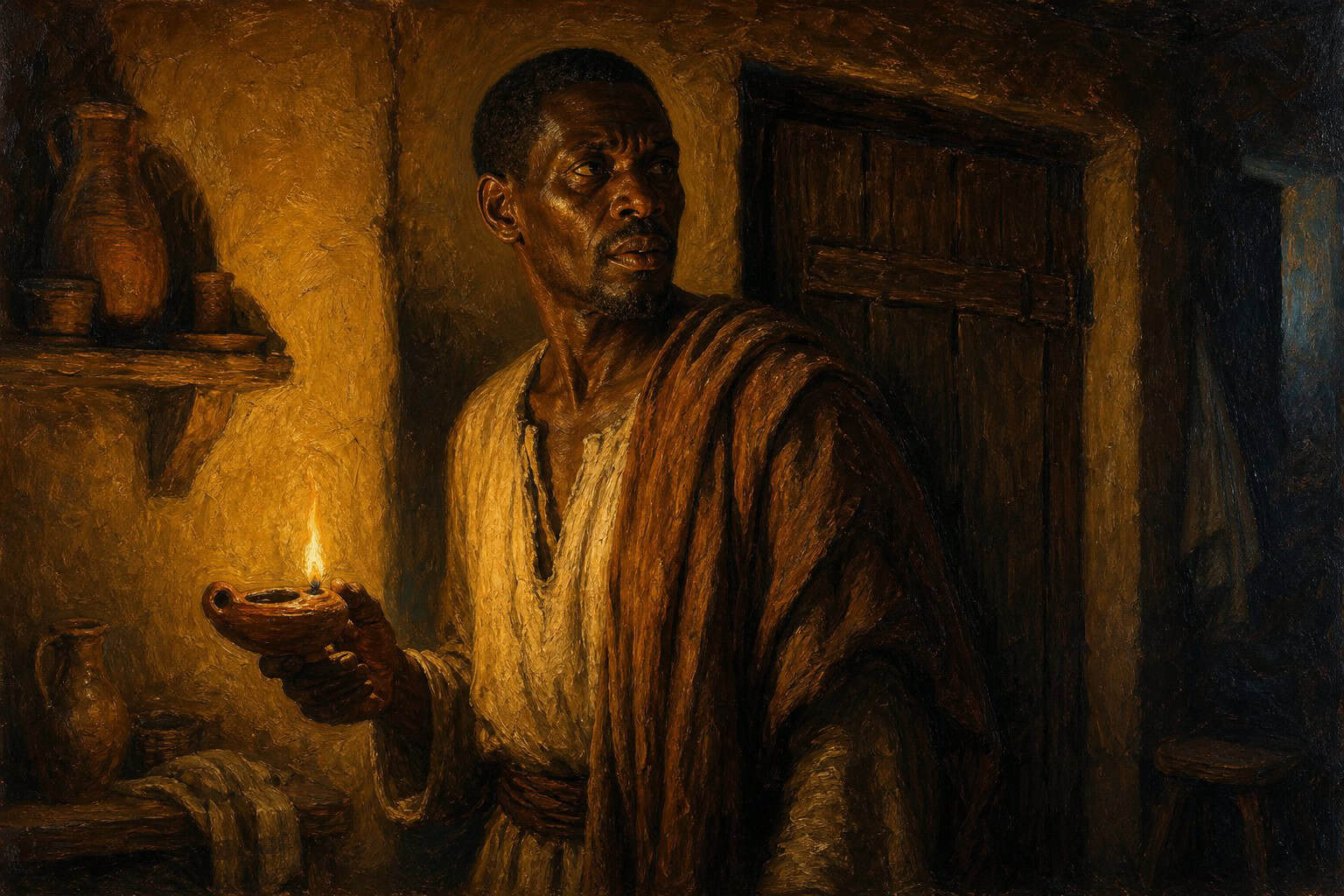
Why do we hide from God? A raw reflection on a knock after midnight, a wall built out of crude words, and the face a man would not let anyone read, least of all the One in the room.
A Knock After Midnight
There was a night I remember better than I want to. A woman I called friend came through the door already unsteady, her words softened at the edges, her balance borrowed from whatever she had been drinking. She slipped past me before I could decide anything, and she gave me a look I recognized the way you recognize a smell from childhood, before you can name it. I felt the knot pull tight low in my gut, that old cinch of dread that arrives before thought. I did not want her. That was the strange part, the part I have turned over for years since. She was not a hunger to me, and still her nearness was a complication, and I hated that word even as I used it, because complication is what a man calls another person when he has already decided to manage her rather than meet her. I want to be honest about where I stood in that room. I stood inside a set of rules I had built, a private codex, and I told myself the rules were mercy. Do not touch the one who cannot consent from her own clear desire. On paper it looks like decency. In the body it felt like something else, something guarding a picture of myself more than guarding her. The lamp was low. The door was shut. Her breath had the sweet-sour weight of drink, and every time she moved toward me the little distance between us collapsed, and I kept trying to widen it with cold words the way you push furniture against a flood. I told her to leave and come back sober. I heard my own voice go tighter than I meant it to, a rope drawn past its ease. I told myself the tactic was clean. Somewhere under the tactic, though, my pulse was doing something I did not want to admit, and the admission is the whole reason I am writing this now, decades on, in a quieter room with no one at the door. This scene sits deep in Confessions to the Empty Chair, one of those nights the book refuses to prettify. But the older man writing it down is not interested in the memory alone. He is interested in what the whole clumsy dance was really doing, what we were both doing, two people in one lit room, each hiding from the other while pretending to be present. Because that is the question underneath it all, the one I did not have words for then: why do we hide from each other, and beneath that, why do we hide from God, even when the door is closed and there is nowhere left to go, and the person we most fear being seen by is standing three feet away with drink on her breath, and the One we fear more is closer still?
A Wall Built Out of Vulgar Words
Watch what I did with my mouth that night. I did not reach for tenderness. I did not say, sit down, drink water, tell me what hurts you. I reached for the coarsest language I could find and swung it like a plank across a doorway. I said the crude thing on purpose, deliberately, hoping the vulgarity would land like a slap and send her back into the hall. I called it a shield. I told myself the crudeness would shock her into retreat and preserve something clean between us, that an apology for ugly words was a smaller price than the wreck of a real encounter. But look closer, because the older man has learned to look closer, and the picture is not flattering. A wall built out of vulgar words is still a hiding place. I was not only protecting her from me. I was protecting me from being seen wanting, or seen not-wanting, or seen at all in the tangle of it. When she pressed against me, when what she called one last hug turned into a feint and her face came suddenly to mine, I felt revulsion, and underneath the revulsion a flicker of something I did not want to own. That flicker terrified me more than she did. My own body had answered a call my intellect was working so hard to refuse, and the flesh does not lie the way the mind can. Here is what I understand now about why we hide from other people, which is where hiding from God first learns its moves. We hide because presence is expensive. To let another stand in your space, near, unguarded, is to hand them the power to name what you are doing and why you are doing it. She was drunk, yes, her judgment loosened, but her nearness had a strange clarity to it, and I sensed that if she stayed she might see the machinery behind my so-called mercy. She might see the ego wearing ethics like a borrowed suit. The rule about consent, the refusal to take the easy advantage — I had told myself it was principle. But a rule that exists to keep my own image intact is not principle. It is vanity that has learned to say no. So I performed coldness, which is a kind of retreat while still standing in the room. That is the deepest hiding of all, the hiding you do without leaving. You lower a shutter behind your eyes and you keep talking. The mind is brilliant at this. It builds the codex, the tactical lines, the elaborate defenses, all so it never has to stand bare before another face and say, here is what I actually feel and I am ashamed of it. I flattened her into a complication. I turned a woman in pain into a problem to be steered back out my door, and the terrible thing is how reasonable it all felt, how completely it wore the costume of the right thing.
The Face I Would Not Let Her Read
The turn came, for me, in the recognition of what I was actually afraid of. I have spent years assuming the fear in that room was moral, that I dreaded doing wrong to a friend. But that is too clean, and clean is exactly what I no longer trust in myself. What I dreaded was being read. Her slurred words carried a strange heaviness, heavier than any ache I thought I could leave behind, and somewhere in the shove and the retreat I understood that if she stayed she might judge the very need that drove me. She might see straight through the withheld gesture and the withheld self to the hollow underneath, and there would be no story left to cover it. I did not fear the sin so much as I feared the witness. We do not hide because we are dark; we hide because we cannot bear to be seen loving badly. I had a story that night, and the story was my clothing. I was the man with a code, the man too principled to take the easy conquest, the man whose rules made him almost noble in his own retelling. Her nearness threatened to strip that story off me and leave the plain animal fact of what I wanted and would not admit to wanting. So I pushed her back toward the hall and closed the account, cold and final, and told myself I had won something. But here is what I could not see then and can barely hold now. There was a face I would not let her read, and it was the same face I would not turn upward. I entered that room already decided, already armored, already hiding from the only One before whom a word can be spoken without strategy. My whole life I had made rooms into hiding places and made other people into walls, and I had done the same to God, keeping Him out in the hallway, feeding Him my codex and my careful crudeness so that He too would misread me as principled rather than see me as I plainly was. That is why we hide from God, and why we hide from other people at all. Underneath every shut door is the older, deeper flight, the refusal to be found while you are in the middle of your worst self. I dressed my hiding as protection. I dressed it as mercy, as ethics, as tactics, as tenderness for the friendship. Strip all of it and the thing underneath was flight, and it was very old, and it had begun long before any woman ever knocked. I have wondered since whether she came looking, in her clumsy state, for someone to simply see her without turning her into a problem — and whether I refused her that not out of virtue but out of terror that seeing her would mean being seen back.
We do not hide because we are dark; we hide because we cannot bear to be seen loving badly.
What the Shut Door Could Not Keep Out
After she was gone the room did not feel like victory. It felt like a held breath finally let out into empty air, and the emptiness had a texture I have never forgotten, a flat quiet where a person had just been. I had preserved the friendship, or so I told myself. I had followed my rule to the letter. And yet I stood there hollow, because the thing I had guarded was not her dignity and not mine but an image, and images do not warm a room or fill a silence. This is the fallout no codex prepares you for. When you hide successfully, you win only your own company, and your own company is exactly what you were fleeing when you built the walls in the first place. The strange grace of that night — and I did not feel it as grace for years, I felt it as failure — was that nothing was fixed. There was no descent of comfort, no clean resolution, no quiet voice assuring me I had done the decent thing. The despair stayed raw. I had managed the situation with surgical care and I felt worse, not better, and the worseness was honest, the only honest thing in the whole hour. But I have come to believe the nearness I could not name in that room was never only hers. Something was present in my hiding, walking with me even there, in the coldness I performed and the flicker I refused to own. Not rescuing me from the dark. Not lifting the shame from my shoulders. Just there, close, in the very act of sin, the way a companion sits inside a locked room and does not knock and does not leave and does not flinch. I have stopped expecting God to break down the walls I build. He rarely does. He does something stranger and harder to accept. He stays inside the hiding place with me, in the tears, in the ugliness, in the moment I am busy making walls out of vulgar words, and He does not misread me the way I begged everyone else to. He is the one witness I was hiding from and the one witness who was already inside, already seeing, already unsurprised by any of it. The shut door kept out the woman. It could not keep out that. And this is what makes the whole memory unbearable and also, oddly, survivable. I was not alone in my hiding. I have never once been alone in my hiding. The retreat I mistook for privacy was crowded the whole time by a presence that neither shamed me nor pretended the shame away, but simply remained, near, in the debris of my careful cruelty.
The Homesickness Under the Hiding
So why do we hide from God, and from every face that might read us on His behalf? I can only answer now as an older man reading a younger one, and the answer is not a comfort. We hide because to be seen is to be judged, and to be judged is to lose the story that lets us live with ourselves. I hid behind a rule I called mercy. I hid behind crudeness I called protection. I hid a face I could not bear to have read, first from a drunken woman at my door and, under her, from God. And beneath all of it was a longing I had misnamed for most of my life. I thought I was lonely for a woman that night, or lonely for the version of myself another person might finally confirm to me. But running through that ache was something older, a homesickness no encounter could reach, a reach toward a wholeness I could name and never once hold in my two hands. I wanted to be known and I could not bear to be known, and that contradiction is the engine of every wall I ever raised. We build the rooms and shut the doors and then we stand inside the shut rooms aching to be found by the very eyes we barred. That is the human wound, and no codex heals it, and no conquest fills it, and no careful managing of another person will ever close the distance we were made to have closed by Someone else. I could not see this with my voice gone cold and her face still too near mine. I see it now, and seeing it does not make me clean. It only makes me honest, which is a smaller and harder thing. The reach outran its object every time. The woman was never the point. The reassurance she might have given was never the point. What I wanted was a room where a word could be spoken without strategy, and I had spent my whole life making sure no such room existed, because I was terrified of what I would have to say once I stood in it. If you have ever bolted a door and then wept behind it, if you have ever made walls out of words and stood hollow in the space they cleared, you already know this ache from the inside of your own chest. The strangest thing I have learned, the thing I keep having to relearn, is that the One I was hiding from was never waiting out in the hallway. He was already in the room, breathing the same stale air, watching me build my wall, and staying anyway.