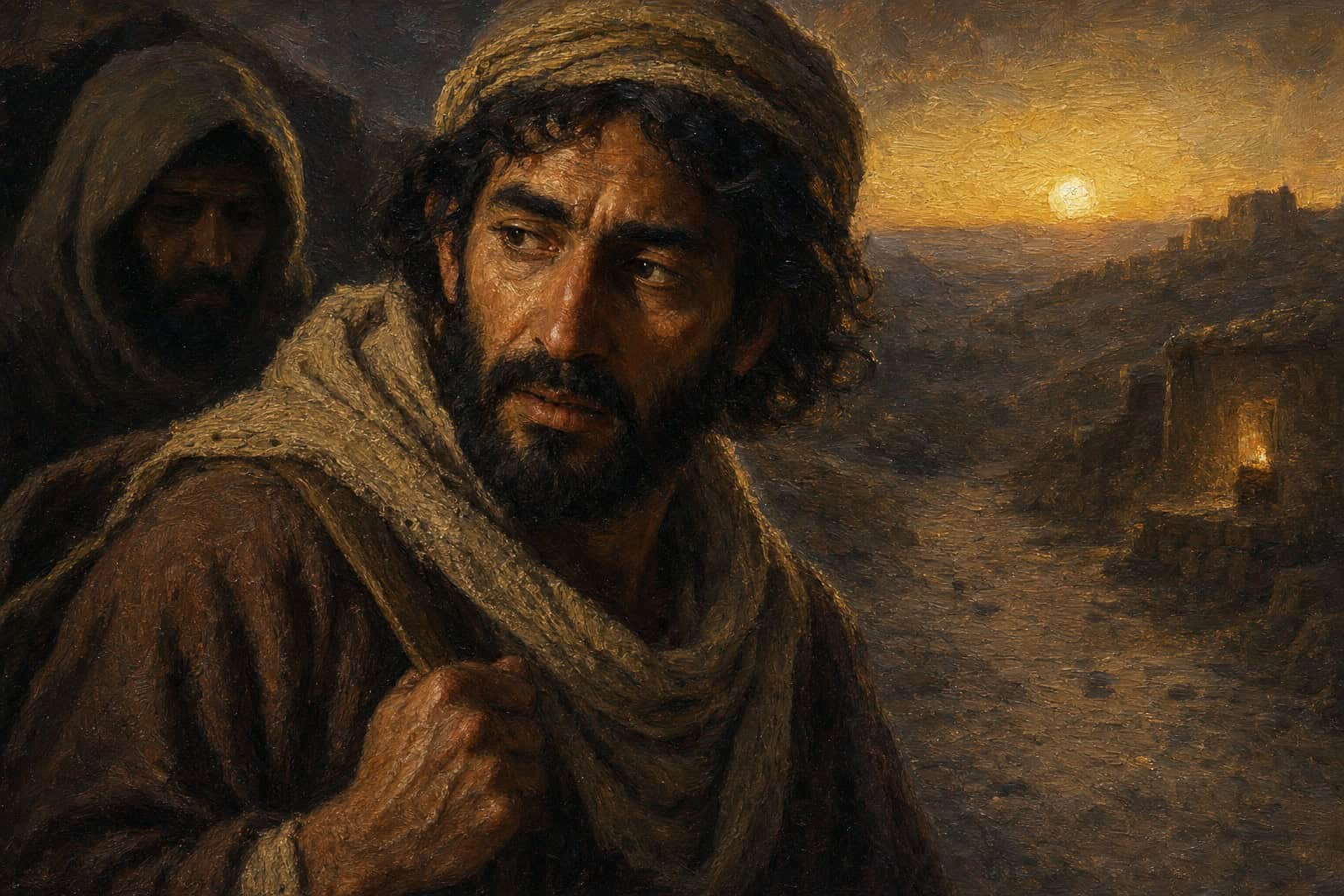
Prayer for when you’re angry: how a rage you can’t put down might be the truest thing you bring to God. A reading from Confessions to the Empty Chair.
The Boy Who Kept a Ledger of What Was Denied
Long before the crisis that opens the fourth chapter of Confessions to the Empty Chair, there was a younger self who kept a private ledger of disappointments. He wrote nothing down, but he remembered everything. He remembered the encounters that never came. He remembered chances that seemed to open a half inch and then shut, girls whose attention might have flattered him, warmth he could almost feel on his skin before it was gone. The strange thing, the thing that took him years to name, was that these closings did not feel like accidents. They felt arranged. He came to believe God had stepped in and blocked the road, quietly, without asking. And that belief did not comfort him. It felt like a hand pressed flat against his shoulder, holding him in place, keeping him inside a fight he had never signed up for. He was young. The body wanted what it had not yet tasted, and the wanting soured into something bitter when the tasting was refused. His stomach knew the disappointment before his mind found words for it, a dull ache under the ribs, a heat behind the eyes. That soreness is where prayer for the angry man actually begins, because he did not walk toward God with folded hands and a scrubbed heart. He walked toward Him carrying a grievance. He resented the very protection he would later thank God for, and he could not hold both feelings at once without shaking. The older narrator, writing back across the years, refuses to make the boy noble. He sits with the disappointment and will not sand it smooth. He wonders aloud whether the desires were even his own, or whispers stirred in his flesh by something that wanted him wrecked. He cannot fully answer, and he does not pretend to. What he knows is that the anger and the appetite arrived tangled together, one knot, and that God removed neither. God stayed. God let him haul both into the years ahead like luggage he could not set down. If you have typed your question into a search box because you are furious and you still want to pray, this is your doorway in. You do not have to arrive calm. You do not have to have forgiven anyone, yourself least of all. The narrator did not. He came with his fist half shut, still owing God a grudge for pleasures he never got, and that grudge, he slowly discovers, is not a barred gate. It is the first honest sentence of the prayer, spoken through gritted teeth.
The Eye That Feasts and the Heart That Learns to Bow
The scene turns on a warning most men would rather skip. Speaking to the men in the crowd and not to the women, the Lord warned against harboring lust, and the narrator reads this less as scolding than as diagnosis, a map of how the male body actually works. It begins in the eyes. The pleasant sight of soft, inviting flesh reaches the eye first, and the eye feeds the imagination, and the imagination builds a small private theater with the doors locked. Inside that theater she submits. She reciprocates. She communicates her pleasure with soft sounds meant for him alone, and his own potency is crowned like a king. The narrator names this with unnerving exactness because he has stood inside that theater and knows its heat. He knows the swelling of the ego it hands over for free. He knows how a memory hardens into a fantasy and the fantasy calcifies into a craving. Here the anger and the shame braid tight, because the man who prays in fury is so often furious at his own flesh. The body did something the will never authorized. It kept looking. It kept remembering. It manufactured its own betrayal while the conscience turned its face away in disgust, and still the eye went back. That is a specific rage, sharp and private: the rage of a man ashamed of what his own eyes keep serving up to him unbidden. He wants to pull a cloth over himself. He wants to vanish from his own sight, to not be the thing he is watching himself be. The scene reads the ancient king David into this shame. The man walked casually along a rooftop, glanced from a distance, and the glance set a whole machine in motion. His eye put obsession moving, and obsession put murder moving, and none of it looked like sin in the first second, only like seeing. The narrator will not let anyone file this away as old history. He insists the same wiring lives inside him now, warm and running. What frightens him is not the sexual sin as such, the act a person could confess and name. It is the thing underneath it: that whatever the eye is permitted to feast on becomes, over time, what the heart begins to serve. The lust was never only about the body. It was the first altar of a much larger falling-away, a heart being trained, glance by glance, day by day, to kneel toward something that is not God at all. So when he carries his anger into prayer, part of that anger is aimed at himself for the altars he built in his own imagination, and he cannot decide whether to despise the boy who raised them or to weep for him.
Where the Anger Actually Falls
Then comes the hinge of the whole meditation, the moment the narrator’s reading cracks open and lets light through. He follows David’s line down to his son Solomon, born of that first lustful union, a child who carried his father’s hunger like an inheritance stitched into the blood. Solomon knew a thousand women, seven hundred wives and three hundred concubines, an appetite so vast the mind cannot picture it. You expect the story to strike him down for the sheer excess of it, the raw greed for flesh. But the text refuses that easy verdict, and the narrator, reading closely, refuses it too. He notices, with something close to alarm, where the breaking point truly lands. God’s anger does not descend because Solomon desired many women. It descends because his heart turned away. The ungoverned desire opened a road, and at the far end of that road Solomon built temples with his own hands to please his foreign wives. David’s eyes led to murder. Solomon’s hands led to idolatry. The Lord was angry, the passage says plainly, not jealous of the count of bodies but jealous of the rival altars that desire had raised, brick by brick. This is the revelation that answers the searcher directly, and it lands like a hand laid flat on the chest. Your anger, and your lust, and your shame are not the true crisis. The true crisis is where your heart has quietly learned to bow.
Anger brought honestly to God is still an altar; the only ruinous prayer is the one that pretends you feel nothing.
A God Who Was Never Disgusted by the Hunger
Once you see that God’s jealousy is aimed at the rival altar and not at the bare fact of desire, the whole shape of angry prayer bends into something new. The narrator has to go back and reconsider what he always assumed God was angry about. For years he had pictured a God repulsed by the appetite itself, disgusted by the boy who wanted what he was denied, sickened by the man whose eyes kept feasting behind closed lids. That picture made prayer impossible, because who kneels before a God he believes is nauseated by the sight of him? The scene moves the anger to a different place. God is not offended by the hunger. God grieves the turning of the heart toward another altar. This means the angry man does not have to launder himself before he approaches. He can come exactly as he is, appetite and resentment still hot in his hands, and set it down on the floor. The prayer for when you are furious is not a plea to have the fury lifted away. In this chapter God almost never lifts things away. He does not pull the narrator off the battlefield. He does not erase the disappointment or bleach the memory clean. He walks alongside instead, present in the tears sliding down, present even inside the sin, a companion on a slow and bleeding road who offers a pilgrimage rather than an exit. So this stretch of the reading is quiet and hard, and it does not flatter anyone. The searcher learns that his fury, spoken plainly to God, is itself a strange kind of faithfulness, because it refuses to build a rival altar out of a peace he does not actually feel. The false prayer is the smooth one, the polished sentence that lies about what the body remembers and what the eye still craves in the dark. The honest prayer names the grudge out loud. It names the shame. It admits the appetite without softening it, and it hands over the whole clenched fist to God without waiting to open the fingers first. The narrator does not pretend this brings sudden relief, that the muscles unlock and the heat drains out. He stays in the ache, and he turns the lens on himself even here, questioning his own motives, wondering whether his anger is righteous or only wounded pride wearing borrowed theology like a costume. He does not tie it off. What he keeps is smaller and truer than resolution: that God stayed close inside the fury, and that nearness, not the erasure of the fury, was the answer he was actually handed.
Two Ways the Fury Goes
Where this settles is not a solution but a posture, a way of standing in the dark. By the end of the meditation the narrator is no longer begging God to make the anger vanish or the flesh fall silent. He is asking to keep walking, and to not walk the road alone. The scene has stripped away his last illusions about what devotion demands. It does not demand a heart already calm and governed, its appetites folded and put away. It demands a heart that refuses to raise other altars, even mid-rage, even mid-wanting, even with the fist still shut. The searcher who came looking for a script to recite while furious is handed something stranger and more lasting than a formula: leave to be furious in the presence of God, and a sober warning about where fury travels when it is never brought to Him. Left in the dark and alone, the anger hardens into a comforting shield that holds the cracked self together, and that shield can quietly become its own idol, an altar built from pure grievance and defended to the death. Carried into the light and spoken honestly, the very same anger becomes an afflicted spirit, and the narrator has come to believe that an afflicted spirit is a sacrifice God does not turn away from. He will not close this with a bow. He is still the boy resenting his denied chances and the man ashamed of his feasting eyes, and he suspects he will be both for a long stretch of road yet. But he has found, in the fourth chapter of this memoir, that the walk through the dark is not empty of company. Someone moves beside him, mostly silent, felt as accompaniment more than rescue, breaking through now and then in a way he can only call grace and never earn. If you are angry and you want to pray, this book will not press calm into your palm. It will offer a companion for the walk you are already on, and it will tell you the plain truth about the altars your heart keeps trying to build out of your worst days. Confessions to the Empty Chair was written by a man who prayed with a clenched fist and refused to lie about it, and who found that the God he was furious with had never once stepped off the road. The last thing you see is not a light or a door but the two of them, still walking, the fist loosening a finger at a time.