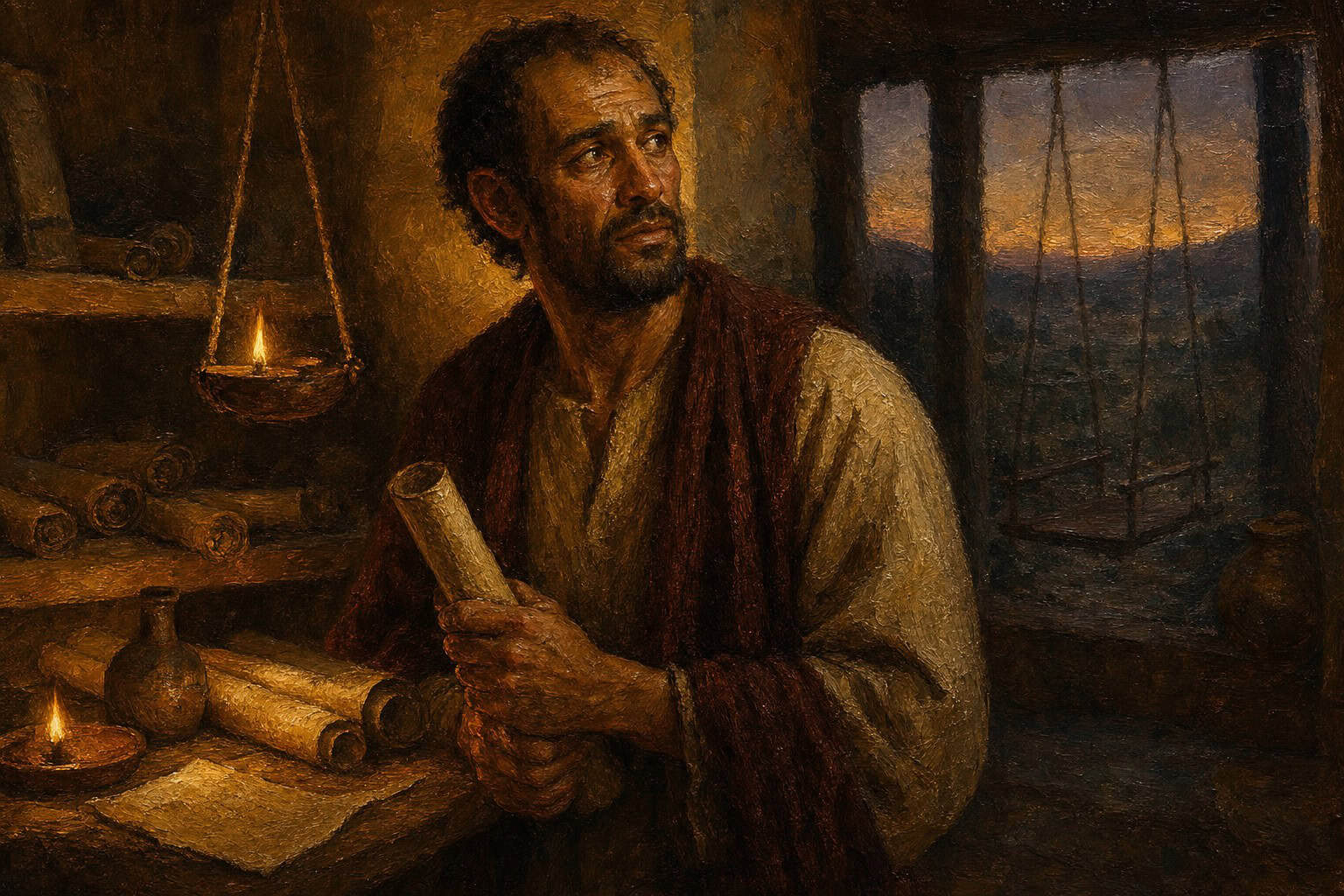
Does my ex still love me? A raw reflection, through Confessions to the Empty Chair, on love, debt, and what we mistake for devotion.
The Front Porch Swing And The Speaking Dead
You want a yes or a no, and the swing keeps moving under you. That back-and-forth is the whole trouble with the question you typed into the dark tonight. In Confessions to the Empty Chair, near the start of his university life, the narrator sits inside a similar suspension, and his scene hands your question a strange, useful angle. He walks onto a campus that measures a person by the mind, and something in him that had slept through his whole boyhood suddenly opens its eyes. West Texas had taught him that a boy is worth his speed on a football field, worth the force in his shoulders. Here the dead thinkers talk to him from inside their books, and he finds pieces of himself lying scattered across their long centuries of work. He does not feel lost anymore. He calls it arriving. Hold that word against your own aching question, because before this awakening there was a girl named Jeannètte and the slow creak of a porch swing at dusk. On those boards, in the years when nobody in his life took his hunger seriously, he poured out his half-formed thoughts to her. She listened. She was the single human ear his young self owned. And here is the detail that should make you set your cup down: he called his own outpourings soliloquies, speeches to himself, as if he were always half alone even while she sat warm beside him and let the swing carry them both. The person who loved him first was, in his own telling, an audience for a show he was really performing for himself. You ask whether your ex still loves you. His scene asks the colder thing folded underneath it: what was the love made of when it started? At this point in the book he does not yet know what he did to Jeannètte. He only feels his mind catching fire and his old certainties beginning to slide. That slide, quiet as the swing settling still, is already the first inch of a betrayal he cannot name yet. The mood of the whole scene is not victory. It is a nervous, blushing excitement, the tremble of a man who has begun to suspect the floor under his feet was never the floor he thought. Feel how thin that excitement is, how easily it tips toward dread. He is thrilled and he is afraid, and he cannot tell you which one is honest. Sit with him on that unsteady seat. Your midnight question and his lamplit scene are resting on the same cold, moving ground, and neither of you can make it hold still by wanting it to.
The Gate That Opens Only To Force
Watch closely how the narrator describes what is allowed to reach him. Only those he judges smarter can move him or change his mind, and smarter, in his private math, means stronger, means more powerful than he is. Read it twice, slowly, because it is the whole key to your question. He has built himself so that both grace and harm come in through one narrow slot, and that slot opens only to force. A gentle person, someone who might actually need him back, someone who might lean their head on his shoulder and ask for care, cannot get through. Jeannètte on the swing, patient and near and utterly ordinary, could never move him the way a long-dead philosopher could. This is the hard thing to name when you lie awake asking whether your ex still loves you. Some people can only be stirred by what overpowers them, and they name that helplessness love. So ask it plainly. When your ex was first drawn to you, was it because you made them feel safe, or because you made them feel outmatched and small? Those are not the same feeling, and the difference decides whether anything you had could last. The narrator’s craving for the great minds wears the clothes of humility. He calls himself humbled, intimidated, honored to be near such company. But under the modest words sits a brutal condition: prove you are stronger than me, or you may not touch me. A man built this way sorts every living soul into two bins, the ones towering enough to break through and the ones too small to bother with. There is no shelf for an equal. There is no shelf for a girl who simply keeps showing up at dusk and staying. His body knew this before his reasons caught up. Certain minds made his muscles ease and lean forward. The near and the ordinary made something in him lock and turn its back. You have felt this same thing from the far side. You have wondered why your steady presence stopped counting, why the person who once softened at your voice began reaching past you toward something louder and colder. It may be that they, too, could only be moved by force, so your tenderness reached them as weakness, as a thing beneath their notice. That is not a verdict on you. But it tells you what the love had been standing on, and whether it was ever standing on you at all. The unbearable part is that the narrator cannot see any of this in himself yet. He believes his awakening is clean, all light and no shadow. He does not know that the exact pride letting the dead thinkers in is the pride bolting the living girl out. He is dissolving her without a single cruel word, simply by looking past her toward the thunder.
When The Ledger Collapses And The Love Stands Bare
Then the scene turns, and it turns on God. Since eighth grade the narrator has believed that becoming a priest was the road that ran closest to God. Now, surrounded by professors and open books, that belief begins to crumble under his own honest gaze. He turns the light on his own motives and finds something he does not want to see. A large part of his hunger for the priesthood was never love at all. It was repayment. He felt he owed God for His kindness, and the priesthood was the coin he meant to pay the debt with. But repayment, he understands here, is not only pointless; it is refused outright. No sinner can pay God back. The Son alone was ever worthy, and it is only by being hidden under that blood that any of us is seen at all. The debt he had carried like a stone in his chest since boyhood was never real money. And this is exactly why the scene answers your question. When he strips the transaction out of his faith, what stays behind is a love that was always underneath, steadfast and quiet, no longer dressed up as duty. The debt was a costume the love had been wearing all along. Now ask what your own relationship had been wearing. Was your ex beside you out of love, or out of some felt obligation, some debt they believed they owed you, or you owed them? Love and debt can look identical from across the room. They use the same tender words. They share the same pillow. Only when the debt caves in do you discover whether anything real was standing behind it, or whether the words were holding up empty air.
When you can only be moved by the strong, you have made love a payment you can never afford to receive.
That is the sharpest thing this scene exposes. If your ex loved you as a debt to be settled, then the moment the account felt paid, or simply too expensive to keep paying, they walked, and their walking says nothing whatsoever about your worth. But if your ex loved you the way the narrator finally loves God, freely, under the collapsed obligation, with the costume torn away, then that love does not evaporate because the relationship ended. It only changes shape. It goes quiet and defenseless. It may still be there, bare and unarmed, buried under all the wreckage of what fell apart. The terrible mercy of this moment in the book is that the narrator cannot tell the difference inside himself until the false layer finally dies in him. And you cannot tell it from the outside, in another person’s chest, from across the ruins. You are asking a question that only their own naked honesty could ever answer, and honesty like that is rare enough to be called a small miracle.
When you can only be moved by the strong, you have made love a payment you can never afford to receive.
The Cost Jeannètte Absorbed For His Blindness
Now the fallout comes in, and it is brutal precisely because it is so quiet. Feeling his old vocation dissolve, the narrator does not simply throw a party for his new freedom. He sets down a line that should make you flinch and reread it: Jeannètte paid the price for his ignorance. For years he had believed the priesthood was best, and it was false, and while he chased that false best across the sky, a real living girl waited on real wooden boards and was harmed by his not-knowing. This is the honest reckoning your question needs, and it goes both directions at once. Love is not only a feeling that comes and goes like weather. It is a thing people do to each other while they are confused, while they are chasing the wrong star, while they are still half-built and stumbling. The narrator did not neglect Jeannètte out of cruelty. He neglected her because he was somewhere else in his own head, sincere in his mistake, and she absorbed the whole cost of his sincerity without ever being asked. Turn this on your own story, and turn it both ways, because the scene refuses to let anyone stand clean. Maybe your ex still carries some real love for you and left anyway, because they were confused, because they were paying an old debt to someone who was never you, because they were reaching for what they thought was best and could not see you standing right there. Their love, if it is real, does not erase the price you paid for their blindness. And now be as unsparing with yourself as the narrator forces himself to be. Was there a Jeannètte in your story, someone waiting patient on a swing while you stared past them at something louder and brighter? Were you the one whose sincere mistake made another person quietly pay? The scene lets no one off the hook. It shows a man who loved genuinely and still did real damage, and it flatly refuses to pretend those two facts cancel each other out. The mood here is not anger, not even regret shaped into a tidy lesson. It is a slow, dawning grief for what his own good intentions cost a person who trusted him. If you want the true shape of your own ending, you may have to sit down inside that same grief, and stop asking only whether they still love you, and start asking whether love was ever the thing that would have been enough to save it. God did not lift the narrator’s ignorance away before it did its harm. God let him reach the truth late, after Jeannètte had already been made to pay. That is not a comfortable God to kneel before. That is a God who walks beside a man deep inside his own mistake, saying nothing, letting him feel the full weight of what he did with the love he was handed and looked past.
What Is Left On The Boards When The Costume Falls
So where does all this leave the question you typed at midnight. Not with a yes, and not with a no, because the scene will not give you either, and honesty will not let me forge one for you and call it comfort. What the narrator’s awakening offers is better and harder than an answer: it teaches you to ask the right thing. Stop asking whether your ex still loves you as if love were a porch lamp someone left burning in an empty house. Ask instead what the love was made of down at its roots. Ask whether it could only be stirred by strength, in which case your tenderness was never going to be loud enough to reach it. Ask whether it was a debt in disguise, in which case its ending was only a ledger closing, not a heart breaking. Ask whether you were somebody’s Jeannètte, loved and neglected in the same breath, or whether they were yours and you have not yet had the courage to say so. These are harder questions and they will not tuck you in tonight. But they are true, and truth is the only ground that will hold your weight when the sun comes up. At this point in Confessions to the Empty Chair, the narrator resolves to go home and finally confess the enduring love and devotion he has let sit unspoken for years, to say aloud the thing the porch swing already knew. He believes he is arriving at last, right on time. Whether he arrives before the boards go cold, whether the girl is still there in the dusk, whether love confessed after a long silence is love that can still be received, the book keeps behind its own pages, and I will not lift it out and spoil it for you here. What I can tell you plainly is that the man is about to learn that love spoken after a long silence is not the same creature as love that was tended all along, day after ordinary day. There is a nearness of God in this, quiet and unshowy, walking beside a man who is about to say the right words at possibly the wrong hour. God does not stop him. God does not repair it in advance. God simply stays on the porch while he finds out what his love was worth. If your own question keeps you awake, let it carry you there, into the honest dark where you stop measuring their heart and finally start naming your own. This whole memoir grows out of a chair left empty, a confession spoken to someone no longer there to hear it. You do not want to arrive at your own reckoning that late, with only wood and silence to answer you. Read his, and let it teach you the question that heals instead of the one that only aches.