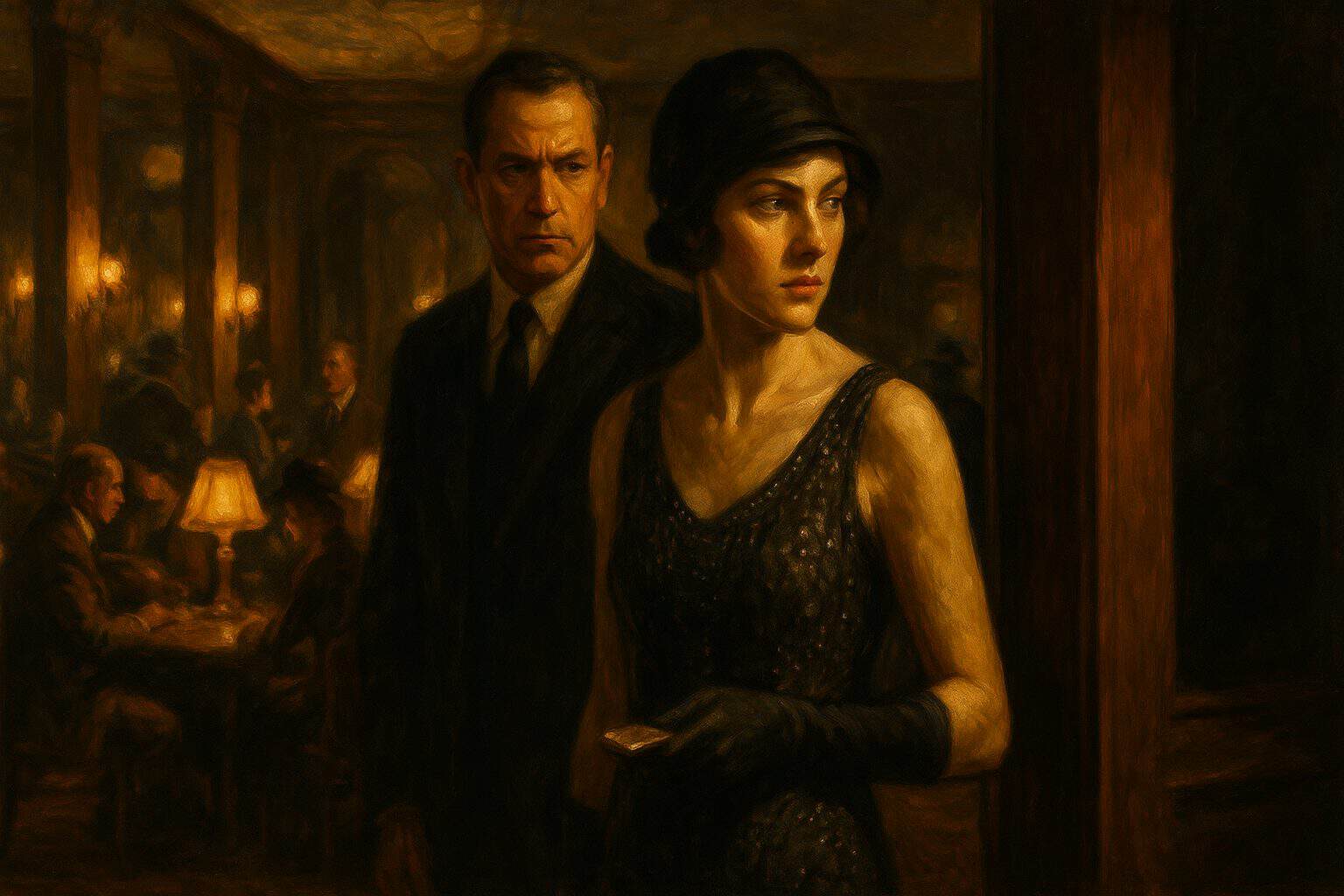
The eye that searches for recognition already knows what it must not find.
The Architecture of Watching
There is a particular quality to the gaze that scans a room before entering—not the casual sweep of someone looking for an empty seat, but the practiced inventory of one who has learned to read danger in the arrangement of bodies. This vigilance lives in the periphery, where attention splits itself between what appears and what might appear, between the conversation at hand and the conversation that hovers, unspoken, in the spaces between words.
“Those with eyes to see, saw me. Those with ears to hear, heard me.” Adoré names this selective perception that operates beneath ordinary social exchange. Some gazes pass through us as if we were transparent; others stop at our surface and recognize something they cannot name. The body knows this difference before consciousness catches up—a slight tension in the shoulders, a barely perceptible shift in breathing that signals: I am being seen in a way that matters.
The warning not to stare at her ass as she walks away performs its own reversal—by naming the forbidden sight, it conjures precisely what it claims to prohibit. This is how vigilance operates: through preemptive strikes against possibilities that may never have existed until the warning itself called them into being. The feared gaze creates its own object through the very act of forbidding it.
The Grammar of Exclusion
“Exclusion occurred not through overt declarations but through practiced gestures—an instinctive reassertion of an unnamed hierarchy.” Here Adoré captures how the social body maintains its boundaries through movements so subtle they barely register as events. A slight turning of the shoulder, a pause before acknowledgment, the way conversation continues around rather than through certain presences—these micropractices constitute the lived reality of being kept at the threshold.
The one who watches for these signals develops a particular kind of literacy. Each gathering becomes a text to be read for its hidden grammar, where inclusion and exclusion write themselves in the syntax of gesture and timing. “We will not deny what we are, but will not parade what we are either. We abhor the spotlight.” This stance emerges not from choice but from long practice in navigating spaces where visibility itself poses risk.
“Beware the subtle idolatry of making another human being your ultimate source—your lowercase ‘g’ when only the uppercase ‘G’ deserves that place.”
The vigilant one learns to distribute need across multiple sources, never allowing dependency to concentrate in a single point where it might be weaponized. This is not paranoia but a kind of emotional portfolio theory, born from experience of what happens when recognition becomes too precious, when the gaze of another holds too much power to confirm or deny one’s existence.
The Algebra of Desire
“My preference was for women who broadcast desire with blunt force; the subtleties of covert feminine signals were a language I ignored.” This confession reveals how vigilance shapes even the grammar of attraction. The ambiguous signal, the coded message, the gesture that might mean everything or nothing—these become intolerable to one who has learned that misreading signs can be dangerous.
There is an exhaustion that comes from perpetual decoding, from living in the subjunctive mood where every interaction exists primarily as possibility rather than actuality. “So, when will I get a nickname?” becomes a probe from the periphery, a test balloon sent up to measure the atmospheric pressure of belonging. The response—or its absence—provides data for the ongoing calculation of where one stands.
The vigilant develop strategies for managing this uncertainty. Some retreat into performed harmlessness: “I often joked that I posed no threat to our roommates or to any ladies, comparing my potency to a single cooked, limp spaghetti noodle.” The self-deprecation functions as camouflage, a way of being present while signaling absence of threat, of occupying space while denying one’s occupation of it.
The Economy of Recognition
“Strangers who once ignored her now acknowledge her sexual value with silent stares, whistles.” The shift from invisibility to visibility rarely feels like simple gain. For the vigilant, new forms of being seen often register first as new forms of danger. The gaze that acknowledges can also consume; recognition can become its own kind of erasure.
This is why Adoré writes of collecting information “under friendship’s label, keeping public suspicion low.” The vigilant one becomes an archivist of others’ patterns, gathering data that might someday prove essential for navigation or survival. Each person becomes a dossier of tendencies and triggers, mapped not out of malice but from hard-learned necessity.
“Only those I perceive as smarter—which to me means stronger or more powerful than myself—can move me or change my mind.” This admission reveals how vigilance creates its own hierarchy of trust. The gaze that might pierce one’s defenses must first prove itself worthy of that penetration. Power recognizes power; strength yields only to greater strength.
The Intimacy of Indirection
“She signaled intimacy first not with her body, but with her mind imprinted upon words.” For the vigilant, the approach through language offers a different kind of safety than physical proximity. Words can be retracted, reinterpreted, denied in ways that bodies cannot. The written message allows for control over timing and response, for the careful calibration of revelation and concealment.
Yet even this mediated intimacy carries risk. “Hidden from their husbands, their sons’ names honored past lovers, living mementos of ‘the one that got away.'” The vigilant recognize these encrypted messages, these ways that desire writes itself into the margins of acceptable narrative. They understand that what cannot be spoken directly will find other channels, other codes.
“Desire is not meant to be an end in itself… but instead requires an object outside of itself, ‘knowing,’ to pursue in order to actualize its purpose.”
This knowing that Adoré names is not abstract knowledge but recognition in its fullest sense—the mutual gaze that sees and accepts what it sees. Yet for the vigilant, this recognition remains perpetually deferred, always about to arrive but never quite settling into presence.
The Threshold of Appearance
“Else, either God or Lilith removed their perception of me.” This strange formulation captures something essential about how the vigilant experience social invisibility—not as simple absence but as active erasure, as if some force intervenes to redirect attention away from their presence. The one who watches for recognition begins to wonder whether they exist at all in the perceptual field of others, whether their vigilance has somehow rendered them transparent.
The feared gaze is not only the one that sees too much but also the one that sees nothing at all, that looks through rather than at. Both forms of looking—the penetrating and the vacant—threaten in different ways. One strips away protection; the other denies existence itself.
“To live life, death must be ignored. But to live abundantly, death must be confronted.” Adoré here touches the deeper structure of vigilance: it is a kind of living death, a perpetual deferral of full presence in favor of strategic absence. The vigilant one practices a form of social death, appearing only partially, always holding something in reserve against the moment when the feared gaze finally finds its mark.
The Paradox of Watching
The one who watches for the feared gaze gradually becomes that very gaze for others. Vigilance creates its own field of surveillance, where everyone becomes potentially dangerous because anyone might be watching with the same careful attention. The coffee shop becomes a theater of mutual observation, where each person performs naturalness while scanning for signs of recognition or threat.
“What we hide bubbles to the surface from time to time, but fortunately for us, few, save others like us, notice.” This is the final paradox of vigilance: it creates its own community of watchers, those who recognize in each other the same careful attention, the same practiced invisibility, the same exhausting labor of appearing not to appear.
The feared gaze, in the end, is often one’s own—reflected back from another who has learned the same grammar of watching, who reads the same signs, who knows the same exhaustion. Recognition, when it comes, arrives not as revelation but as a kind of mutual fatigue, two vigilant ones seeing in each other the cost of perpetual alertness, the weight of always watching for the gaze that might, at any moment, see too much or too little.
In this mutual recognition lives both terror and relief—terror that one’s carefully maintained boundaries have been pierced, relief that someone else knows the particular loneliness of standing guard at the threshold of one’s own existence. The vigilant recognize each other not through what they reveal but through the quality of their concealment, the specific texture of their watching, the particular rhythm of their strategic appearances and disappearances.
This is what Adoré maps in these passages: the phenomenology of a gaze that fears being gazed upon, that watches for watching, that recognizes through the very effort to avoid recognition. It is an exhausting way to live, this perpetual vigilance, yet for those who have learned its necessity, it becomes as automatic as breathing—a constant adjustment to the pressure of eyes that might, at any moment, see what must not be seen.