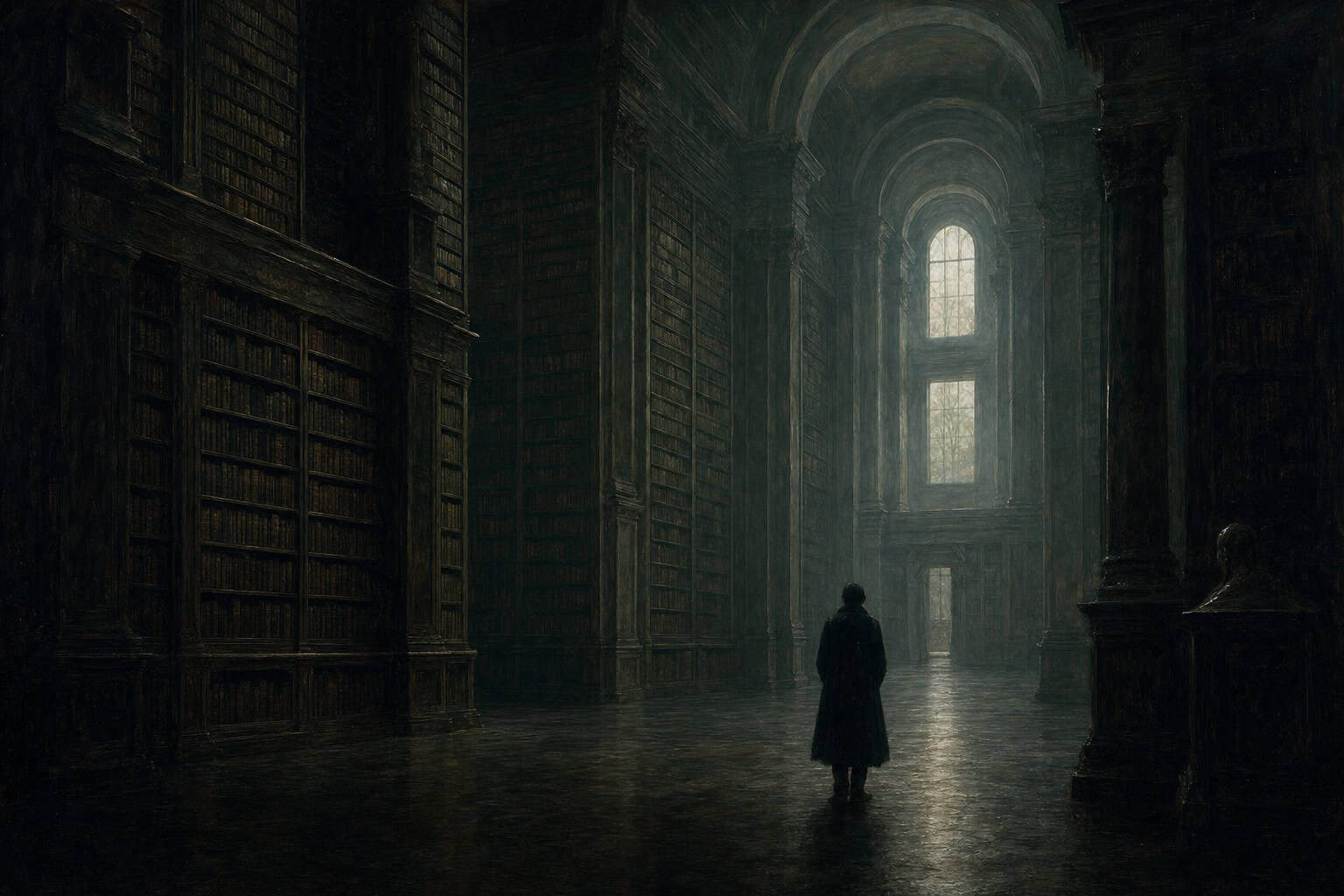
He stands among the leather spines with a cup too delicate for his hands, learning in one afternoon that he is studying a species he was never bred to belong to.
Leather Spines and Fine Dust
Leather presses against leather, row after row, the smell of old paper and polish holding you at a distance. In her family’s Austin library, you stand with a mug that is almost too delicate for your hand, tracing titles you never had the chance to study, places you’ve only seen in movies. The shelves run higher than your reach, a dark, gleaming forest arranged by someone paid to make thought look effortless. Framed portraits look down with that soft, casual confidence of people who have never wondered if they belong in the frame. You are not just visiting a house; you are entering a language you were never taught. Even the silence feels expensive. You notice how easily she moves here, how her laugh fits the room, how her father’s mention of a second home sounds like a weather report. Each object tells you, without malice, that this is their normal and your intrusion.
A Table Laid Like a Confession
Weeks earlier, your own apartment glowed under softer light, the table dressed in its best attempt at beauty: cheap candles, a thrift-store tablecloth ironed flat, flowers bought with hours of your labor. Every detail carries a piece of you—music chosen for her, food cooked slower than your nerves can bear. You are trying to say, with plates and forks, that she matters, that you are capable of tenderness that is not devouring. But when she walks in, her body stiffens as if she has stepped into a crime scene. Her eyes move over the candles and wine and land on you with a faint, polite horror, as though your care has violated some boundary of proportion. The room does not change, but its meaning does. What you built as an altar of welcome becomes, in her gaze, proof of your excess, your appetite, your supposed need to swallow her whole.
Compliments Like Scalpel Blades
Her refusal never raises its voice. It arrives dressed in praise, each word trimmed and folded so neatly you almost miss the cut. You hear that you are kind, that you are gifted, that you will make an excellent partner for someone who is not her. She does not storm out or break plates; she simply rearranges the future so that you are placed gently outside of it. When you name the men who now occupy her nights and messages, your concern becomes a symptom to be managed. You are told you are jealous, insecure, reading too much into ordinary friendship. The more accurately you read the pattern, the more unstable you are made to seem. Courtesy becomes the instrument by which she keeps both her image of goodness and her freedom to drift away. You start to doubt not just your claims, but your own eyes, your memory, your sense of proportion.
Nothing schools a man in his own insufficiency like standing in a house that was never built for him, learning he is studying a different species.
When Hunger Meets Surplus
Back in that Austin library, the divide comes into focus: not only who has more, but who is allowed to treat love as optional. Her parents speak of travel and plans with the easy rhythm of people wrapped in layers of safety. If something fails, something else will catch them. You come from a world where a missed paycheck rearranges the month, where commitment is not a lifestyle choice but an act that keeps the lights on and the body fed. In your bones, attachment has always carried a cost; in hers, it seems more like a flavor—pleasant, but never required. This gap explains why your careful dinner felt to her like a problem to solve rather than a gift to receive. It is not just that you love more. You love from a place where being needed has always been holy and terrifying, where presence keeps people alive, while she has been trained to see deep need as a red flag.
Notes in the Margin of a Life
So you stand between the shelves, holding the too-thin cup, listening to travel plans and investments and semester plans, adding each detail to an inner field journal you never meant to keep. You do not argue with her father about privilege or try to explain the weight of the rent back home; you nod, you smile, you perform fluency in a world whose grammar still bruises your tongue. A slow, stubborn question forms anyway: if your hunger for love was born from real absences, can it be only pathology now? You watch her move across the carpet, perfectly at ease, as if neither your dinner nor your doubts ever happened. Somewhere under your ribs, another kind of knowing presses forward—the sense that whatever this library teaches you about distance and class, it will also force a reckoning with the shape of your own desire. That reckoning will not happen here, among their leather spines, but the first line has already been written on the inside of your chest.