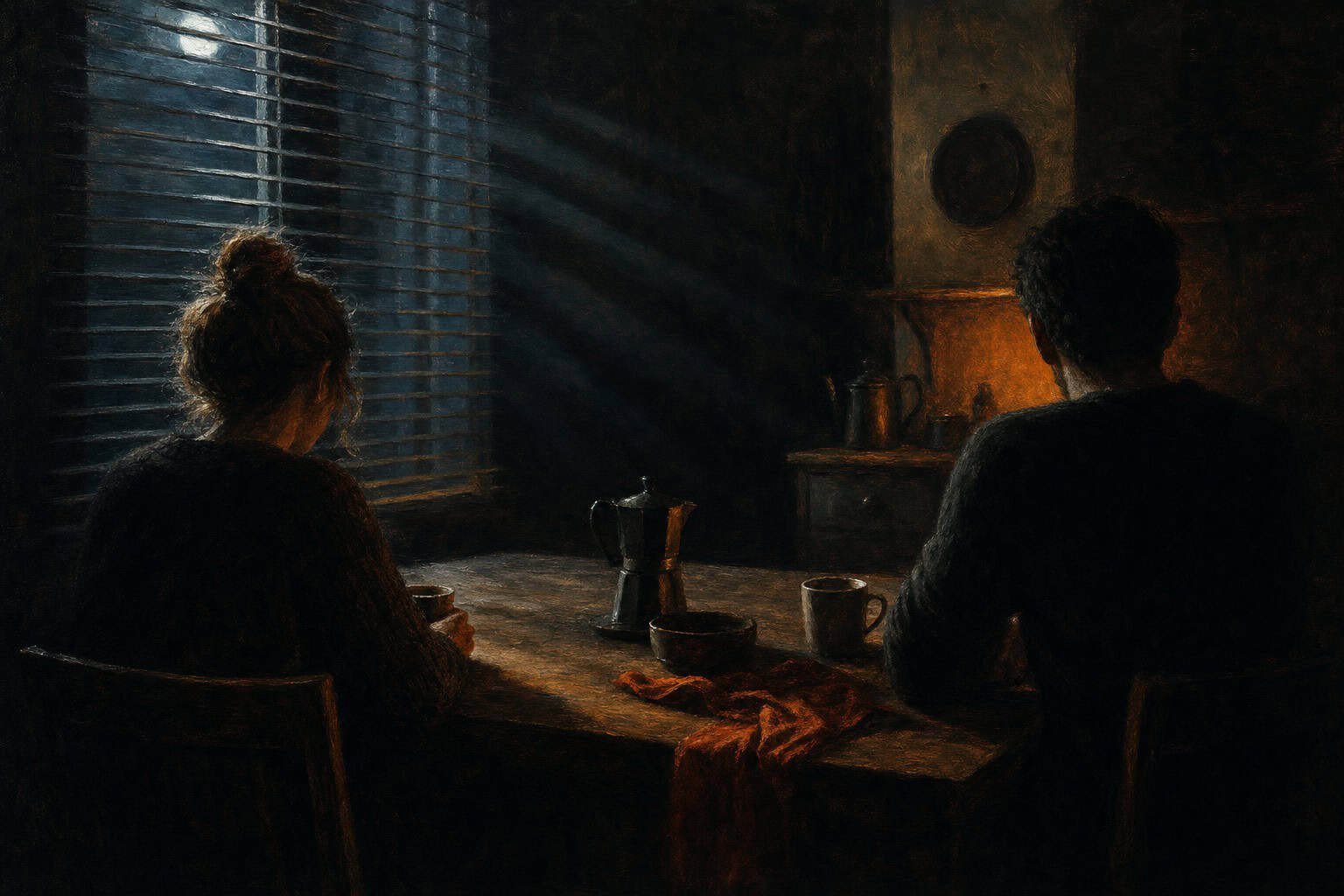
Steam is the only thing between them still moving toward warmth, and he begins to count the exact cost of a devotion performed for someone who will never return it.
Steam Rising From the Morning Mug
Steam lifts from her coffee, thin and straight, the only thing between you that still moves toward warmth. She sits at the small table, wrist tilted just enough that the cup’s handle turns away from where you stand. Newsprint lies between you, its fold a quiet line you are not invited to cross. You have made the coffee exactly as she prefers, down to the separate pan used to warm the milk, but she drinks it with the flat indifference of someone hydrating before a commute. When her phone lights, her mouth shifts into a softness you have never been able to summon from her. Your body reads what your mind refuses: the new way she leans slightly out of reach, the kiss that now grazes cheek instead of mouth, the sudden privacy of codes on screens that once lay faceup. In this kitchen, before any confession, the truth already burns in your chest like the first swallow of coffee gone cold.
Hooked on the Spark in Her Eyes
What keeps you at that table isn’t her shoulders or her scent but the way her mind once turned fully toward you. You remember nights when an idea you offered made her eyes light, when she took your halting thought and drew it out, refined it, set it down between you like a polished stone. Those flashes became your drug. You bring her arguments, articles, half-formed insights, hoping to feel that jolt again when she corrects you, expands you, names something you fumbled. When she does, rarely now, the air sharpens; you feel chosen, even as her body remains angled away, fingers still grazing the phone. You tell yourself this is a higher love, that your surrender to her brilliance is holier than wanting her touch. In truth, you are bargaining: maybe if you can be impressive enough a student, she will someday want you as more than a loyal note-taker at the edge of her life.
Shirts Smoothed Flat Against the Lie
Later, you stand over the ironing board, smoothing heat over the same blouse she wore the night she said she was with friends. The fabric gives under your hand, obedient, taking the sharp line you press into it without protest. You fold her clothes into careful squares, stack them in drawers you organized, in a home you help pay for, in a life you maintain like background machinery. While you match her socks, you replay small shifts you’ve tracked with the scientist’s eye she once praised: the changed passwords, the altered shower times, the way her laughter, generous and whole, now happens mostly in other rooms. You tell yourself that excellence in these small things might tilt some inner scale—meals prepared, schedules managed, comfort offered on cue—as if love could be summoned by precision. Each neat pile becomes another quiet ledger entry in a system you suspect is rigged, yet you keep folding, unable to stop proving your usefulness to a hunger that never turns toward you.
There is a particular hunger in being merely tolerated, where all your devotion becomes theater for someone who will never desire you back.
The Ache of Being the Safe Option
If you’ve ever been the one people lean on but never lean toward, this scene feels painfully familiar. You know what it is to be the ride home, the late-night listener, the person trusted with house keys but not with the raw center of another’s desire. You hear yourself in the way he reads small changes in tone and timing, becoming fluent in a language of minor withdrawals. You also know the shame that rises when someone asks why you stay, and no answer sounds anything but foolish. To admit the truth would be to say out loud that you have confused being depended on with being loved, that you have traded your own hunger for the low, steady hum of being needed. This passage names that trade without softening it. It holds up the ordinary objects—mugs, shirts, shared passwords—and lets them accuse the arrangement both of you have agreed to, an arrangement that feeds one person and hollows the other.
Equations That Don’t Balance on the Kitchen Table
On the same table where her coffee cooled, you run the numbers again in your head. Years of fidelity, multiplied by errands run and dinners cooked, plus the power of her mind over yours—surely that sum should equal something more than this quiet dread. The math refuses you. Affection does not rise with increased effort; her distance does not shrink no matter how many small sacrifices you add to the column. The deeper question in this passage is not only whether she wants you, but what it has done to your soul to live by such calculations at all. You’ve learned to accept crumbs from a human mind as if they were the only food available, and the thought of a love that is not earned, not tallied, almost terrifies you. The chapter lingers right there, where devotion and self-erasure blur, where the steam from your own untouched cup has already vanished and you still sit, staring at the empty surface, waiting for an answer that will not come from her.