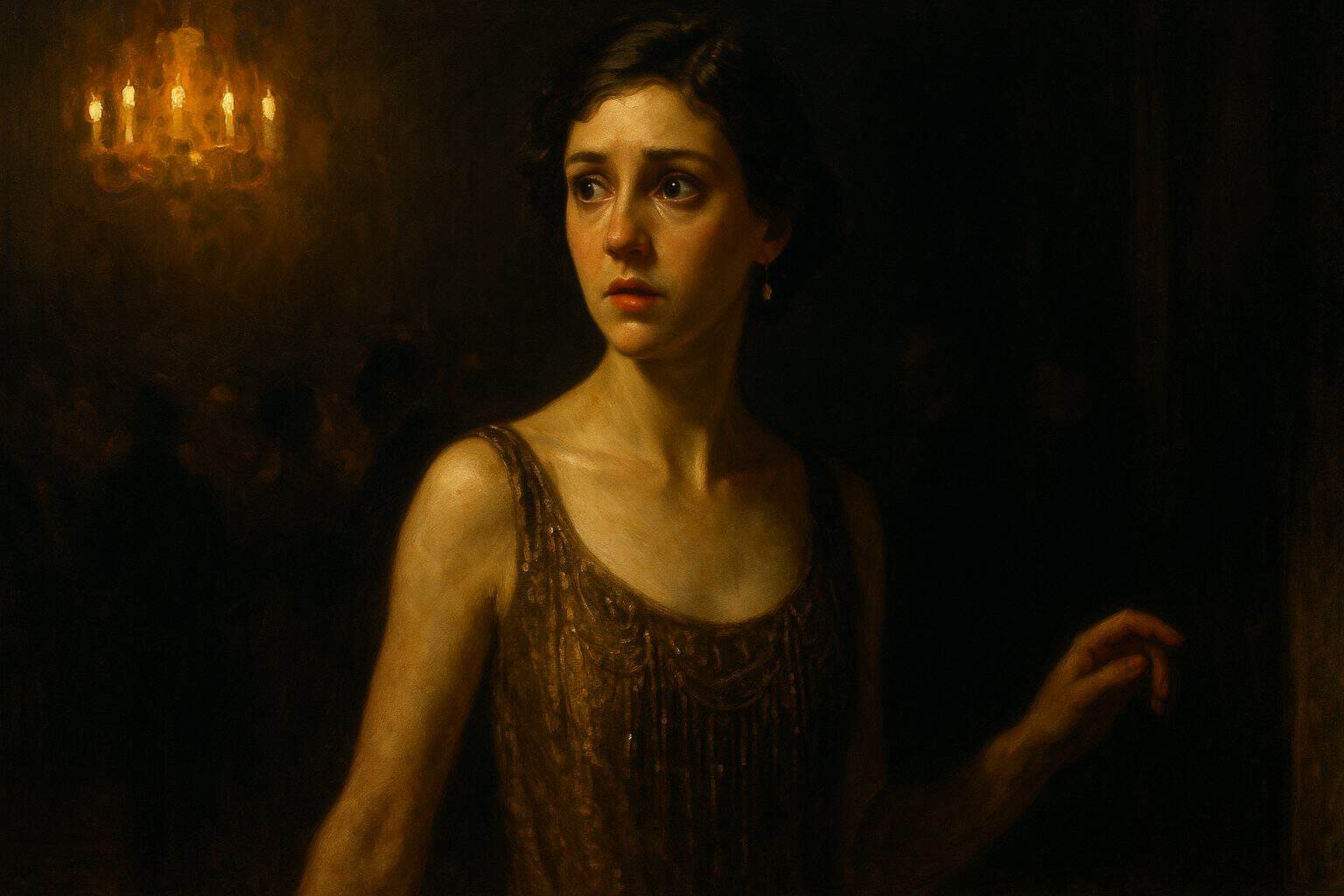
How the eye that seeks differs from the eye that finds
The First Gaze
There is a moment—we have all lived it—when you become aware that you are being watched. Not the casual sweep of a stranger’s glance in a crowded room, but that particular quality of attention that makes the skin prickle, makes the body adjust itself without conscious decision. Anthony Adoré names this lived truth with startling precision: “people tend to change their normal behavior in order to present themselves in a more positive light after they realize that they are being observed.”
The phenomenon gives itself first as bodily knowledge. Before thought intervenes, before we can name what is happening, the shoulders straighten, the expression composes itself, the gesture becomes deliberate. We are suddenly performing ourselves, though we may not know for whom. This is not deception—it is the body’s immediate response to finding itself within another’s perceptual field, what Sartre would call being constituted as object by the Look.
But Adoré presses deeper into the lived structure. He recognizes that seduction itself—that most embodied of human negotiations—”begins with the eyes.” Not with words, not with touch, but with that primary opening through which we both give and receive the world. He writes of making his “physical form worthy of a woman’s gaze through diet and discipline,” revealing how the anticipated look shapes the very flesh before any actual encounter. The body prepares itself to be seen, sculpts itself in response to an imagined perception that has not yet occurred but already exerts its force.
The Threshold of Recognition
“How you look shapes what you see. Perceptions through, with, and because of the intangible… reveal co-constituted objects back to consciousness”
Consider Adoré’s precise phenomenology of the held gaze: “I held her gaze a moment longer than social comfort allowed—not long enough to be aggressive, but long enough for her to register my intent.” Here the look becomes a calibrated instrument, measured in fractions of seconds, navigating the delicate boundary between invitation and intrusion. The eyes do not merely see—they speak, they propose, they question. And in that extended moment, that deliberate lingering, a whole world of possibility opens or closes.
Yet there is another register entirely, what Adoré calls those “with eyes to see.” This is not the look that objectifies or desires, but the look that recognizes. “Those with eyes to see, saw me. Those with ears to hear, heard me. Else, either God or Lilith removed their perception of me.” The passive construction reveals something essential: we do not choose this seeing—it is given or withheld. Some possess the capacity for this deeper perception, others do not, and the difference cannot be forced or taught.
The Hierarchy of Sight
In one of his most enigmatic passages, Adoré describes a strange taxonomy: “By their eyes, you will be able to determine their rank: black eyes for common soldiers, red eyes for warriors, and green eyes for heralds.” This is not literal description but phenomenological metaphor—the eyes themselves become readable texts, revealing not just mood or intention but something like spiritual station. The one who knows how to read these signs moves through the world differently, alert to distinctions invisible to ordinary perception.
This connects to what Adoré calls the work of “keen observers” who “begin gathering information from what they can see and deduce the immaterial framework from which it came through questioning.” The phenomenologist’s task emerges here: to see not just the surface but the structure, not just the gesture but the world from which it emerges. Like Odysseus “observing from afar in disguise, hiding our intelligence and intention,” the one who truly sees must first learn to conceal their seeing, to look without seeming to look.
The Wound of Perception
But Adoré introduces a radical qualification: “All human beings perceive through sin, with sin, and because of sin.” This is not moralizing but phenomenological description. Our looking is always already compromised, colored by what he elsewhere describes as the passage of experience through various wounds—how “compassion passes through pain and suffering” to become “suspicion,” how “empathetic understanding passes through neglect and darkness” to become “malicious intent.”
The look, then, is never neutral. It carries the whole history of the one who looks, their wounds and desires, their fears and longings. “Most people are unaware of their lens,” Adoré observes, “as it does not itself stand out in the forefront of consciousness as a thing to be examined.” We see through our wounds without seeing the wounds themselves, perceive through our limitations without perceiving the limitations.
The Forbidden Sight
There is a peculiar phenomenology of prohibition that Adoré captures with precision. A woman “warns not to stare at her ass as she walks away, which in effect calls attention to the forbidden sight.” The prohibition creates what it forbids, draws the eye precisely where it claims not to want it. This is not mere reverse psychology but something structural about how consciousness relates to the forbidden—the not-to-be-seen becomes magnetically visible through the very act of its prohibition.
This connects to a deeper structure Adoré identifies: “If your only method of perception is through the limits of the flesh… then all you will be able to see is the flesh.” The carnal look traps itself in carnality, sees only what corresponds to its own level of perception. Yet this is not simply a moral failing but a phenomenological law—we can only recognize what we have organs to perceive.
The Angel’s Recognition
“Out of the blue, she interrupted, ‘You remind me of a sad angel.’ What? Frozen. I looked at her. Exposed. She saw me.”
This moment breaks the entire economy of looking. Here is not the look that objectifies or desires, not the look that measures or evaluates, but the look that sees through to something essential. The response is immediate and bodily: “Frozen… Exposed.” To be truly seen—not your surface, not your performance, but something deeper—creates a particular kind of vulnerability that has nothing to do with being naked.
Adoré positions himself as “an observer, a scientist of the soul,” yet in this moment the observer becomes the observed, the one who sees becomes the one truly seen. The reversal is total and unexpected. She sees not what he presents but what he cannot help revealing—some quality of sadness, some angelic nature that persists despite all attempts at concealment.
The Two Looks Converge
We live, then, between two fundamental modes of being-seen. There is the look we prepare for, the one we anticipate and shape ourselves to meet—the look of desire, evaluation, judgment. This is the look that makes us perform ourselves, that we try to manage and control. We know its approach, feel its weight, adjust ourselves to its imagined standards.
But there is also the look that arrives unexpected, that sees what we did not know we were showing. This look does not evaluate but recognizes, does not desire but acknowledges. It sees the “sad angel” where we thought we were showing strength, sees the wound where we thought we were showing wholeness.
Between these two looks—the one we court and the one that finds us anyway—our entire life unfolds. We spend years preparing for gazes that may never come, sculpting ourselves for eyes that look elsewhere. Meanwhile, in some unexpected moment, someone sees through all our preparations to something we cannot name, something we did not know was visible.
This is what Adoré means when he writes that perception reveals “co-constituted objects back to consciousness.” We do not simply see or are seen—we discover ourselves in the seeing, find ourselves constituted by looks we never anticipated. The flesh prepares itself for one kind of recognition while the soul, despite all our efforts, remains visible to those “with eyes to see.”
The two looks are not opposites but intertwined aspects of a single phenomenon. Even as we prepare our surface for the evaluating gaze, something deeper in us longs for the look of recognition. Even as we hide behind our preparations, we hope to be found. The tragedy and grace of human existence lives precisely in this gap—between the look we invite and the look that finds us, between what we try to show and what shows itself anyway, between the eyes that see flesh and the eyes that see angels.