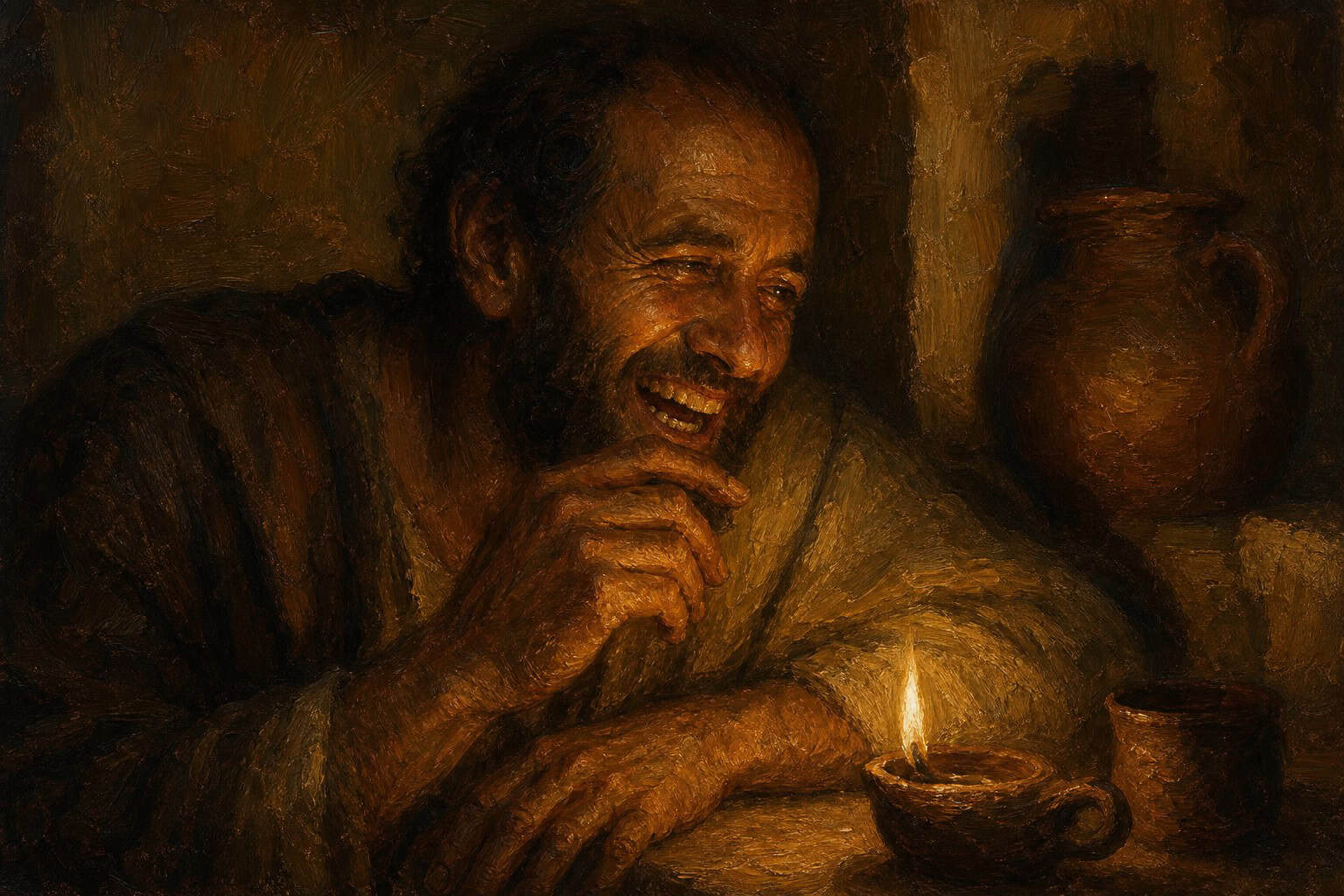
Why do I joke about serious things? Because the joke lets the wound speak with its hand over its own mouth, until someone actually listens.
Adam Sandler at Highway Speed
You already know the trick, because you learned it before you had words for it. Something happened that should have folded you in half, and instead you made the room laugh, and the laughter came back at you warm, like arms. So you kept doing it. You turned the ache into timing. You learned that a good line lands a half-second before the silence would, and that silence is exactly where the fear lives, so you never let it arrive. In one small stretch of Confessions to the Empty Chair, a comedy album fills a truck cab as two men drive toward a girl’s house, and the juvenile bits from an old tape carry them straight back to who they were in high school. It is such an ordinary picture. Two grown men in a cab, laughing at jokes they have memorized down to the timing, the truck eating up dark road. But sit with it a moment and you feel what the laughing is actually doing. It is keeping the ride light. It is holding the nerves off. It is a way of driving toward something frightening while pretending the trip costs nothing at all. That is what your humor does too. It rides shotgun toward every hard thing you have ever had to face. You crack the joke before the doctor speaks, before the argument breaks open, before the person you love says the sentence you are not sure you can survive. You joke about serious things because being funny is faster than being afraid, and speed is safety when you are small and cornered. You did not pick this the way you pick a shirt in the morning. It was pressed into you by a hand you did not choose. Something hurt, and the hurt taught your face to smile and your mouth to move quick, and now the smile and the flinch are welded together so tightly you cannot always tell which one is running the machine. The narrator here is driving toward a girl he barely knows, going along to balance out the pairing, and the comedy playing in the cab is the anesthetic for the nerves in his gut. He wants something from this night. The jokes make the wanting bearable, make it feel like a lark instead of a hunger. You do the exact same thing, most days, and you have done it so long that you no longer feel the old wound underneath, only the reflex it left in its place. The reflex is quick. The reflex is charming. The reflex is a scared kid who figured out that if he keeps the adults laughing, nobody in the house gets hurt, and now that kid is grown and still doing the bit, still working the room, still afraid of the quiet where the truth might get a word in edgewise.
A Test Dressed Up as a Gift
Watch what happens when the driving stops and the real talking begins. Earlier in the same book, before the drive, the narrator sits outside with this girl and does not reach for jokes at first. He says something stranger than a joke. He speaks of suffering. He half-mentions the crucifixion, drops one of his private reflections into the night air to see what her hands do with it. And here is the thing about his cleverness, the thing worth slowing down for. It is a test wearing the costume of a gift. He hands her a thought and studies her face while she holds it. If she laughs it off, or gets up and goes back inside to smoke with her friend, he has lost nothing at all, because he can tell himself he was only being clever, only playing. If she leans in instead, he has found something rare and worth the risk. This is the exact machinery of joking about serious things, of the funny wound. You say the true thing wrapped inside the joke, so that if the room turns cold you can claim you were only kidding, only performing. The joke is the armor and the message at once, the same breath doing both jobs. It lets you show the ache while keeping your own hand clamped over your own mouth. He does this on purpose in the passage. He knows people give themselves away by the words they choose, and he has chosen his to sort her, to learn whether she is the kind who cries fanatic or the kind who can carry a heavy sentence without dropping it. His wit is not there for her entertainment. It is a filter, a sieve. And you have built the very same sieve, haven’t you. You are funny at the gathering, but the funniness is quietly running surveillance the whole time. You are clocking who laughs at what. You are learning who will bolt when you finally say the real thing and who will hold their ground. The comedian in you is also the guard at the gate, and he does not sleep. He decides who gets near you and who stays out in the cold. The hard thing, the thing that keeps you staring at the ceiling, is that the same gift that shields you also holds every last person at arm’s length. You perform so smoothly that nobody thinks to ask how you are actually doing. You are the funny one. The funny one is fine. The funny one does not need checking on, does not need saving, does not need a hand on the shoulder. So the wound that first taught you to be funny gets to keep hiding inside the very thing that was supposed to let it out. He is testing her, yes. But underneath the test he is also, without ever admitting it, begging her to pass, to be the one soul who hears past the performance and does not stand up to leave. That is what the joke was always secretly for. Not to amuse anyone. To find the person who will not walk out when the laughing finally runs dry.
Her Silence Doing Its Slow Work
Then comes the moment that quietly wrecks the whole strategy. She does not laugh. She does not flee. She listens. In the passage her eyes stop being merely polite and begin to hold weight, real weight, the kind you feel in your chest. She nods slowly, not on reflex, but as if she is trying his words on like a coat before she decides whether to keep them. Her silence is not the empty kind. It is dense, alive, working through what he said, and he can feel it working. She hears the thing hidden under the thing. And something in him lurches sideways. Because the joke was engineered to be deflected. The reflection was offered as a test he half expected, maybe even half hoped, to lose. He had grown so accustomed to performing that being actually received felt like the floor tilting out from under his feet. This is what nobody warns you about being the funny one. The disaster is not that people laugh. The disaster is that someone stops laughing, and looks at you, and you feel the buckle of your armor come undone without your say-so. When she harkens to him instead of merely hearing the noise he made, his whole clever apparatus fails in the best and most frightening way. He wanted to be seen. Now he is being seen. And it scares him, because a man who has spent years being funny has never once learned how to simply be met.
The joke is the wound speaking with its hand over its own mouth.
And when someone reaches up gently and pulls the hand away, the mouth underneath has no idea what to do with itself. He notices, right there, that he wants to show off now, wants to hand her more reflections, and even that hunger is honest and sad at the same time. It is the kid again, thrilled that the trick landed, greedy to keep it landing. But beneath the showing-off a real question is forming in him, slow as her nod. What if she is not just a screen for the other men’s fantasies. What if there is genuine substance under that poise, tension, resistance, maybe even steel. What if she is a whole other person, lived from the inside, and not a mirror he can perform into and watch himself flatter. That question is the crack running through the whole structure. Because the funny wound only survives as long as everyone else stays a spectator in the seats. The instant one of them stands up and becomes a witness, someone who truly receives what you smuggled inside the punchline, the game changes for good, and you are no longer safe and no longer alone, and both of those are unbearably true at the same second. He does not grasp all of this in the moment. The older voice narrating him does. It knows he came into this already decided, already using his cleverness as a lever to move her, and that her real listening was something he had not made himself worthy of.
The joke is the wound speaking with its hand over its own mouth.
When Being Received Turns to Pursuit
Now sit in the aftermath, the lonely field where the funny person always seems to end up standing. Watch what the narrator does with her attention once he actually has it in his hands. He does not soften. He gets hungrier. He decides he will go after her, will not wait around for her to pursue him, will do the pursuing himself. The performance that began its life as a shield has quietly become a campaign with a map. And here the older self turns the lens back on his younger self with something close to grief. He sees that he took her genuine listening and read it as proof his strategy had worked, when what she was actually giving him was a person’s real attention, freely spent, costly, not owed. There is a hard thing to admit in this stretch, and the book refuses to let him slide past it. The gift she offered, that rare thing where a beautiful girl heard clean past his cleverness and did not get up to leave, he received as a conquest instead of a communion. This is the specific danger of being the funny one who was made funny by pain. The wit gets so skilled at slipping past other people’s defenses that you forget the other person even has an inside, a whole life running underneath, that was never a puzzle for you to solve and win. You learn to read people so you can stay safe, and then the reading itself curdles into a way of using them. He confesses it sideways, that he entered those rooms already decided, that the performance was never truly a question he was asking but a plan he was executing. And you know this shape from your own life, if you are honest at three in the morning. The funny reflex that once saved a frightened kid grows up into something that manages people, sorts them, wins them, and quietly refuses to ever be surprised by them, because surprise means you were not in control. Here is where I want to hold two things at once, and not collapse them. There is a reading that says the pursuit is just old strategy, the oldest one there is, a man wanting a woman and dressing the wanting up as depth. And there is a truer, tenderer reading underneath it, that he was starving to be received by one person before he ever knew how to receive anyone back. Both are alive in him at the same time, and she deserves to be seen as neither trophy nor lesson, but as the whole self she was, listening with a discernment that cost her something. That is the real price he pays, the one in the currency you cannot get back. You get very good at being received, and very bad at receiving. You can make anyone in the room laugh, and you cannot let a single one of them in without turning it into a match you are determined to win. The wound that made you funny keeps right on making you lonely, because it trained you to treat every real moment of being seen as a scene you are supposed to be directing from behind the camera. She listened. She turned out to be more than the others had imagined her. And instead of just standing there grateful, he went back to work. The bit never fully ends. It only gets more sophisticated, and the more sophisticated it grows, the farther it carries him from the plain, unfunny sentence he has been trying to say since he was small enough to hide under a table.
Out of Jokes, and Not Alone
Here is where the ache finally settles, and where the book flatly refuses to hand you a ribbon to tie around it. Your humor is not a sin, and it is not a lie. It is a bandage a frightened child fashioned out of whatever scraps were lying in the room. It kept something alive in you that might otherwise have quietly died in the dark. You should not despise it, and you should not sneer at the kid who made it. But you cannot live inside it forever, because a bandage that is never once removed slowly becomes the wound it was meant to cover. What the narrator glimpses, and what he does not yet know how to reach for, is a place where the joke is simply not necessary anymore. He half-names it himself when he speaks of the crucifixion, of a mind that stays fully awake inside its own suffering rather than numbing it down or laughing it off. Somewhere deep in him there is a hunger to stand before someone, or before God, and say one plain word with no strategy folded inside it. No timing. No filter. No half-second joke fired off to beat the silence to the punch. Just the true sentence, spoken flat, and the silence that follows it, and no one getting up to leave. That is what you want too, underneath all the material you keep prepared and ready. You joke about serious things because you were hurt, and you want, far more than that, to be somewhere you do not have to be funny at all, where the quiet is safe. The consolation this book offers is not that such a place arrives easily or on schedule. It rarely does. The girl listens, and it undoes him, and he still turns her listening into a pursuit, and the honest older voice narrating knows every bit of it and does not pretend otherwise or clean it up. Grace here is not a cure that reaches in and lifts the reflex clean out of you. Grace is closer than that, and quieter. It is the strange sense that even in the middle of the performance, even while you are working the room with everything you have, you are not actually alone in that room. Something patient is present, awake in the dark alongside you, unamused and unfrightened, sitting there while the bit slowly runs out of gas. It does not shame the child who learned to make the house laugh so the house would not break apart. It sits down next to him on the floor. And it seems to know that one day, worn out, entirely out of jokes, you will finally say the flat true thing you have been smuggling inside every punchline for the length of your whole life, and that this exhausted, unfunny moment is the one it has been waiting beside you for the entire time. Read this if you have ever been the funny one and felt, in the very second after the laugh, unbearably unseen. It will not fix you. It will do the harder and kinder thing. It will keep you company in the exact spot your comedy was built to hide.