Trauma made you funny? The joke came first because the fear needed a place to hide. Here’s why laughter learned to talk before your grief could.
The Punchline Arrives Before the Pain Does
When did the joke start beating the fear to the door? You know the feeling from the inside, in the flesh, before the mind catches up. Something lands hard—a look across the table, a memory that opens under you like a trapdoor, a sentence that presses on an old bruise—and before the ache can climb into your throat, a joke is already out of your mouth. It happens faster than thought, faster than shame, faster than the truth. Your body has learned a trick and it performs the trick without asking you: it takes the sharp thing, files it down, makes it small and shiny, and hands it to the room before anyone can see how it cut you. This is not a choice you make. This is reflex, the way a hand snaps back from a hot stove before the heat even registers as pain. You have made yourself funny the way a man dropped into a strange country learns the local words fast, out of hunger and out of fear, because his silence would mark him and his mistakes would cost him a place at the table. The comedy is a kind of fluency you paid for. You became fluent in disarming people. You learned to read a room the way a starving man reads a menu—scanning, calculating, hunting for the one thing that will let you belong before they notice how badly you don’t. And here is what nobody tells the funny one: the joke is a real gift and a real wound in the same breath, the same instant, the same word. It buys you a seat. It turns the frightening face soft with laughter instead of hard with judgment. It slides a thin screen between your eyes and their eyes. But the same screen that hides your fear hides your whole face, and you cannot have one without the other. You are in the room now, welcomed, warm, laughing—and no one has met you. Not once. Not the real you. The mood of it is a low, constant exhaustion, this endless fast translation of pain into performance, this running the numbers on every silence before the silence can turn on you. You live one beat behind and one joke ahead, sweating to catch a rhythm the others seem to have been born knowing. The air feels heavier in these rooms, as if belonging cost extra breath. You breathe shallow. You wait for the small gap where a laugh can go. And the terrible tenderness of it is that it worked—it truly did shelter you. The child who learned this was not stupid and not weak. He was quick and desperate and alone, and he built the only walls a body with no other walls could build.
The Air Turns Thick Where You Arrive Late
Notice where you feel it first—not in the mind but in the chest, low, physical, before a single word is spoken. Difference registers in the body before the mind can name it: your skin knows its poverty, your lungs know they are in the wrong room. You step into a space that already has its rhythm and every nerve tells you that you arrived after the music started, that you must not stumble on the beat everyone else has already memorized. The suffocation is real. The pressure has weight. Somewhere behind your ribs a small voice starts giving orders—make yourself smaller, buy time, don’t let them see how underdone you are. And so the joke rises as cover, the way silence rises as cover for someone else; both are ways a frightened body survives a room it was never sure it was allowed to enter. This is the part that shames people, so let me say it plainly and without softening it: humor and hiding are cousins, born of the same fear. The funny one and the silent one are doing the exact same thing from opposite ends of the table. One goes quiet and lets the pen speak until courage learns the language of the room. The other goes loud and lets the joke speak so the fear never has to open its mouth. Both are scribes before they are ever speakers. Both are waiting, without knowing they are waiting, for the day their real voice might finally be safe out loud. You have spent years being the funny one. You are the person people phone to lighten a bad hour, the one who can turn a whole table’s mood in three sentences, the one whose timing feels like a thing given to you at birth. And privately, in the dark, you wonder whether anyone would actually like the un-funny you. You wonder whether the jokes are the only thing keeping the darkness in you sealed inside, whether it would leak out and stain the people you love if you ever stopped. That fear runs to the bone—the conviction that your inner dark is contagious, that your real self is a kind of infection, that comedy is the mask keeping everyone else clean of you. So you perform. You disarm. You cast yourself as the harmless one, the fool, the soft and toothless clown who could never wound anyone. And it works, and the working is the trap, because every laugh you win is one more proof that the real you must stay hidden or the whole thing collapses. The gravity of the room keeps pressing down on your shoulders. You keep translating pain into performance, faster, faster, and the sweat of it never quite dries between one gathering and the next. The question underneath is not why you are funny. It is who you are when the room finally empties, when the last person leaves, and there is no one left to make laugh.
The Mask You Wore So Well You Forgot Your Face
Here is the turn, and it is worse and better than you feared. The joke did not only protect you from other people. It protected you from yourself, which is the harder thing to forgive. Every time the punchline beat the pain to the door, you told yourself a small lie in the same motion—it’s fine, I’m fine, look, I can make it funny. And the lie held. It held for years. It held so long you built a life on it. But grief that gets turned into a joke does not vanish; it only goes underground. It waits. It sits in the very room you built to lock it out, and it does not leave, and it does not sleep. This is what no one warns the clever child about: the same reflex that saved him is now the wall keeping the man from ever being known. You made yourself so skilled at deflection that you can no longer feel the difference between healed and hidden. You laugh at the memory and mistake the laugh for peace. Then one ordinary afternoon the laugh doesn’t come. The joke fails on your tongue. The mask slips in front of someone you love, and the raw thing underneath shows for one exposed second, and you see the shock move across their face—not shock at you, never at you, but shock that you carried this the whole time and never once let them near it. That is the revelation, and it drops through you like cold water. You were not funny in spite of the pain. You were funny to keep everyone, including God, at arm’s length from it. And here is the strangest mercy in the whole terrible discovery: He was never fooled by the joke. Not for a moment. He sat with you in the dark room the entire time you were performing in the bright one next door. He did not need the punchline. He was not disarmed by your timing. He was simply there, present in the exact place the comedy was built to hide, waiting without a single demand, near in the tear you turned into a laugh before it could fall.
The joke is the smallest room you can build fast enough to hide in when the truth walks toward you.
And the reason that line stings is that you built it well. You built it fast and you built it often and somewhere along the way you stopped noticing the walls at all. You called it your personality. You called it a coping thing, a gift, a talent, and every one of those is true, and none of them touches the plain fact that a frightened soul made a house out of laughter and then forgot it had ever been hiding inside it.
The joke is the smallest room you can build fast enough to hide in when the truth walks toward you.
When the Laugh Runs Out and the Silence Stays
So what happens now, after the mask has slipped and cannot be pressed back into place? The fallout is quiet, and it is heavy, and it does not announce itself. You cannot un-know what you saw—that the funny you and the wounded you are one person, and that one of them has been holding the other hostage for as long as you can remember. There is grief in this, real grief, and it surprises you. You mourn the shelter even as you finally see it was a cell. The comedy was your first theology, your first way of surviving rooms that would have marked you as the outsider, the latecomer, the one who never learned the beat. And now you have to ask whether you still need it, or whether you are simply afraid to discover who you are without the applause ringing in your ears. This is the hard, unsettled part, and I will not tie a bow on it for you, because that would be another kind of joke. The dark does not lift because you finally named it. The wound does not close because you stopped making it a punchline. You sit in the quiet and it is uncomfortable and slow and your mouth keeps forming the deflection out of habit, the joke half-built behind your teeth, and you have to catch it and hold it back, and the holding back feels like stepping off a ledge. There is a vertigo in it—the sudden solitude of a soul that has climbed out of its hiding place and now stands in open air with nothing familiar under its feet. But that same height pulls at you strangely. Something in you wants to be known more than it wants to be safe, wants to be seen more than it wants to be liked. That wanting is the beginning of everything that matters. And the astonishing thing—the thing that stops the breath, that dwarfs you and yet makes room for you in the same instant—is that you are not standing out there alone. The One who sat with you in the dark did not come to tear the joke away like a father snatching a toy. He came to be with you in the very place the joke was covering all this time. He does not remove the wound. He moves into it. He does not empty the emptiness; He fills it with His own unbearable nearness, until the absence you have been laughing off for years becomes, of all impossible things, the one place where you are finally met and held.
Being Known Weighs More Than Being Liked
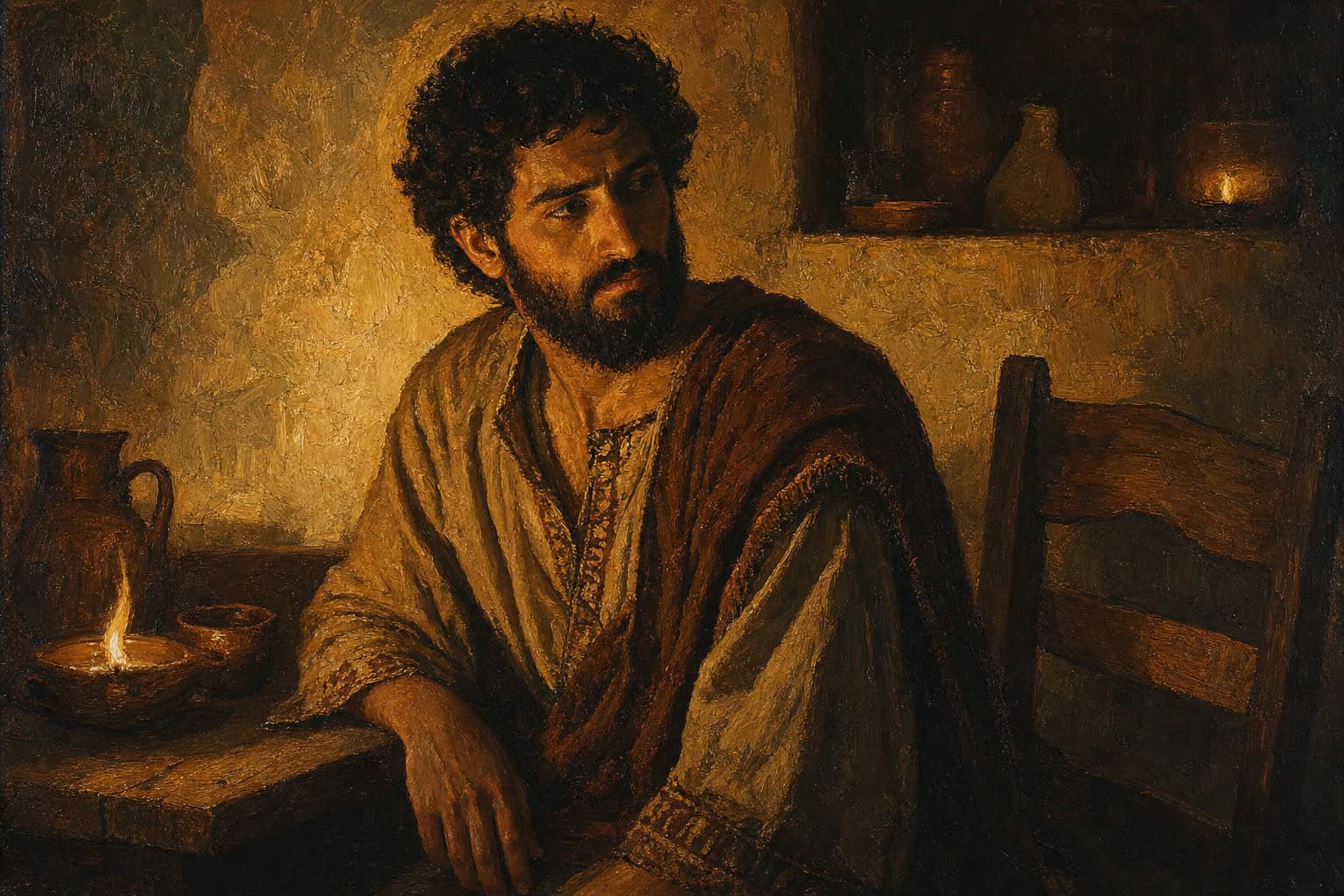
Where does it settle in the end? Not in a cure. Not in some clean morning when you finally stop being funny—because you probably never will, and you shouldn’t, since the humor is real and it is yours and it has carried you and others through nights worth surviving. It settles instead in a slow, uneven, stumbling learning to let the joke be a gift and not a wall. To laugh because something is genuinely funny, not because something is quietly threatening. To sit in a room and, sometimes, deliberately, not rush to fill the silence—to let one person see the un-funny you and watch them stay. This is the harder courage by far. Anyone can make a room laugh; it takes everything you have to let a room see you not laughing and remain in your chair anyway. The awe of it, the thing that leaves you still, is that you are more than your best line. You were never only the entertainment, never only the fast tongue at the end of the table. The vast, quiet fact underneath your whole life is that you are wanted exactly as you are—wound and all, dark and all, the very parts you were certain would infect the people you love. You are not an infection. You are a person that a frightened boy learned to hide because the world came at him too fast and too refined and too crowded with people who already knew the beat. This is the country a certain memoir walks through—a man who learned to disarm and deflect and shrink, who built masks so convincing he mislaid his own face, and who slowly, painfully, in the dark and not out of it, begins to be found. Confessions to the Empty Chair does not promise that the pain resolves into a punchline that finally lands. It offers something stranger and truer: that the God who was never once fooled by the joke has been sitting in the empty chair the whole time, waiting for you to set the performance down and let Him look at your real, unguarded face. You do not have to be funny for Him. You never did. And the tears you turned into laughter for so many years—He has been counting each one, holding each one, present in every single one you were sure no one saw. That is where the whole thing points. Not toward the day the laughing stops, but toward the day you no longer need it to keep from being seen.