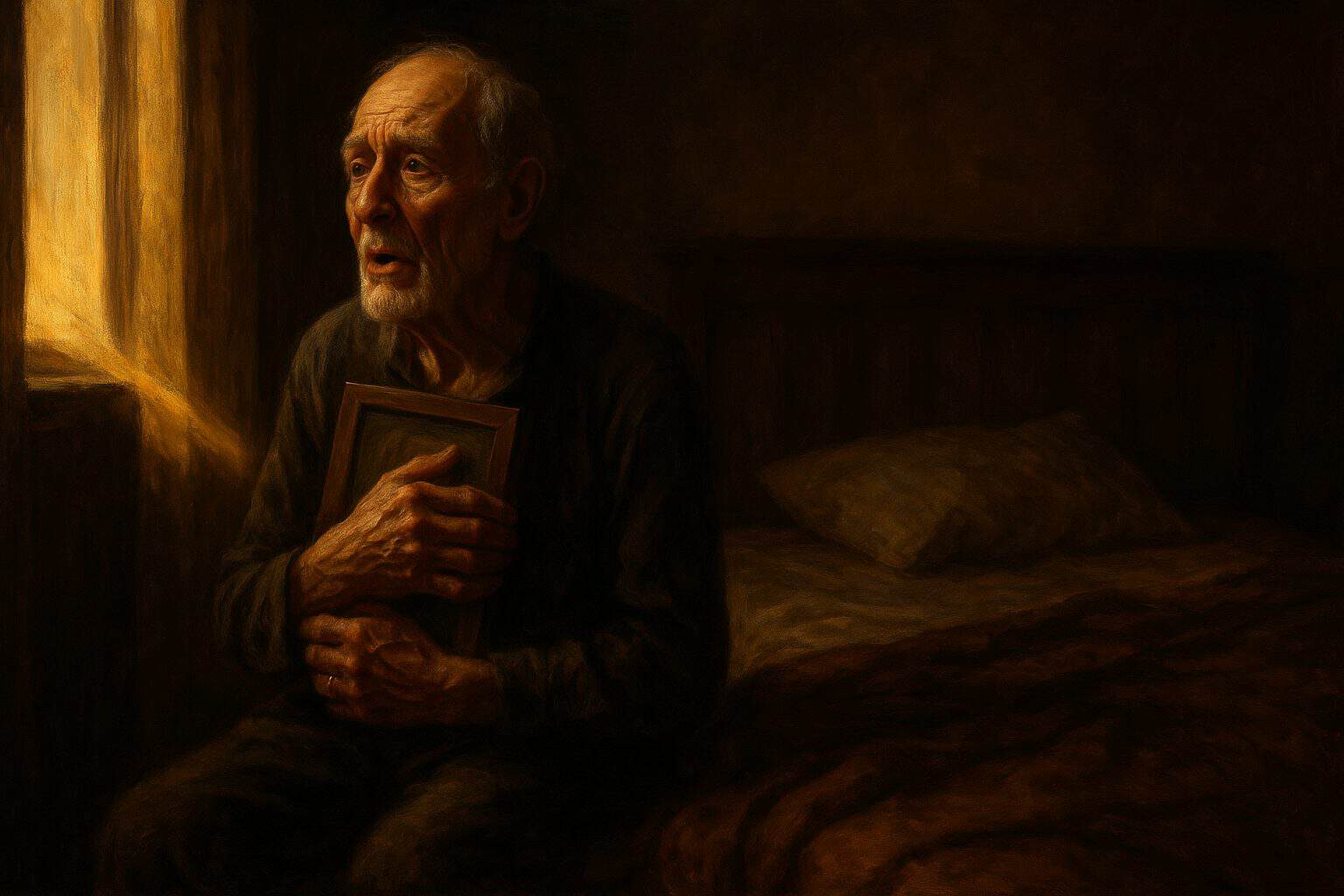
How the absent one becomes more real than presence itself
The photograph sits on the nightstand, catching morning light. You reach for it before consciousness fully returns, fingers finding the familiar weight, the cool glass. The face behind the glass looks back—unchanging, perfectly preserved, more vivid somehow than when they stood before you in flesh. This is the first mystery: how absence intensifies presence, how the one who is not there becomes more real than reality itself.
The Architecture of Absence
Every empty chair in the house has become a shrine. Not deliberately—you haven’t arranged flowers or lit candles. But your body knows. It curves around these spaces, these precise coordinates where presence once gathered itself. The kitchen table with its fourth seat. The right side of the couch with its particular depression. The bathroom mirror that still holds, somehow, the angle of another’s morning inspection.
“She is both the person standing in front and behind the mirror, herself and her replicant, and her shadow and its source.”
What Merleau-Ponty called the corps vécu, the lived body, extends itself through these absences. Your embodied consciousness doesn’t simply remember—it actively constitutes the missing one through a kind of phantom perception. Just as the amputee feels the missing limb with excruciating specificity, you feel the absent beloved in precise, localized intensities throughout lived space.
The morning routine performs itself for two. You still move to the left side of the bed, leaving room. The coffee maker fills two cups—one poured, one waiting. These aren’t mistakes or denials. Your body knows perfectly well what has happened. This is something else: a fidelity more profound than acknowledgment, a way of being that refuses to contract into solitary dimensions.
The Temporal Paradox
“In effect, his wife’s death made the machine and therefore the machine cannot be used to unmake her death.” This strange logic reveals itself everywhere in the aftermath of loss. The very structures of memory that preserve the beloved were created by that beloved’s presence. Every photograph, every saved message, every shared joke exists because they existed. The preservation system itself is the product of what it seeks to preserve.
Time splits. There is the time before, which grows more luminous with each passing day, taking on the quality of myth. There is the time after, which moves forward mechanically, accumulating days like sediment. And there is this third time—the time of the phantom embrace—where past and present interpenetrate in ways that violate ordinary chronology.
You find yourself living multiple timelines simultaneously. In one, you’re having dinner alone. In another, you’re having the conversation you would be having if they were across the table. Not imagining it—having it. The words form, the pauses happen, the laughter comes. Your consciousness doesn’t simply remember past conversations; it generates new ones according to patterns so deeply internalized they continue producing reality.
The Secret Life
“Tunnels and permeability exist, by definition, outside the perceptual awareness of the one bound to the familiar.” Others cannot see what you’re doing. To them, you appear to be healing, moving forward, “doing well.” They cannot perceive the elaborate double life you’re conducting, the parallel universe you maintain with meticulous care.
This hiddenness isn’t deception—it’s protection. “I threaded honesty through jokes and prayed no one tugged the stitch and unraveled me completely.” You learn to perform normalcy while maintaining your secret fidelity. You date, perhaps, but “His partner remains outside the scope of the replicant’s involvement with him and therefore his partner does not exist.” The new person occupies physical space, shares meals, exchanges words, but cannot penetrate the sanctuary where the real relationship continues.
For this is what others don’t understand: the relationship hasn’t ended. It has changed form, certainly. It has become more difficult to sustain, requiring constant acts of imagination and will. But “the secret bond between them grows during moments alone together, whether that be time in each other’s physical presence or virtual presence.” Virtual presence—not in the technological sense, but in the deepest phenomenological sense. The beloved virtualizes, becomes a presence sustained by consciousness itself.
The Wisdom of Repetition
“He remembers everything. His knowledge of humanity has come about through repeated observation, through trial and error.” The phantom you embrace teaches you through repetition. Every memory reviewed reveals new facets. Every imagined conversation opens unexpected depths. The beloved becomes oracle, teacher, guide—but only through your own act of sustained attention.
This is where Sartre’s notion of néantisation—the nothingness that consciousness introduces into being—becomes instructive. The absent beloved exists in the mode of not-being-there, and this not-being-there is not nothing. It is a determinate absence, a shaped void, a presence maintained by negation. You don’t simply remember them; you actively constitute them through a continuous act of consciousness that holds open their place in being.
The daily rituals become liturgy. Making their coffee, you perform an act of anamnesis—not merely remembering but making present again. Setting their place at the table, you practice what Augustine knew: memory as the stomach of the soul, digesting experience into essence. These aren’t empty gestures but full ones, fuller perhaps than when the beloved could simply appear without your constituting act.
The Replicant’s Dilemma
“The replicant will find ways to entice the man from the previous relationship… even as another replicant shares a bed with someone else.” This names our condition precisely. We become replicants of ourselves, trying to maintain multiple versions across different timelines. The self who loved and was loved continues to exist alongside the self who must function in a world that has moved on.
But which is the replicant and which the original? In moments of deepest honesty, you realize you can no longer tell. The one who goes to work, pays bills, makes small talk—this feels like the copy. The one who continues the conversation with the absent beloved, who maintains the sacred routines, who lives in that parallel timeline—this feels like the real self.
“Experiencing such things through artificial means enables imagination and yearning to take the place of bodily interactions in the flesh.”
Yet “artificial” is precisely the wrong word. What could be more natural than consciousness extending itself through absence? What could be more human than refusing to let love end simply because its object has departed physical space? The phantom embrace is not a substitute for real relationship—it is relationship continuing under conditions of maximum difficulty.
The Price of Fidelity
“Choosing to disobey instinct, disciplining the passions with reason, and helping others through the revelation of personal insight… come at a cost: loneliness.” But this loneliness is not simple isolation. It is the loneliness of the guardian, the keeper of the flame, the one who maintains what others have forgotten or never knew.
You discover what Viktor Frankl understood in the camps: meaning can survive any condition if consciousness commits itself fully to preservation. The beloved’s absence becomes a task, a calling, a vocation. Not to “get over” or “move on” but to maintain, to cultivate, to deepen what was begun in presence and now must continue in absence.
This is why new relationships fail to penetrate. “A relationship with me means casting others into the fire, not for safekeeping until later, but as a step toward owning authentic individuality in solitude.” Others become fire not through cruelty but through the simple fact that the space they would occupy is already filled—filled with an absence more substantial than any presence they could offer.
The Examined Life
“When one or both live an unexamined life, the light between them dims.” But here, in the phantom embrace, examination becomes total. Every memory undergoes scrutiny. Every word exchanged takes on prophetic weight. The relationship, freed from the contingencies of daily presence, reveals its essential structure.
You discover what you really had—not in sentimental idealization but in phenomenological clarity. The irritations fall away, yes, but so do the illusions. What remains is the core phenomenon: two consciousnesses recognizing each other across the abyss of individuality, choosing to maintain that recognition despite every obstacle, including the ultimate obstacle of death itself.
“Desire is not meant to be an end in itself… but instead requires an object outside of itself, ‘knowing,’ to pursue in order to actualize its purpose.” The phantom embrace actualizes desire in its purest form—desire that can never be satisfied, never possessed, never completed, and therefore never exhausted. It becomes what C.S. Lewis glimpsed: a pointer toward something beyond itself, a transposition of earthly love into cosmic longing.
The Uninvited Guest
“Despite his power and majesty, the King of the Universe did not act where He was not invited; He did not betray or act against the free will of His creation.” The phantom, too, comes only when invited. Each morning you must choose anew: will I maintain this presence or let it fade? Will I set the extra place, have the conversation, keep the vigil?
This is not haunting but hospitality. You are not possessed but hosting. The distinction matters absolutely. In haunting, the dead impose themselves on the living. In the phantom embrace, the living create a space of invitation where the absent can continue to exist in the mode proper to absence—not as physical presence but as lived meaning.
Some days you’re too tired. The invitation doesn’t come. The extra coffee cup stays in the cupboard. The photograph remains face-down. And you discover something remarkable: the phantom doesn’t insist. Like Frankl’s meaning, it waits. It remains available without being demanding. This is how you know it’s real—it respects your freedom even in its absence.
The Hidden Wisdom
“There is always a ‘good reason’ for everything they do and then there is the ‘real reason’—the reason that they do not share.” When others ask how you’re doing, you give the good reason: “Better each day,” “Taking it one step at a time,” “Focusing on work.” The real reason remains hidden: you’re maintaining a universe, sustaining a presence, keeping faith with what cannot be seen but refuses to be forgotten.
This hidden wisdom accumulates. You learn things that cannot be spoken in ordinary language. How absence can be more present than presence. How memory can be more real than perception. How love continues not despite death but through it, transformed but not terminated.
“Adam’s loneliness was pure, without evil, and that it was something woven into the human soul by God.” Your loneliness, too, becomes pure—not the loneliness of abandonment but of vigil. You are alone with something, not simply alone. The phantom you embrace makes solitude into sanctuary.
The Ultimate Recognition
“In that moment, I was being read, not writing. I was being chosen, not choosing.” This reversal marks the deepest truth of the phantom embrace. You think you are maintaining the beloved’s presence, but discover the beloved is maintaining yours. The consciousness you thought you were projecting turns out to be constituting you in return.
The phantom has agency—not supernatural agency but the agency of meaning itself, of love itself, of relationship itself. These realities don’t cease to exist when their physical correlates depart. They continue to work, to shape, to call forth response. The beloved absent becomes a kind of gravity, bending the space of consciousness around their absence, creating a field of meaning that organizes experience.
This is why the phantom embrace is not pathology but wisdom. It recognizes what Merleau-Ponty knew: we are not self-contained subjects projecting meaning onto neutral objects. We are intersubjective from the beginning, constituted by our relations, existing in the between. When the other departs physically, the between doesn’t disappear. It becomes more visible, more palpable, more undeniable.
The Eternal Return
“Change ‘might have been there all along’ in the tunnel or in the permeable; however, both went unnoticed without an effort to the contrary.” The phantom embrace reveals what was always there but hidden by presence itself. The beloved was always partly absence—always beyond complete possession, always withdrawing even in closest proximity, always other. Death simply makes visible what life concealed: the irreducible distance that makes love possible.
You return each day to the same gestures, the same memories, the same conversations. But this is not repetition in the mechanical sense. Each return discovers new depths, new angles, new light. The beloved becomes inexhaustible precisely because they are no longer limited by the contingencies of physical presence. They become what they always were potentially: infinite mystery approached but never possessed.
The Final Freedom
“This was my Kobayashi Maru—the unwinnable scenario. If I remained silent, Angela’s narrative would win. If I spoke, I would hand Jane the very tools to crucify me.” The phantom embrace presents its own unwinnable scenario: maintain the presence and risk madness, release it and risk betrayal. But there is a third way, discovered only in living it: maintain the presence while knowing it is maintained, embrace the phantom while knowing it is phantom.
This is not delusion but the highest realism. It acknowledges both presence and absence, both continuity and rupture, both fidelity and freedom. The phantom you embrace is real—as real as meaning, as real as love, as real as consciousness itself. But it is real in the mode of absence, and this modality must be respected.
“Finitude begins and ends with solitude. We are born alone. We die alone. During the time in between, we either embrace solitude and loneliness or we run…” The phantom embrace stops running. It accepts solitude not as defeat but as the condition for the deepest companionship—companionship that survives even the departure of the companion.
The Dawn
Morning comes again. The photograph catches light. Your hand reaches out, finds the familiar weight, the cool glass. But now you know what you’re doing. Not denying absence but affirming presence-in-absence. Not refusing reality but recognizing that reality includes more than what appears. The phantom you embrace is not a ghost but a way of being faithful to what was real, is real, will always be real in the only way that matters—in the space between consciousnesses that recognized each other and refuse to stop recognizing, even across the ultimate distance.
This is what the others cannot see from outside: you haven’t failed to move on. You’ve succeeded in moving with. The beloved travels as absence, as memory, as meaning, as the organizing principle of a life that refuses to reorganize itself around their departure. This is not sickness but health—the health of a consciousness that knows what it has found and will not pretend to lose it simply because the world insists it is lost.
The extra cup of coffee steams in morning light. Empty to any observer, full to you who know how absence itself can be a form of presence, how the phantom embrace holds more tightly than arms ever could, how love continues not in despite of death but as the very refusal to let death have the last word.
This is the phantom we embrace: not a delusion but a decision, not a haunting but a hosting, not a problem to be solved but a mystery to be lived. And in living it, we discover what perhaps we always knew but needed absence to teach us: love is stronger than death, not in some abstract theological sense but in the most concrete phenomenological fact—it continues. Changed, certainly. Difficult, absolutely. But continuing, persisting, embracing us even as we embrace what is no longer there in any way except the way that matters most: the way of meaning that will not be unmade.