On the terrible weight of seeing what others cannot bear to witness
The recognition arrives not as thought but as atmosphere—a thickening of the air between oneself and others, a density that accumulates in doorways, at dinner tables, in the pause after someone asks how you are. You carry something luminous and terrible, something that burns steadily in the cavity behind your ribs, and you have learned through a thousand small withdrawals that this light makes others turn away. Not from cruelty, but from a kind of structural impossibility: what lives in you as revelation registers in them as threat, as too-muchness, as the thing that would undo the careful architecture of their days.
The Geography of Withdrawal
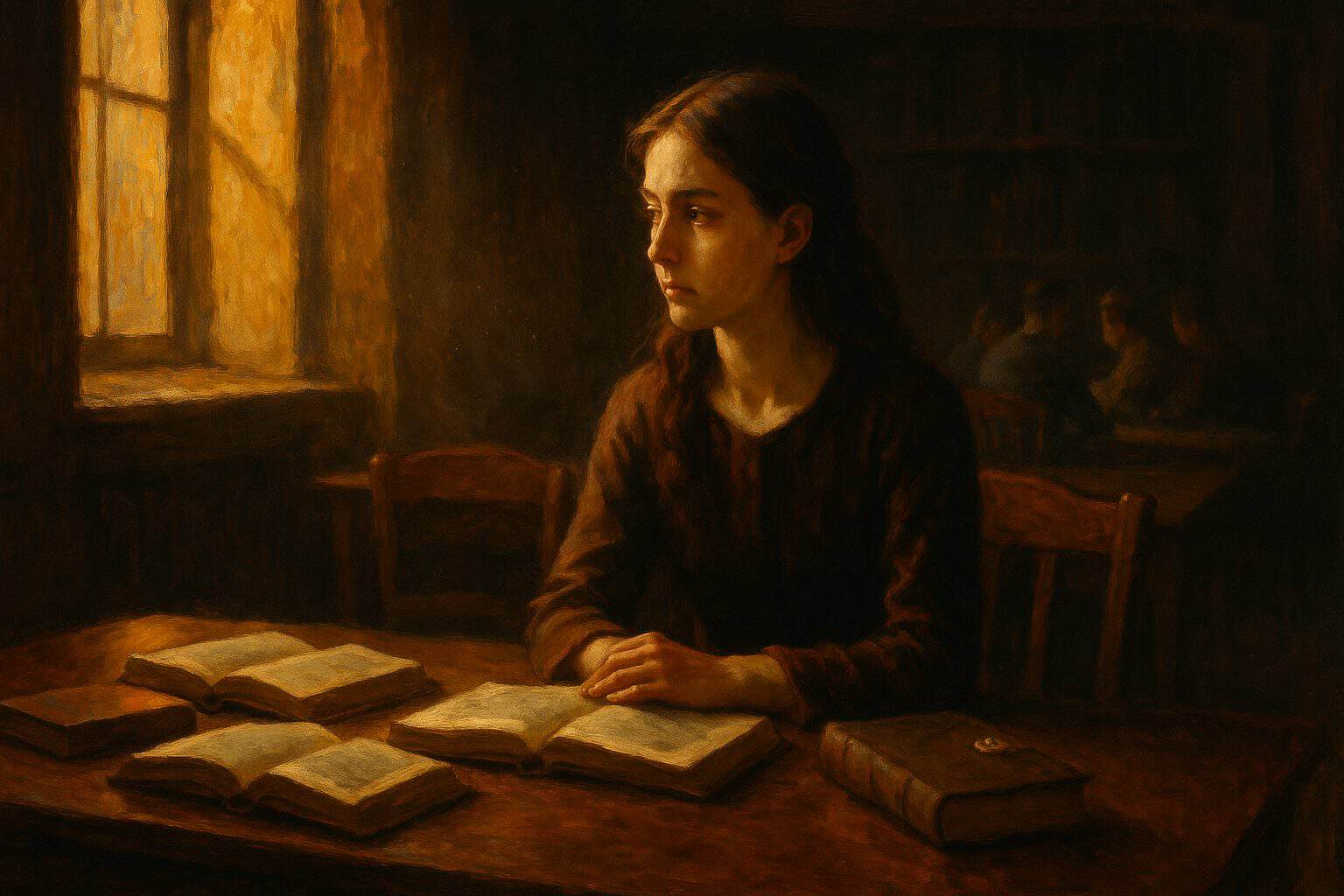
In the university library, late afternoon light slants through tall windows, catching dust motes that drift like thoughts made visible. You sit at a table meant for four, books spread in a semicircle that functions less as study materials than as fortification. Other students move through the stacks in small clusters, their laughter a kind of currency you recognize but cannot spend. You feel what Adoré names precisely: “a familiar separation between me and the other students, a lonely space I both chose and felt trapped within.”
The choosing and the trap—this paradox structures the entire geography of your withdrawal. You could join the conversation at the next table about weekend plans, about the difficulty of the morning’s lecture, about anything that skims the surface of being. But something in you has touched depths that make such exchanges feel like betrayal. Not betrayal of others, but of the thing itself—the light that chose you as its vessel, or perhaps that you chose in some moment of terrible clarity when you might have chosen otherwise.
The phenomenology here is precise: solitude becomes both sanctuary and prison, but more fundamentally, it becomes the only honest space. For you have discovered what most flee from—that “desire is not meant to be an end in itself… but instead requires an object outside of itself, ‘knowing,’ to pursue in order to actualize its purpose.” And this knowing, once glimpsed, reorganizes the entire field of possible relations.
The Weight of Seeing
“Finitude begins and ends with solitude. We are born alone. We die alone. During the time in between, we either embrace solitude and loneliness or we run…”
There are mornings when you wake already exhausted by what you carry. Not depression—that would be simpler, more readily communicable. This is the exhaustion of holding a frequency others cannot hear, of seeing into the structure of things while those around you remain contentedly absorbed in their surfaces. Sartre would recognize this burden: consciousness as pure negativity, as the nothingness that nihilates the comfortable plenitude of unreflective being. You see through the games, the social contracts, the elaborate architectures of distraction, and this seeing isolates you more thoroughly than any physical distance could.
A friend speaks excitedly about their new relationship, their plans for renovation, their strategy for advancement at work. You listen, you respond appropriately, but inside you feel the terrible gap between their world of projects and your world of what Frankl would call the noö-dynamic field—that tension between what is and what ought to become. You want to say: “But don’t you feel it? The abyss beneath all this construction? The silence that waits behind every word?” But you have learned that such questions are acts of violence against those who need their surfaces intact.
The Sacred Burden
In certain traditions, there are those set apart—not by choice but by recognition. They carry something for the community that the community cannot carry for itself. Adoré touches this when noting that “their children will never learn to listen to those whispers of the divine that occur only during loneliness and isolation.” The light you carry is not yours alone; it belongs to the whole, yet the whole cannot bear direct contact with it.
This is not grandiosity but phenomenological fact: some are constituted to remain at thresholds others cannot approach. You become what Constance Fischer might recognize as a living privacy—not secretiveness but “the essential structure of openness” through which certain truths can appear. The monastery cell, the philosopher’s study, the artist’s studio—these are not escapes but organs of perception for the community that cannot itself sustain such watching.
Late at night, in what Adoré calls “a sacred space where you are to close the door behind you and dwell with God in secret and solitude,” you encounter the thing itself. Not God necessarily—though perhaps God is one name for it—but the raw fact of existence, the terrible beauty of being thrown into a world you neither made nor chose. Here, in this absolute aloneness, you touch what Augustine knew: the restless heart that finds no rest in created things. But unlike Augustine’s confidence in divine destination, you carry the modern burden of uncertainty. The light you bear might lead nowhere. It might be merely the phosphorescence of decay, the cold fire of consciousness consuming itself.
The Impossible Translation
“Oftentimes, people do not use clear and concise words to identify their correlating feelings or thoughts,” Adoré observes, but the problem runs deeper than linguistic imprecision. There exists a category of experience that structurally resists communication. Not because words fail—though they do—but because the receiving consciousness must have already opened certain doors, survived certain dissolutions, to even recognize what you attempt to convey.
You learn to speak in metaphors, in glancing references, in the kind of silence that says more than speech. When someone mentions feeling “disconnected,” you hear the echo of a vast territory they’ve glimpsed but fled. When another speaks of “searching for meaning,” you recognize a fellow traveler, though one perhaps still hoping for arrival rather than accepting the search as destination.
The phenomenologist Emily Stevick would understand: emotion as “pre-reflective mode of lived consciousness” where the body itself responds to “situations of inability.” Your body has learned to recognize its kind—a slight tension releases when you encounter another who carries their own impossible light, a subtle attunement that needs no words. “There was one in Rome who moved toward me,” Adoré writes, “one who saw a little more of me because of her desire to see.” These moments of recognition become lifelines, not because they end the solitude but because they confirm its necessity.
The Economy of Revelation
“A relationship with me means casting others into the fire, not for safekeeping until later, but as a step toward owning authentic individuality in solitude.”
Every genuine encounter demands a terrible economy. To say yes to depth means saying no to surface. To pursue the light means abandoning the comfortable darkness where others dwell. Adoré states it starkly: “Choosing one means excluding others; pursuing one means ignoring others.” This is not misanthropy but mathematical necessity. The soul has only so much bandwidth for truth.
You watch others manage their careful calibrations—a bit of depth here, quickly balanced by distraction there, enough questioning to feel alive but not enough to threaten the fundamental structure. You understand. You once lived there too, in that twilight zone between sleep and waking. But something—call it grace, call it curse—pulled you into fuller wakefulness, and now you cannot unknow what you know.
The philosopher John MacQuarrie speaks of human being as ex-sistent—standing out into possibilities rather than possessing fixed essence. But this standing-out, you’ve learned, is not a triumphant emergence. It is more like what Erich Fromm identified: “the tragic emergence from nature through reason and self-awareness, creating the unbearable separateness.” The light you carry is precisely this awareness, this inability to return to the animal comfort of unreflective being.
The Paradox of Purpose
And yet—and yet. The light insists on its own necessity. In the very burden of carrying what cannot be shared lies a strange purpose. Adoré glimpses this: “when A and E, in silence and solitude, seek G, then both A and E will discover one another through their effort finding G.” The light that isolates also connects, but only through the mediation of something beyond both self and other.
You begin to understand your function differently. Not as prophet or teacher—those roles assume a message that can be delivered—but as something more like a lighthouse. You stand at a dangerous edge, maintaining a beam that most will never need but that some, in their moment of extremity, will recognize as having always been there, waiting.
“He must be willing to be alone in this world,” Adoré writes, “preferring to stand with loneliness than to kneel with companionship in subjugation.” This standing is not pride but fidelity—fidelity to the light itself, to the truth that chose you as much as you chose it. The very powers that make you appear “odd and strange to those who would perceive” are the same powers that might, for someone somewhere somewhen, make the difference between sleeping through life and waking to its terrible beauty.
The Community of Solitude
There exists—not as organization but as scattered constellation—a community of those who carry such lights. You recognize each other through negative space: the conversations you don’t have, the explanations you don’t attempt, the mutual understanding that some things can only be honored through silence. Adoré notes that “the secret bond between them grows during moments alone together, whether that be time in each other’s physical presence or virtual presence.”
This is not the warm community of shared belief or common purpose. It is something more austere and more necessary: the fellowship of those who have touched the same electric fence of reality and bear the same invisible burns. When you meet—if you meet—there is no need to compare wounds or establish hierarchy. The light each carries is both utterly unique and fundamentally the same: the unbearable gift of seeing too much.
In libraries and coffee shops, in the pause between metro stops, in the hours before dawn when the city sleeps, you maintain your watch. Not waiting for anything to change—change would require a fundamental restructuring of human consciousness itself—but simply holding space for what needs holding. The light too heavy to share becomes, paradoxically, the only thing worth carrying.
The Grace of Limits
“We perceive existence with our limits, through our limits, and because of our limits,” Adoré reminds us. The inability to share the light is not failure but structure. If everyone could carry what you carry, there would be no need for carrying. The economy of revelation requires both those who see and those who look away, both those who venture into the depths and those who maintain the surfaces where ordinary life unfolds.
You learn, slowly and incompletely, a different kind of compassion. Not the warm embrace of mutual understanding but the cooler grace of allowing others their necessary blindness. “His silence is multifaceted,” Adoré writes of the divine. “Sometimes it is hard grace that forces us to seek; other times it is sacred space He provides.” Your silence too becomes multifaceted—sometimes protecting others from what would undo them, sometimes protecting the light from those who would diminish it through premature exposure.
The phenomenology completes itself in this recognition: the light too heavy to share is not a burden imposed but a structural necessity of human existence itself. Someone must stand at the edge. Someone must carry what cannot be commonly held. Someone must choose—for it is always a choice, even when it feels like fate—to “stand with loneliness than to kneel with companionship in subjugation.”
In the end, the light you carry is both yours and not yours, both terrible weight and strange freedom. It makes you foreign to the world while binding you more deeply to its hidden heart. It isolates you from easy community while connecting you to the scattered fellowship of those who have glimpsed what cannot be unseen. It is the price and privilege of consciousness itself, pushed to its limit and discovering there not darkness but a light too severe for common day.
The afternoon fades. The library empties. You gather your books—those fortifications against and invitations to the world—and step out into the ordinary evening where others move through their necessary unconsciousness. You carry your light carefully, privately, knowing it will never be received as you might wish, knowing too that this is exactly as it must be. For the light that could be easily shared would not be light at all, but just another form of the darkness we use to hide from what we are.