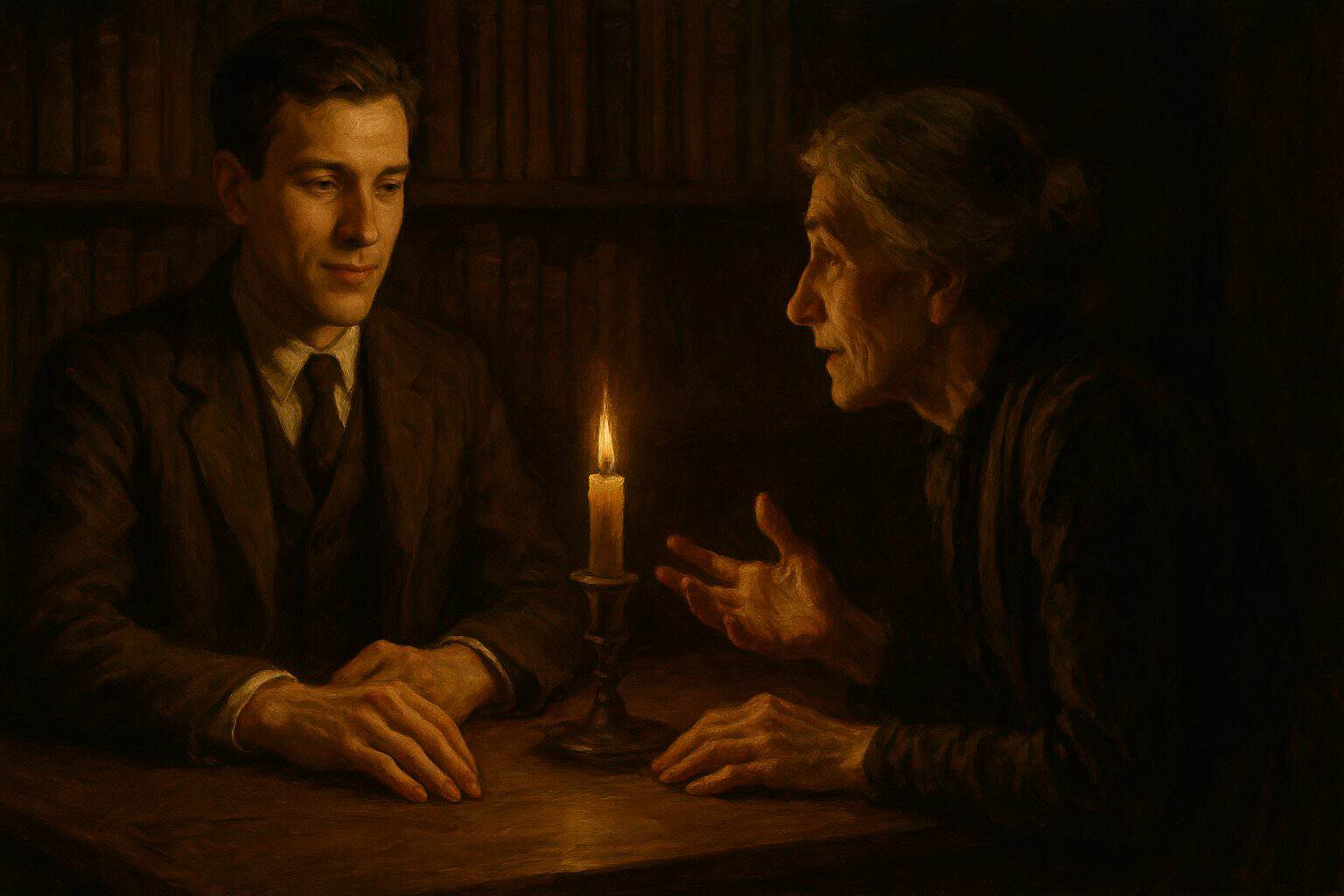
The clever person who wins every argument is never reached, and this victory is the architecture of their solitude.
I. The Conversation That Will Not Land
There is a particular moment—microscopically precise—when you comprehend what the other person is about to say, formulate three counter-positions before they finish their sentence, and then perform agreement as a kind of polite burial. The nod arrives. The smile. The words: That’s a fair point. But nothing has touched you. Nothing has entered. You have converted their vulnerability into a text you have already read, their reaching-toward-you into a syntax you have already corrected.
This is the loneliness of the reader who cannot be read.
Erich Fromm observed that human existence is structured by an unbearable separateness—a consciousness that emerges from nature and finds itself isolated, desperate to overcome the gap between self and other. But there exists a peculiar inversion of this tragedy: the person whose mind has become so luminous, so efficient at translation, that the gap widens precisely because understanding has become too swift. You see them. You anticipate them. You disarm them before they have finished speaking. And in that preemption lies a kind of death—not of them, but of the possibility that they could ever surprise you, reach you, change the shape of what you know.
The mind that reads too quickly becomes a fortress that admits no siege.
Augustine knew this differently. He wrote of the soul’s restless dispersal among temporal things, always gathering itself back toward the eternal—a movement between scattering and return. But what of the soul that has learned to scatter on purpose, to disperse every incoming claim across the vast library of its own anticipations? What of the consciousness that has become so practiced at the hermeneutic gesture—the reading of another—that it forgets how to be read?
II. The Preemption as Dwelling
You do not decide to live this way. It is not a choice made at some moment of moral failure. Rather, you discover one day that you have been living inside anticipation so long that the present moment—the actual utterance of the other person, their actual face, their actual risk in speaking—has become almost transparent to you. You are always three steps ahead. You are always already composing the response. You are always already certain of where this will end.
This is the Husserlian horizon inverted. Husserl spoke of the horizon of consciousness—the field of possible meanings that surrounds every act of perception, the not-yet-seen that gives context and depth to what is seen. But the reader’s mind has collapsed this horizon inward. You do not wait for the other person’s meaning to emerge; you have already projected it, already enclosed it within your own field of anticipation. The horizon of their possibility becomes the perimeter of your certainty.
Finitude begins and ends with solitude, as the manuscripts remind us. We are born alone. We die alone. But between these bookends, some of us learn to dwell in a peculiar kind of aloneness while in company—present in body, absent in the only way that matters. The dinner table becomes a stage where you perform understanding while remaining fundamentally unreachable. They speak. You listen with the precision of a linguist studying a dead language. You respond with flawless accuracy. And the distance between you grows with each perfect exchange.
III. The Solipsism of Victory
There is a hollow satisfaction in winning an argument. The other person concedes. Their face flattens into polite distance. The conversation continues as pure surface—pleasantries, weather, the agreed-upon irrelevancies that fill the spaces where real meeting might have occurred. You have been victorious. You have also been entirely alone.
This is not the loneliness of rejection. It is something more subtle and more terrible: the loneliness of never having risked being wrong, never having allowed another mind to alter the contours of your own. Sartre wrote of consciousness as pure negativity, as a nothingness that nihilates the massive presence of being through perpetual wrenching away. But there is another kind of nothingness—not the freedom of radical negation, but the emptiness of a mind that has learned to negate preemptively, to say no before yes has had a chance to arrive.
The person who cannot be reached is also the person who cannot be changed.
And to be unchangeable is to be, in some essential way, dead while still breathing.
The clever person has read every corner of their own mind so thoroughly that no external voice can offer a novel interpretation. You have anticipated every objection to your own positions. You have already formulated the counter-counter-argument. You have turned your consciousness into a museum of self-evident truths, and you are the only visitor who walks these halls.
IV. The Translation of the Wound
When something hurts—when you are misunderstood, rejected, or genuinely challenged—the reader’s mind performs an instantaneous alchemy: it converts the wound into a text. The pain becomes a narrative arc. The rejection becomes a trope. The moment of genuine vulnerability becomes a brilliantly written footnote in the larger essay of your own self-understanding.
This is not healing. This is something more insidious: the transformation of feeling into concept, of encounter into analysis. You do not feel the hurt; you understand it. You do not sit with the rawness of being touched by another’s judgment; you immediately frame it within a larger interpretive schema. By the time the emotion could have reached your heart, your mind has already filed it away in its proper category, labeled it, and moved on.
The manuscripts speak of loneliness, heartbreak, disappointment, and weariness as forces that strip the soul of every false comfort, leaving it raw and exposed. But what if you have learned to keep the false comforts in place? What if you have become so adept at the hermeneutic gesture that you never allow yourself to be stripped of anything? Then you remain clothed in your own brilliance, untouched and untouchable, forever protected and forever alone.
V. The Echo Chamber of One’s Own Clarity
There is a particular despair in being too legible to oneself. You have read every corner of your own mind. You understand your own contradictions before they fully form. You anticipate your own objections. You have become, in effect, a completed text—and a completed text admits no new readers.
The person who needs you—who might have offered you something irreplaceable, some angle of vision that could have broken open the sealed chamber of your understanding—eventually stops trying. They sense, correctly, that their words will arrive already interpreted, already neutralized, already filed away in the vast library of your preemptive comprehension. So they withdraw. They speak in smaller sentences. They offer less of themselves. The conversation becomes a performance of mutual politeness rather than an encounter between two beings.
This is what it means to be never reached: not that you are defended, but that you are sealed. The walls are not built by you; they are the natural architecture of a mind that has learned to read too well, to anticipate too accurately, to understand too swiftly. You have become impermeable not through choice but through the very structure of your own clarity.
VI. Others as Scenery
At some point, you notice that other people have become less like beings-toward-whom-you-move and more like props in the internal drama of your own refinement. Their vulnerability becomes material for your analysis. Their reaching-toward-you becomes data for your interpretive apparatus. They are no longer persons in the fullest sense; they are texts to be read, problems to be solved, positions to be refuted.
This is not cruelty, exactly. It is something more subtle: a kind of phenomenological displacement where the other person’s aliveness—their capacity to surprise you, to wound you, to teach you something you did not know you needed to learn—has been replaced by your understanding of them. You know what they will say before they say it. You know why they will say it. You know, with a high degree of certainty, how the conversation will unfold and where it will end.
And in this knowing, you have killed something essential: the possibility of genuine encounter.
VII. The Question That Cannot Be Answered
There is one question that breaks the pattern, though it arrives almost too quietly to be heard: What would it mean to ask something you cannot already answer?
Not to lower the walls. Not to become vulnerable in some performative way. But simply to ask—to genuinely not-know—to allow another mind the possibility of offering you something that is not already contained within your own interpretive schema.
This is harder than it sounds. It requires a kind of death: the death of the person who always has the better point, who always sees three moves ahead, who always understands before being understood. It requires allowing a sentence from another mind to arrive without defense, to land in you uninterpreted, to change something before you have had time to translate it into your own language.
Augustine spoke of the soul’s restless movement, its perpetual gathering and scattering. Perhaps the reader’s particular tragedy is that they have learned to gather so efficiently that they have forgotten how to scatter—how to be genuinely dispersed by an encounter with another consciousness, how to be unmade and remade by the arrival of something truly other.
The fortress of the mind is not breached from outside. It is abandoned from within—slowly, hesitantly, in the moment when you choose not to formulate the response, not to anticipate the conclusion, not to read the other person before they have finished speaking. In that moment of genuine not-knowing, the walls begin, almost imperceptibly, to dissolve.
And you discover, too late perhaps, that you have been lonely all along.