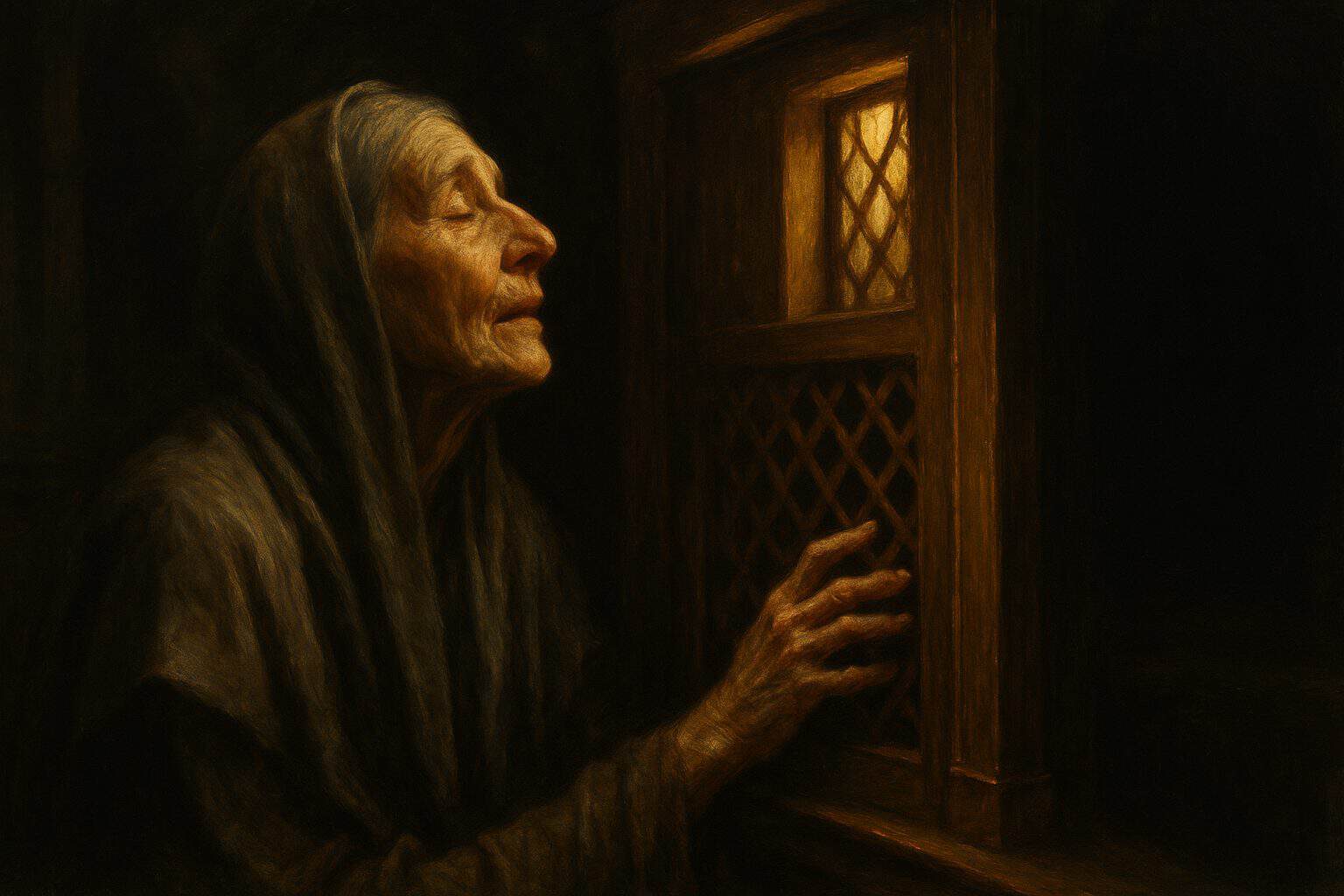
Where wounds become windows, grace enters uninvited through the very places we guard most fiercely.
The Architecture of Distance
The window stands between us—not merely glass and frame, but the entire weight of what cannot be crossed. She remains on one side of the screen, I on the other, and this physical barrier only confirms what the soul already knows: some distances are measured not in space but in the quality of separation itself. The sigh that escapes her lips carries neither annoyance nor inconvenience precisely, but something more terrible—the sound of a door closing from the inside, a turning away that happens in the very act of remaining present.
When I turn my back on her window, my soul limps away. Not the body—the body walks with its usual gait, maintains its composure. But something deeper drags itself across the yard, wounded by what presence itself has become. The window that will soon slam shut for the last time already echoes in this moment, as if endings cast their shadows backward through time, darkening even the moments that should have held possibility.
The Idol of the Wound
“The idol of my wound, once fuel for the fire, forged itself into the very tool that gave me eyes to see the spiritual realm.”
The wound transforms itself through its own burning. What begins as raw damage, as the place where the self breaks open, slowly transmutes into something else entirely—not healing exactly, but a different kind of opening. The idol we make of our pain, polishing it with attention, feeding it with memory, becomes paradoxically the very instrument through which something beyond pain becomes visible.
Like staring at a candle flame until the eyes adjust to darkness, the wound teaches a different kind of seeing. The spiritual realm doesn’t appear despite the wound but through it, as if damage itself could become a lens. The very thing we worship in our pain—that secret altar where we offer our days—transforms into the window through which grace enters uninvited.
Empty Pews and Silent Gods
The campus chapel holds me each night in its particular embrace—not the warmth of human arms but something more honest in its coolness. Empty pews possess their own kind of tenderness, offering support without demand, presence without intrusion. Here, in this space consecrated to encounter, I learn how loud silence can become when it carries the weight of divine absence.
The God who stays silent doesn’t simply not speak—His silence fills the chapel like water fills a basin, pressing against the eardrums with its own kind of sound. Part of me pushes this silent God away, the natural recoil from what feels like abandonment. But another part, deeper and less articulate, compels me back each night to sit in this same silence, as if absence itself might be a form of presence I haven’t learned to recognize.
The prayer that emerges in such spaces thins itself to groans, words dissolving into pure intent aimed at the God who hides and reveals according to His own logic. The consolation I once sought—that first touch of divine presence that marks the soul forever—gives way to something simpler and more difficult: the desire not to feel Him but to belong to Him, even in the not-feeling.
The Friendship Cage
She holds others close through a particular choreography of promise—physical intimacy offered or withheld, suggested or withdrawn, always maintaining the exact distance that keeps everyone in orbit. The friendship cage she constructs has bars made not of rejection but of perpetual possibility, each person held in place by what might be rather than what is.
This form of tenderness wounds precisely through its gentleness. Nothing harsh enough to justify leaving, nothing solid enough to rest upon. The cage feels spacious until you try to move closer or farther away—then the boundaries reveal themselves, invisible but absolute. We mistake this for intimacy because it involves such careful attention, such precise calibration of distance. But intimacy doesn’t calculate; it risks. What she offers instead is the appearance of closeness maintained through the mechanics of separation.
Pixels and Presence
The photograph on the screen promises what it cannot deliver—the fire behind the eyes, that living flame that makes a face more than surface. I lock eyes with these pixels searching for what I know isn’t there, yet the searching itself reveals something true: the hollowness that technology presents as presence, the way images mock the very intimacy they pretend to preserve.
Dasein‘s thrownness into the digital age means encountering others through screens that pretend to be windows but function as walls. The face on the screen gives itself as pure surface, all noema without the underlying consciousness that would make it truly face. We scroll through these substitutes for encounter, each image a small betrayal of what presence actually means—that risk of two consciousnesses meeting without mediation, where the look of the other can actually touch and transform.
The Waters That Mix
Inside the heart, strange alchemies occur. The waters of God, of that ancient tempter Lilith, of the soul itself—they don’t remain separate but mix into something unprecedented. The demon harbored within doesn’t simply oppose the divine; it creates a third thing, a mixture that confounds the clean categories of sacred and profane.
I hide my spirit from women now, that essential part held back even as the body goes through its motions. The splitting isn’t clean—spirit here, body there—but rather a kind of internal exile where different parts of the self no longer speak to each other. Once I believed in a future where love would make sense, where Jeannètte and I would write a story that resolved into meaning. Now the body shares itself without the spirit’s participation, a generosity that is actually a form of withholding.
The Memory That Burns
Memory doesn’t simply recall—it brands. The phantom limb of what was throbs with a pain that has no present source, only the cruel searing of remembered sweetness against current bitterness. The memory burns not because it is false but because it is true, carrying a reality that the present cannot honor.
Each return to these moments—her sigh, the closing window, the screen that divides—doesn’t dull but sharpens their edge. The Stimmung of loss permeates not just the remembered moment but the remembering itself, until past and present share the same wounded atmosphere. Time doesn’t heal but clarifies, showing us exactly the shape of what we’ve lost.
Stickman at the Threshold
When Stickman crosses the threshold, the marking begins. Not a gentle touch but a branding with flame, the kind of marking that changes what it touches at the level of essence. He doesn’t ask permission—grace rarely does. Instead, he claims ground that darkness thought it owned, interrupting the sovereignty of despair with uninvited presence.
The threshold itself becomes the place of transformation. Not inside, not outside, but in that liminal space where categories blur and ordinary protections fail. Stickman’s flame doesn’t heal the wound but transforms it into something else—a window perhaps, an opening through which different kinds of light might enter.
The Mud of Mercy
“Perhaps this is what the mud of mercy sometimes looks like—not always a healing balm pressed against blind eyes, but the shock of being interrupted by desire.”
Mercy arrives in forms we don’t recognize. Not the gentle salve we imagine, not the tender hand on the fevered brow, but sometimes as mud—gritty, unexpected, almost insulting in its earthiness. The divine doesn’t always console; sometimes it disrupts, introducing desire where resignation had made its home.
The shock of being interrupted—this too is grace. When we’ve settled into our wounds, made peace with our limitations, learned to navigate with our specific forms of blindness, mercy sometimes comes as disturbance rather than comfort. It reawakens want in places we’d taught ourselves not to feel, introduces possibility where we’d accepted impossibility as fact.
Sin’s Door Cracked Open
Since Eden, we carry this inheritance: a door inside that won’t completely close. Sin isn’t merely what we do but this structural opening, this crack that no amount of striving can seal. The cemetery demonstrates this with its rows of stones, each marking a life that struggled with this same uncloseable door.
The weak-minded and emotionally unstable—these categories we use to distance ourselves from vulnerability—offer less resistance not because they are worse but because they are honest about the crack. The demon’s careful observation notes who pretends the door is closed and who acknowledges its opening. Sometimes strength lies not in resistance but in recognition.
Windows from Wounds
Looking back through what the wounds became, a different geography emerges. Each wound, which seemed at the time to be only damage, only loss, transformed into a window—not immediately, not cleanly, but through some alchemy of time and grace that can’t be forced or scheduled.
The descent that reveals our idols, the ascent that reveals the God who remains when idols fall—this isn’t a journey we choose but one that chooses us. The forge where God hammers out His saints isn’t separate from the world’s fray or the heart’s internal war; it is precisely these struggles transformed through endurance into something else.
The window that Jeannètte’s departure created doesn’t show her absence but something stranger—the presence that absence makes possible, the way a wound can become an opening for what we never expected to enter. Tenderness arrives not in the healing but in the breaking, not in the closure but in what refuses to close.
The Risk of Light
The diplomatic necessity of dragging transgression from dark to light with Jane—this too partakes of the wound’s logic. The new and fragile thing between us requires exactly what threatens it: exposure, confession, the risk of showing what would rather remain hidden.
Light doesn’t always heal what it touches. Sometimes it simply reveals the extent of damage, makes visible what darkness had mercifully concealed. But this revelation itself becomes a form of tenderness—the terrible mercy of being seen as we actually are, wounds and windows alike, the places where we break and the places where light enters uninvited.
The crossing happens not despite the wound but through it. The well we draw from is fed by underground streams we don’t control, carrying minerals from stone we’ve never seen. What rises to refresh us carries the taste of depths we didn’t choose to explore but found ourselves thrown into—and there, in that unwilled descent, discovered that even darkness can become a kind of door.