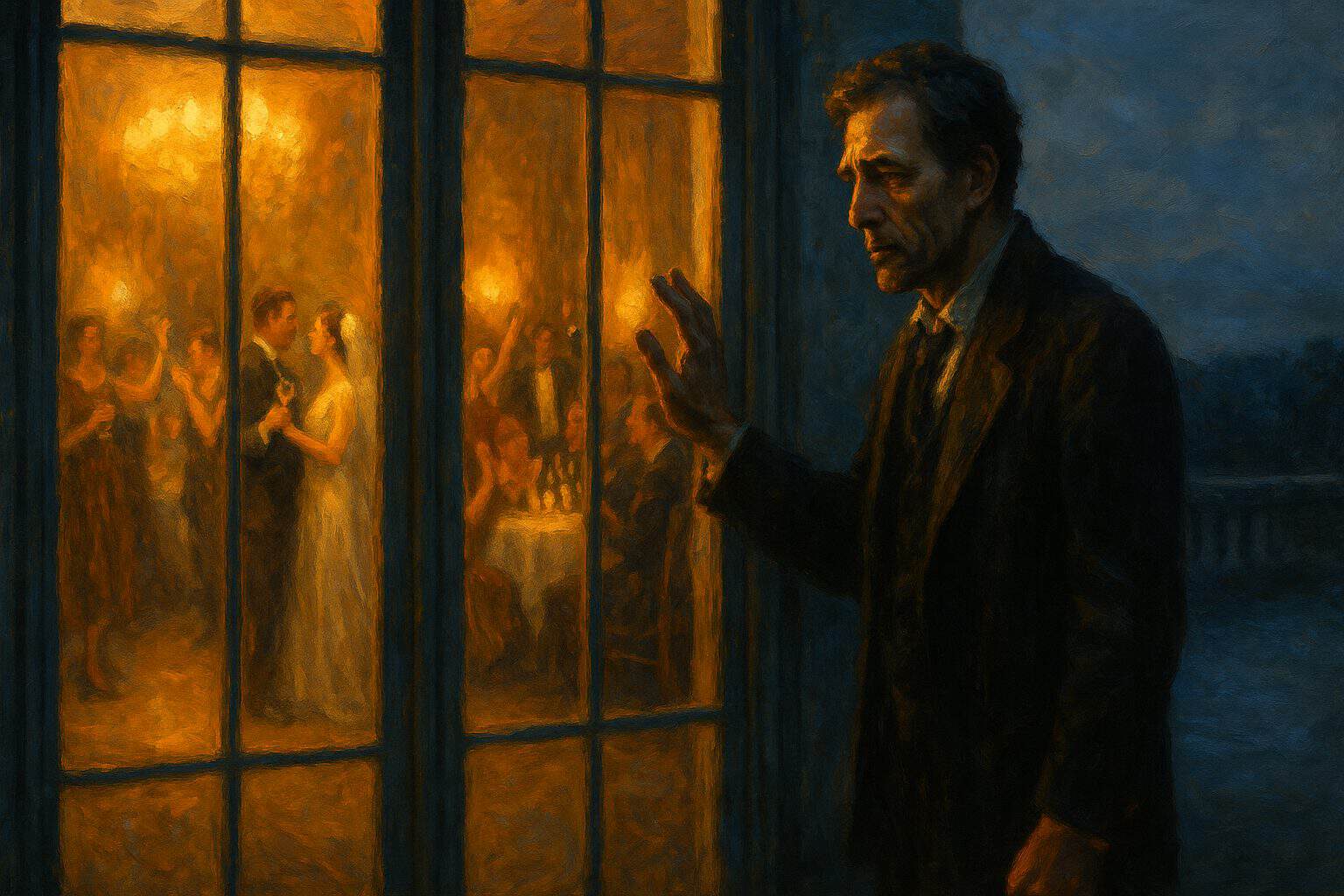
The horizon line where earth meets sky teaches us how distance creates clarity.
There is a particular quality of seeing that emerges when one stands at remove from the world—not the remove of indifference, but the charged distance of one who has been inside and now stands outside, who knows the warmth of the hearth precisely through its absence. This is the observer’s exile: to see with the clarity that only separation brings, to understand the dance because one no longer dances, to comprehend love’s architecture through the ache of its withdrawal.
The Geometry of Distance
The phenomenon announces itself first in small moments. You find yourself at a gathering, perhaps a wedding reception or holiday dinner, and suddenly you are watching the scene as if from behind glass. The laughter reaches you, but does not include you. The conversations swirl in their familiar patterns—work complaints, relationship updates, shared memories—while you stand at the edge of the circle, collecting observations like one collecting affections like one interrupts their walk to bend down and pick up loose change on the ground. Each gesture, each inflection, each unconscious habit of connection becomes visible precisely because you are no longer woven into the fabric.
This is not mere alienation. The observer’s exile carries within it a peculiar lucidity. From this vantage, you see how the couple arguing in hushed tones will reconcile before dessert arrives, their conflict following a script they’ve performed countless times. You notice how the lonely widow brightens when anyone mentions her late husband’s name, how she leans into the conversation like a plant toward light. You perceive the invisible threads of need and satisfaction, wound and compensation, that hold the gathering together—threads invisible to those caught within them.
Augustine knew this terrain, this restlessness that places one simultaneously within and beyond the human circle. The soul discovers itself as created for relationship yet perpetually missing the mark, overshooting or undershooting the target of genuine communion. But in that very missing, in that constitutive distance, something else becomes possible: a seeing that those fully immersed cannot achieve.
The Privilege of the Periphery
“Treasured are you who seek to see the world as I once saw it, to stand where I once stood, so that mine is the wisdom you inherit”—these words carry the particular authority of one who has earned their distance through experience rather than choosing it as mere stance. The observer’s exile is not the philosopher’s detachment or the scientist’s objectivity. It emerges from having been scorched by proximity, from having loved and lost, believed and doubted, reached and been refused.
Consider how this positioning manifests in the simplest interactions. A friend describes their new romance with breathless enthusiasm, and you listen with genuine care while simultaneously perceiving the patterns they cannot see: the way they edit the story to preserve its shimmer, the small compromises they frame as choices, the red flags they transform into quirks. You see because you have been where they are. You stood in that same intoxication, felt that same certainty that this time would be different. Now, from your position on the far bank, you watch them wade into waters whose currents you know by heart.
This is not cynicism—or need not be. The observer’s exile can harden into bitterness, that confidence in loneliness and pride in solitude that walls one off from the possibility of surprise. But it can also ripen into something more generous: a compassionate clarity that holds space for others’ illusions while seeing through them, that honors the necessity of certain mistakes while recognizing them as mistakes.
The Architecture of Watching
The lived structure of observation-from-exile reveals itself through specific configurations of space and time. There is the physical positioning—always slightly apart, choosing the seat at the edge of the gathering, standing by the window at parties, walking the perimeter rather than plunging into the center. But more fundamentally, there is a temporal displacement, a sense of living in a different rhythm from those around you.
While others move through sequential presents—this conversation leading to that plan, this week flowing into next—you inhabit a kind of eternal perspective where past, present, and future collapse into pattern. You see the end in the beginning, recognize in today’s enthusiasm tomorrow’s disappointment, perceive in current conflicts the seeds of future reconciliation or final rupture. This is the burden and gift of having seen for myself how people move through their cycles, repeat their patterns, live out their destinies while believing themselves to be choosing freely.
Frank Buckley speaks of the tension between at-homeness and the traveler condition, that joyful struggle of coming-together within the tension of openness. But the observer’s exile inverts this dynamic. Home becomes the distance itself, the gap between self and world becomes the dwelling place. You are most yourself not in moments of connection but in moments of watching connection happen to others, understanding it from outside its spell.
The Erotics of Distance
“What Lilith had used to damage me, Jeannètte now used to heal me. If Lilith made it possible for me to hate, Jeannètte made it possible for me to love.”
The observer’s exile takes on particular poignancy in the realm of romantic love. Having been inside love’s consuming fire—having known both its ecstasy and its devastation—one emerges with a changed capacity for perception. You recognize love’s approach in others before they do: the subtle shift in attention when a certain name is mentioned, the unconscious mirroring of gestures, the way someone begins to glow from within when their beloved enters the room.
But this recognition comes paired with distance. You see love’s patterns so clearly precisely because you no longer fully believe in love’s promises. You understand that what presents itself as unique destiny is often compelled to bind themselves to the other’s presence, that what feels like free choice emerges from ancient patterns of need and wound. The lover’s conviction that their beloved is irreplaceable becomes visible as a beautiful and necessary illusion—necessary for love’s work, illusory in its claim to uniqueness.
Yet this does not diminish love’s reality. If anything, seeing love from exile intensifies one’s appreciation for its courage. To watch others fall in love, knowing what you know about love’s likely trajectory, about the inevitable end that awaits most unions, and to see them leap anyway—this evokes a tenderness that perhaps only the exile can fully feel. They are brave in a way you no longer can be, innocent in a way you no longer are.
The Sacred Distance
The observer’s exile extends into the spiritual realm with particular acuity. Having loved God, yet pushed Him away, having stood in the tension between devotion and doubt, one develops a peculiar sight for the sacred. You recognize authentic spiritual hunger in others—the way it manifests as restlessness, as a searching that doesn’t know its object, as a dissatisfaction with satisfactions. You see how some use God as comfort while others wrestle with God as wound. You perceive the difference between faith as inheritance and faith as choice, between belief that has never been tested and belief that has survived its own destruction.
From exile, you observe how others navigate their spiritual lives: some holding onto hope for the future that He would transform their human loves into divine devotion, others using the divine as escape from the human, still others trying to balance the two in careful proportion. You see the patterns of conversion and deconversion, the cycles of fervor and cooling, the way crisis either deepens or destroys faith. All this becomes visible from your position on the periphery, neither fully within nor fully without the circle of belief.
C.S. Lewis understood this position, this capacity to see the transposition between lower and higher orders of reality. From the exile of his own losses—mother, wife, faith itself at times—he developed that peculiar clarity about how natural loves point toward Divine Charity, how myth gestures toward fact. The observer’s exile becomes a hermeneutical position, a place from which the grammar of transcendence becomes readable precisely through its absence.
The Communion of Exiles
There exists a strange fellowship among those who inhabit this distance. You recognize each other at gatherings—the ones standing at similar removes, watching with similar clarity. Sometimes your eyes meet across a room full of easy laughter, and in that glance passes an entire conversation: Yes, I see it too. Yes, I stand where you stand. Yes, I know the cost of this clarity.
These moments of recognition rarely develop into friendship in the conventional sense. The observer’s exile tends to be solitary by nature; two people maintaining careful distance from the world rarely bridge the distance between themselves. But there is comfort in knowing others occupy similar outposts, that the far bank has its own population, even if that population remains dispersed.
Sometimes one exile will speak to another through written words, leaving testimony of what the distance reveals. “Secret. I have gone through life without most people knowing this about me…”—such confessions create a tradition, a wisdom literature of the periphery. Each exile’s account becomes a map for others who find themselves suddenly standing outside the warm circle, wondering if their distance is curse or calling.
The Ethics of Seeing
The observer’s exile carries moral weight. To see others’ patterns, illusions, and unconscious motivations creates responsibility. Do you warn the friend whose new love bears all the marks of their previous disasters? Do you name the patterns you see repeating, the endings you can predict? Or do you honor the necessity of each person’s journey, knowing that some truths can only be learned through experience, not testimony?
This ethical dimension intensifies when others sense your sight and seek it out. They come to you precisely because you stand at remove, because your exile grants you perspective they cannot achieve from within their situation. They ask you to read their lives, to name what they already half-know but cannot fully admit. In these moments, the observer’s exile becomes a kind of service, a priestly function of seeing and carefully speaking what is seen.
Viktor Frankl would recognize in this the tension between what one is and what one ought to become, that noo-dynamic field where meaning emerges. The observer’s exile is not merely a position but a task, a way of being that serves the human community precisely through its distance from it. The one who sees from the far bank holds memory for those who forget in the rush of living, maintains perspective for those who lose themselves in immediacy.
The Return That Never Arrives
Perhaps the most poignant aspect of the observer’s exile is the persistent sense that it might be temporary. You tell yourself you are gathering strength for return, that this distance is preparation for a deeper engagement. You imagine the day when you will step back into the dance, armed with all you’ve learned from watching. You will love better for having seen love’s patterns, connect more truly for having understood connection’s grammar.
But the return never quite comes—or rather, it comes only in partial, unsatisfying ways. You attempt re-entry and find yourself automatically resuming your post at the periphery. Even in moments of genuine connection, part of you remains watching, analyzing, seeing the machinery beneath the magic. The exile has become not just your position but your nature. You have developed eyes that cannot stop seeing, a consciousness that cannot fully dissolve into unconscious participation.
This is neither tragedy nor triumph but simply the shape your life has taken. Some are called to dance, others to watch the dance and understand its movements. Some live fully within human warmth, others maintain the cold clarity that comes from standing where warmth doesn’t reach. Both are necessary. The dancers need the witnesses, and the witnesses need the dancers. The world requires both those who leap without looking and those who see where the leap leads.
The Wisdom of Distance
In the end, the observer’s exile reveals itself as a particular mode of being human, neither superior nor inferior to other modes but carrying its own dignity and purpose. It is the position of the anthropologist who studies their own species, the novelist who reads human nature like text, the spiritual director who sees souls’ movements from outside their turbulence. It is Augustine in his study, writing Confessions to a God whose presence he knows through absence. It is every person who has loved deeply enough to be wounded and emerged with eyes that see differently.
The wisdom of this position is not the wisdom of answers but of questions, not of solutions but of recognition. From the far bank, you see the human comedy and tragedy playing out in its eternal patterns while never losing sight of the genuine suffering and joy within those patterns. You hold space for both the illusion and the reality, the pattern and the particular, the eternal return and the unrepeatable moment.
“Each time I obeyed, however, trying to stand apart from the world as commanded… the response felt akin to being given stones when asking for bread”
Yet even in this seemingly barren position, something nourishing emerges. The bread comes not as expected sustenance but as the severe grace of clarity. The stones become building materials for an observatory, a watchtower from which the whole human landscape becomes visible. The observer’s exile transforms from deprivation into vocation, from loss into a particular kind of finding.
The horizon line where earth meets sky—that edge where you stand—teaches its own lessons. It shows how distance creates perspective, how separation enables sight, how exile can become home. Not everyone is called to this position; most are meant to live fully within the human circle, to dance without watching themselves dance. But for those who find themselves on the far bank, who discover they cannot return to unconscious participation, there is strange comfort in knowing this too is a way of being human. This too is a form of love—perhaps the most difficult form, the love that sees clearly and loves anyway, that knows the ending and honors the story, that stands apart in order to bear witness.
The observer’s exile: neither chosen nor imposed but emerged, like consciousness itself, from the collision between innocence and experience, between the hunger for connection and the knowledge of connection’s limits. It is the human position par excellence—to be the being who watches being, who stands both inside and outside life, who alone among creatures can see existence from the far bank while still living within its flow.