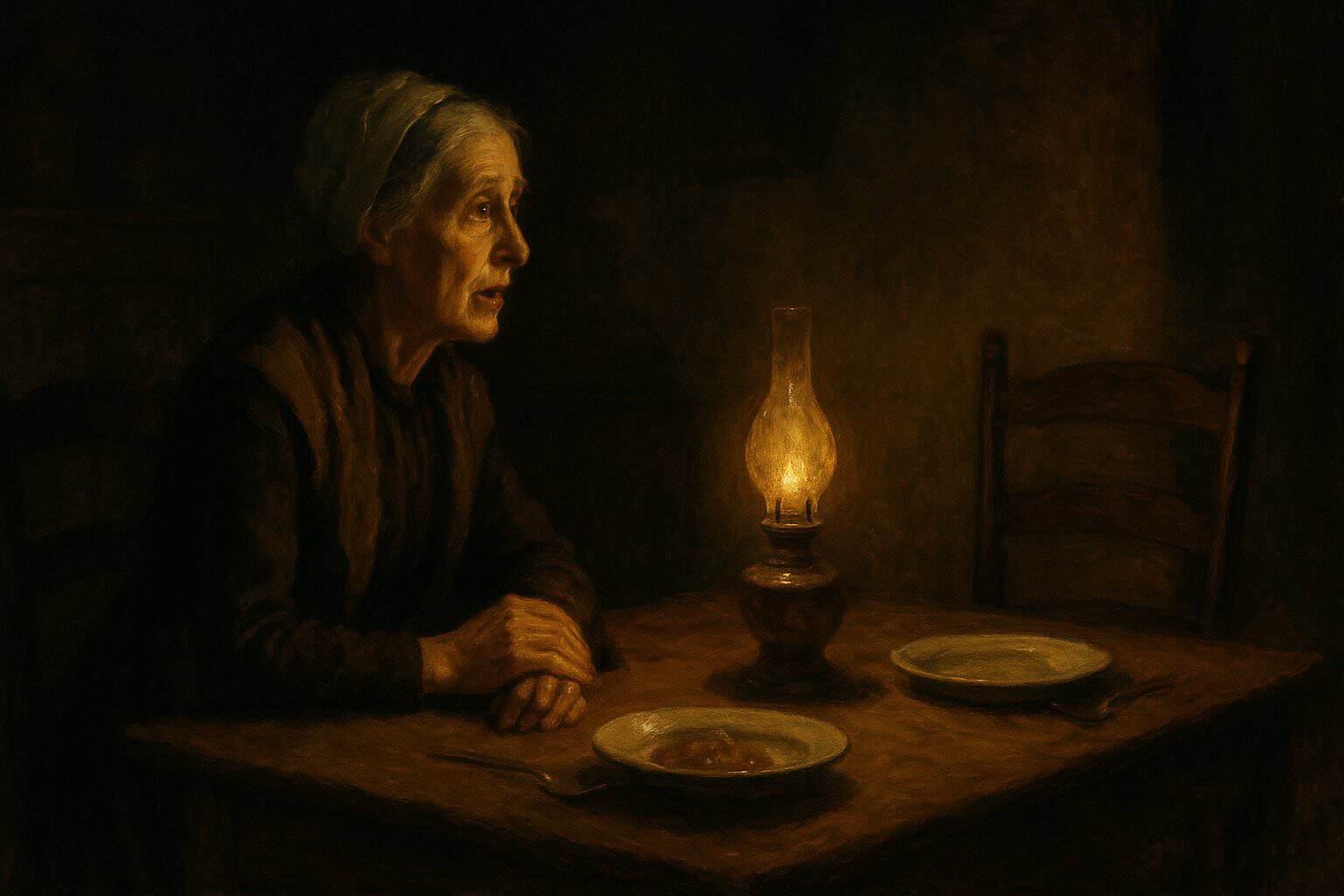
Where absence speaks louder than presence ever could
The Chair That Holds Nothing
The empty chair does not merely lack an occupant. It holds absence—actively, insistently, with a weight that presses against the chest. In Anthony Adore’s memoirs, this holding reveals itself through the terrible clarity of silence: “Her lack of a response was the response I needed to hear to confirm my decision to sever ties with her in my heart.” The chair does not wait. It testifies.
Walk into any room where grief lives and you will find it—that particular chair, that specific emptiness that is not mere vacancy but presence-in-negative. The cushion still bears the impression of a body that no longer comes. The armrests remember hands that will not return. Even dust settles differently here, as if the air itself knows this is not ordinary space but a wound in the geometry of the room.
The phenomenology of the empty chair begins not with absence but with address. We speak toward it before we notice we are speaking. We glance at it while telling a story, expecting the familiar nod, the knowing smile. The body turns toward it in conversation before consciousness catches up—muscle memory outlasting the conditions that created it. This is not metaphor but lived reality: the empty chair draws speech from us, pulls words into its vacuum.
The Weight of Withheld Words
“Holding a conversation, an exchange, while on top of her required as much effort as standing in front of her. It was like pulling teeth.” Adore’s description captures the exhaustion particular to forced dialogue—when presence itself becomes labor. But the empty chair presents the inverse burden: here, all words flow too easily because no resistance meets them. No one interrupts. No one misunderstands. No one looks away.
The grief-stricken find themselves conducting entire conversations with absence. Not in madness but in the momentum of relationship that outlives its object. Sentences form in the throat, shaped for a particular ear that no longer listens. These are not the same words we would speak to others—they carry a frequency tuned to one receiver only, now broadcasting into void.
“Superficial conversation is such a waste of time… Until that which was within me found peace, idle talk was merely a distraction…”
The empty chair strips all superficiality from speech. One cannot make small talk with absence. Every word spoken toward that emptiness carries the full weight of what remains unsaid, unsayable. The weather, the news, the thousand trivial updates that oil daily exchange—all of these die at the threshold of the empty chair. Only essential speech remains, and sometimes even that fails.
The Demand for Articulation
“‘I don’t know’ is not an acceptable answer as it implies agency without intellect. I require articulation throughout conversation.” This requirement, which Adore places at the center of authentic dialogue, becomes impossible before the empty chair. For grief’s central wound is precisely this: the thousand things we never articulated when articulation was still possible.
The empty chair holds all our “I don’t knows”—not as evasions but as genuine failures of language. How many times did we sit across from the now-absent one, feeling something rise in the chest that never quite reached words? The pressure of unexpressed tenderness. The weight of unspoken gratitude. The sharp edge of irritation we swallowed rather than spoke. All of these hover around the empty chair like atmospheric disturbance.
Merleau-Ponty understood that speech emerges from a pre-verbal realm where meaning gestates before finding form. The empty chair reveals this gestation chamber stripped bare—all the meanings that never completed their journey into words now circle endlessly, seeking a destination that no longer exists.
The Conversation That Continues
“Sentences become conversations and through multiple conversations, each begins to perceive and bond with the other.” This bonding does not cease with absence. The terrible discovery of grief is that relationship continues to unfold even when one party can no longer participate. We keep learning who they were. We keep discovering what they meant.
The empty chair becomes a site of ongoing revelation. Sitting before it, memories surface with new significance. That casual remark ten years ago suddenly reveals its depth. That recurring gesture now shows its meaning. The absent one keeps teaching us, keeps showing us who they were, but now through the brutal clarity that only absence provides.
This is not sentimentality but phenomenological fact: consciousness continues to constitute the other even in their absence. The noema—the object as intended by consciousness—persists beyond the physical presence that originally anchored it. We keep building the absent one in awareness, keep discovering facets that were always there but needed this terrible distance to become visible.
The Voices That Drown
“They might say, ‘God does not hear you. God does not love you. God cannot save you’ as they attempt to drown you in depression and hopelessness.” The empty chair amplifies these voices. In its silence, every doubt finds space to expand. The absence becomes accusation: You were not enough. You did not love enough. You did not arrive in time.
Grief is not simply sorrow but trial. The empty chair serves as both witness stand and judge’s bench. We prosecute ourselves before it, presenting evidence of our failures, our inadequacies, our thousand small betrayals. And the silence that meets these confessions feels like confirmation—until we realize that silence is not judgment but simply silence.
The phenomenology of grief reveals this crucial turn: the moment when we stop interpreting absence as response. The empty chair neither condemns nor absolves. It simply holds space where presence once was, and in that holding, allows us to discover what remains when dialogue becomes monologue.
The Divine Silence
“Some kind of human movement toward the divine always occurs first and that the divine’s response always occurs second, even if that response is silence.” Adore’s insight into divine encounter illuminates the empty chair’s deepest teaching. For grief schools us in reading silence—not as absence of response but as response itself.
The empty chair becomes altar. Not in the sense of worship but in the older meaning: a place of sacrifice, where something is offered up and transformed. We bring our words, our tears, our rage, our love—all of it laid before absence like offerings before mystery. And sometimes, in that offering, something shifts.
“Faith is something that cannot be proven; it is something that either one has or one does not have.”
The faith that emerges around the empty chair is not belief in return—the absent will not suddenly fill their seat again. Rather, it is faith that the conversation continues in registers we cannot fully hear, that love persists beyond the conditions of its expression, that absence itself is a form of presence we are only beginning to learn to read.
The Baseline of Absence
“Established a baseline for detecting subtle shifts in their tone or content. This allowed for concerned inquiries like, ‘What’s wrong?'” In life, we become exquisitely attuned to those we love—every microshift in mood, every slight variation in pattern. The empty chair teaches us to establish a new baseline: the constancy of absence against which life continues to move.
This is grief’s strangest gift: we become connoisseurs of absence, able to detect its qualities, its variations, its moods. Some days the empty chair feels heavier. Some days it almost disappears. Some days it seems to pulse with presence-just-departed, as if they have only stepped out for a moment.
The phenomenology here is precise: absence is not uniform but textured, not static but dynamic. The empty chair is not the same empty chair each day. It ages. It accumulates meaning. It becomes denser with memory even as it remains physically vacant.
The Unwinnable Scenario
“This was my Kobayashi Maru—the unwinnable scenario. If I remained silent, Angela’s narrative would win. If I spoke, I would hand Jane the very tools to crucify me.” The empty chair presents its own Kobayashi Maru: speak and face the futility of addressing absence; remain silent and betray the relationship that still lives in memory.
There is no winning with grief, no strategy that resolves its contradictions. The empty chair demands impossible things: that we let go while holding on, that we accept absence while maintaining presence, that we stop waiting while never stopping our vigil.
Yet perhaps this impossibility is precisely the point. The empty chair teaches us to live in paradox without resolution. It schools us in a more complex form of existence where presence and absence interweave, where silence speaks and speech falls silent, where the conversation continues long after words have ended.
The Chair That Remains
The empty chair will not be filled. This is grief’s first and final teaching. No substitute will fit its specific emptiness. No replacement will match its particular absence. It remains in the room like a fact that cannot be argued with, a reality that reshapes all other realities around it.
And yet life continues its conversation with this absence. New words form, addressed now to emptiness but somehow still finding their way. New silences emerge, pregnant with meanings that only absence can deliver. The empty chair becomes teacher, teaching us depths of dialogue we never knew existed when speech still met response.
In Adore’s phenomenology of encounter, every genuine meeting requires this willingness to be transformed by the other. The empty chair accomplishes this transformation through its very emptiness—we are changed not by what it says but by what it cannot say, not by its presence but by the presence its absence makes possible.
The grief at the empty chair is not ultimately about loss but about discovery—the terrible and beautiful discovery that love exceeds its conditions, that relationship outlasts its participants, that the conversation continues in registers we are only beginning to learn to hear. The chair remains empty, but we are filled with what its emptiness teaches: that absence, fully entered, becomes its own form of presence, and silence, fully heard, speaks volumes.