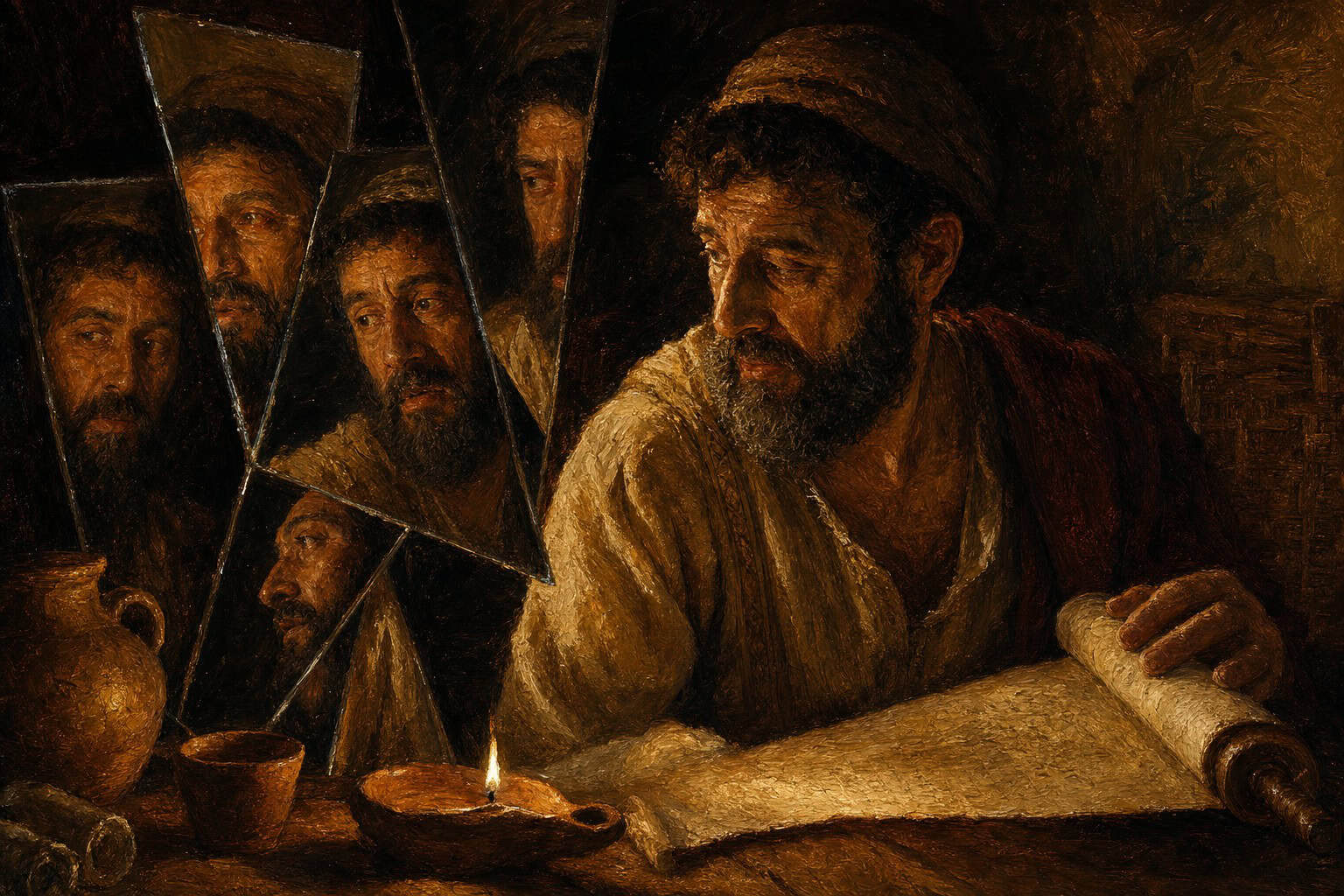
Dating as a Christian in a world of curated selves and denied signals. What honesty and vulnerability really cost, read through Fractions of the Soul.
The Message That Arrives After Midnight
A phone lights the ceiling at an hour when honest things sleep. You feel the buzz against the nightstand before you reach for it, and your thumb already knows the shape of what waits. The note is warm, a little too warm, folded inside the soft cloth of friendship, and you read it twice trying to decide whether you invented the second meaning humming under the first. Your chest tightens in a way you would not admit out loud. This is where so many of us actually begin the question of dating as a Christian—not in a chapel, not across a small table with hands clasped and coffee going cold, but here, in the gray glow of a screen, reading someone who is careful never to say the thing she plainly means. In Fractions of the Soul, the second chapter walks straight into this country. A woman keeps an old connection alive under the cover of the word friend, tending it quietly in the dark while she shares a bed with another man. The narrator does not shout about it. He watches, and his watching carries the ache of a man who has learned this exact pattern from the inside of his own life. He traces how she maintains the contact, how she keeps the past pressed close to her heart across the years, how she takes pains never to let the two worlds touch. Two separate lives run side by side, each sealed off, each kept unaware of the other by design and by will. What unsettles here is not lust, which we half expect and could almost forgive. It is the discipline of it. It is how much steady labor goes into meaning nothing while doing everything, into keeping the true motive from ever being cross-examined in the plain court of ordinary explanation. The scene names the smallest particulars—a private conversation, an innocent check-in, an old lover now quietly refiled under the word acquaintance—and shows how each becomes a small hinge that swings open without ever looking loose. If you are trying to date as a person who wants to belong to God, this fog is the terrain you actually walk. Not open sin, which you could at least confront and name and repent. A haze instead, where every signal can be denied and no one is ever caught holding responsibility. The mood of the chapter is precisely that fog. You feel thrown down into it, breathing it, groping for an edge that keeps receding. And the first honest question the narrator lays on you is soft and terrible at the same time: have you ever been the one composing the careful message, or the one lying awake in the dark, believing it meant only what it said?
The Woman Made of Many Women
She does not lie the way a child lies, in one clumsy blurted sentence with the truth already leaking out the edges. She builds. The chapter describes something like a nest of hidden selves, each one shaped for a single man, each kept from knowing the others breathe in the same body. There is a self for the current partner and a self held warm for the old flame across the distance. There is a self ready to unfold for the trainer, the coworker, the teacher, the coach, the physician, the youth minister, the acquaintance whose glance begins to linger a beat too long—each given his own separate version of her, none of them ever permitted to sit in the same room. The narrator sees the whole machine and names the rule that runs it: these selves do not mingle, and they feel no strain standing inside their own contradiction. That is the quiet horror hiding under such ordinary domestic words. A person can now become nobody by being everybody at once, everywhere, all the time. The tool that promised to connect her has instead become the perfect house for her slow disappearance. And here the older, wounded voice of the book turns the lens on himself, because he is not innocent of admiration for the craft. He understands the pull of never being pinned to one thing. To be whole would mean holding all her longings in one open hand and confessing that she cannot bear their weight together. So she divides herself instead, and quietly renames the division safety. For a Christian reading this in the middle of trying to date, the warning comes from both sides of the mirror. You may be courting a woman who has arranged her whole life so that no single man can ever hold the entire truth of her. Or you may be running the same disciplined madness yourself—keeping one spare self in reserve, a fallback affection tucked away and filed under harmless. The chapter refuses to let you stand above her and judge. Its lens is a strange, disarming tenderness, a care for the frightened creature under all this machinery. She learned to fracture because being seen entire, just once, cost her more than she could pay. That does not soften the harm she scatters through other lives. But it changes how you look at her, and, harder still, how you look at your own locked compartments. The soul was made to be one thing before God, undivided, able to stand in the light and say here I am without flinching. Every secret self is a small, deliberate refusal of that single trembling word. And the narrator, watching her raise her many quiet houses, is counting under his breath how many he once built and furnished for himself.
The Burden She Sets Down on His Shoulders
Then the turn comes, and it does not arrive loud. It is a law of motion she obeys so smoothly she never has to say it aloud. She will not pursue. She will never once step toward the man she wants in any way that could be pointed at later and named plainly as wanting. Instead she arranges the room. She makes herself available to be alone with the men she likes—a private lesson, a quiet meeting, a conversation that just happens to run long past its reason—and she invents small graceful excuses to be never alone with the men she does not. She sets the stage, lowers the light, leaves the space open and inviting, and then she waits to be chased across it. The entire weight of the choice, the whole written record of who decided what, gets slid soundlessly across the table and set down on his shoulders. If it goes wrong, it was his advance, his hunger, his fault to carry home. She keeps her hands clean by keeping them still. The narrator sees straight through the performance to its cold, deliberate center: this is not surrender at all, and it was never meant to be. It is command wearing the borrowed costume of yielding. She has already decided, in private, to give the very thing she pretends he must struggle and earn to win. She asks only one thing of him in return—that he believe the whole idea was his own. The one who hunts has learned to sit perfectly still and wear the trembling stillness of the hunted, right up to the chosen moment of revelation.
Love cannot be built on a person who has arranged never to be caught being herself.
What the Denial Costs the One Who Waits
Live inside that arrangement long enough and something in you begins to erode without your noticing the first crumbling. You wait for a word that is engineered never to come. You read her availability as a gift when it is a trap dressed up as a gift, and you thank her for the space she left open only so that you would be the one caught standing in it. The narrator knows this erosion in his own bones, and he does not narrate it from a safe height. He was, at times, the man carrying the whole burden of a choice that two people made together. He was also, he suspects, the one who once arranged his own rooms and dimmed his own lights and let another soul believe the hunger began with them. That doubling is the true fallout of the scene. Nothing here stays cleanly on one side of the table. When two people meet inside this fog, the harm runs in both directions, and each can convince themselves they were only responding, only reacting, never initiating, never accountable. The genuine meeting of two persons—the kind where a real relationship becomes possible—requires someone standing outside you, exterior and irreversible, someone you cannot simply fold into your own reactions and manage. But the game the chapter describes destroys exactly that. It turns the other into a mirror that reflects back only what you already decided to see. There is no one truly across from you; there is only your own desire, bounced off a surface arranged to send it home. And so the loneliness that everyone in the scene is fleeing only deepens under all the contact. The check-ins multiply. The private conversations pile up. The body lies in a bed that is warm and populated and still somehow empty. This is the ache the narrator will not let himself dodge, even as he confesses his own hand in building it. He asks, and cannot answer cleanly, whether he ever wanted a real person at all, or only the safe reflection of his own wanting sent back to him under cover of night.
The Single Undivided Yes You Are Afraid to Say
Where the chapter finally settles is not in a rule you can post on a wall or a five-step plan for holy courtship. It settles somewhere quieter and far more costly. To date as a Christian, the book keeps pressing, is not first about screening the other person for these fractures, though you will learn to see them. It is about whether you yourself can bear to be one person—seen whole, without a spare self kept warm in the back room, without a signal you can deny in the morning light. The narrator does not hand you comfort here. He does not tell you the fog lifts if you pray hard enough or choose well enough. What he offers instead is stranger and more durable: the sense that God is already down in the fog with you, present in the gray light of that midnight screen, walking beside the man who composed the careful lie and the woman who built her many houses, not standing above them waiting for them to climb out. Grace, in these pages, rarely arrives as a rescue that snatches you clean of the dark. It arrives as company inside it—a nearness that does not flinch at your compartments, that knows every hidden self by name and keeps sitting with you anyway. That kind of love terrifies precisely because it cannot be managed or denied or slid across a table. It asks for the undivided yes, the one word the fractured soul most fears to speak. And it can only grow, the book quietly insists, where there is also room to doubt, to fail, to fracture and be gathered back. You close the chapter not with an answer but with a raw and specific ache—the ache of a man who saw all this clearly and still cannot fully recover the self he was before the wounds taught him to divide. That ache is why you keep reading. Fractions of the Soul does not promise you a clean love. It promises to sit with you in the honest mess of wanting one, and to ask you, gently and without letting you off, whether you are ready to stop performing long enough to be found.