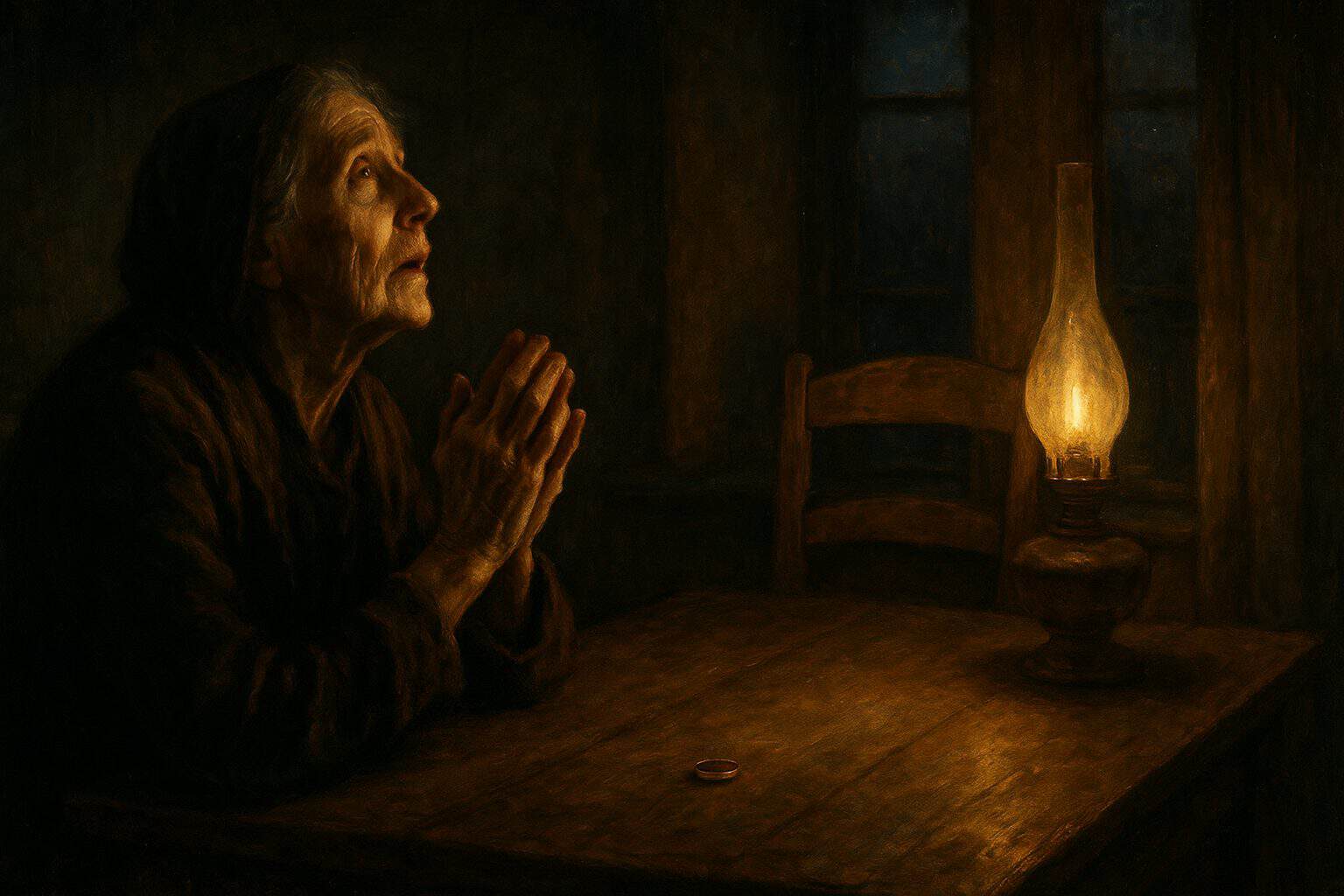
The presence that speaks most eloquently through absence, where God’s withdrawal becomes the space of our deepest encounter.
The Empty Chair
The chair sits across from Anthony, always occupied yet perpetually vacant. Not a physical chair—though sometimes it manifests as one—but a space carved out by address itself, by the movement of speaking toward. “The ‘you’ I address is not a single person,” he writes, “the occupants of the ’empty chair’ constantly shift… And always, God sits in the empty chair.”
This shifting occupancy reveals something essential about divine silence: it does not announce itself as mere absence but as a peculiar form of presence that withdraws even as it draws near. The chair remains empty precisely so it can be filled—by Jeannètte, by the reader, by God—yet this filling never exhausts its emptiness. Like the hollow of a bell that makes resonance possible, the vacancy itself becomes generative.
When Anthony speaks to this empty chair, he performs an ancient gesture: the movement of prayer before it knows itself as prayer. The words go out into what seems like nothing, yet they are received. Not answered, necessarily—but received. The silence that meets them is not the dead silence of the void but the pregnant silence of listening, of a presence so attentive it need not speak.
The Roar of Absence
“I begged for a word and met only the throb of my pulse. I learned how loud silence can roar.”
In the memoir’s most harrowing passages, divine silence transforms from gentle withdrawal into something almost violent in its intensity. After that singular visitation—when God filled the empty chair not metaphorically but with a presence so palpable it reorganized Anthony’s entire world—the subsequent absence becomes unbearable. “I could not feel Him anymore; was it all a dream?” The question hangs in the text like a wound that won’t close.
“I learned that His silence is multifaceted. Sometimes it is hard grace that forces us to seek; other times it is sacred space He provides.”
This multifaceted quality reveals itself through lived experience rather than theological proposition. There is the silence of the beloved who has just left the room, their warmth still lingering in the air. There is the silence of the teacher who refuses to answer so the student might discover. There is the silence of the parent watching their child take first steps, holding back to create space for emergence. And there is the terrible silence after intimacy, when presence has been so total that its withdrawal feels like death.
Anthony’s body knows each of these silences differently. His pulse throbs against the absence. His tears fall “casting a melancholy veil through which I now viewed the world.” The silence carves channels in him, creating capacity for future presence through present emptiness.
The Ghost Behind the Eyes
Jeannètte appears first as absence made flesh: “She sat opposite me—not in a room, but as a ghost I could not exorcise, living behind my eyes.” This haunting precedes her physical presence, as if absence were her primary mode of being, and presence merely a temporary crystallization of that more fundamental void.
Even when physically present, she maintains this quality of withdrawal. “She manufactured distance through long absences, leaving me to wake up in an empty bed.” The bed, like the chair, becomes a site where presence and absence perform their ancient dance. The warmth dissipates but the impression remains—that hollow in the mattress that remembers a body, that scent on the pillow that evokes what is no longer there.
“I looked at her—this stranger I had intimacy with but no connection to—and felt a loneliness more profound than if I had slept alone.” Here divine silence finds its human echo. Jeannètte becomes the empty chair made flesh, the presence that is most absent when most present. Through her, Anthony learns the grammar of divine withdrawal—how God might be closest precisely when He seems furthest away.
The Idol That Breaks
“The Idol of Solitude broke when I finally realized the silence I fled to was, in fact, the one Presence I had been seeking all along.”
The phenomenology of this breaking deserves careful attention. Anthony does not say he broke the idol; rather, the idol broke, as if it carried within itself the seeds of its own undoing. The solitude he had cultivated as refuge reveals itself as disguised seeking. What he took for escape was actually approach.
This recognition comes not through reasoning but through a shift in the phenomenon itself. The same silence that had seemed empty suddenly shows itself as full. Nothing changes except everything. The Stimmung—that fundamental attunement Heidegger describes—undergoes a transformation so complete that the previous way of experiencing becomes almost unintelligible.
“Finitude begins and ends with solitude. We are born alone. We die alone. During the time in between, we either embrace solitude and loneliness or we run…” Yet this existential solitude, which Kierkegaard knew as the single one before God, becomes the very medium through which divine presence communicates itself. Not despite the aloneness but through it, as it, the divine makes itself known.
The Movement and the Response
“Some kind of human movement toward the divine always occurs first and that the divine’s response always occurs second, even if that response is silence.”
This temporal structure—movement first, response second—shapes every encounter in the memoirs. Anthony reaches, speaks, seeks, and then waits. The waiting is not passive but a particular kind of activity, a holding-open of space for what might come. Sometimes what comes is silence, but even this silence arrives as response, as the divine’s way of being present to the human approach.
The phenomenology here recalls Merleau-Ponty’s reversibility of touching and being touched. The hand that reaches out to touch discovers itself being touched by what it encounters. Similarly, the soul that reaches toward God discovers itself already held in a prior embrace. The silence is not empty space between call and response but the medium in which both occur, the element in which spiritual encounter becomes possible.
Not Seeing, At All, Anywhere
“She did not ignore us; she could not. She did not see us. At all. Anywhere.”
This description of Jeannètte’s mother opens another dimension of divine silence—the possibility that what we experience as God’s silence might be something more radical than withdrawal or hiddenness. Perhaps there are moments when we simply do not register in the divine gaze, not through malice or neglect but through some incomprehensible elsewhere-ness of attention.
The terror of this possibility—that we might be calling out to a God whose attention is simply elsewhere—finds its human correlate in those moments when we realize we have been speaking to someone who hasn’t heard a word, whose consciousness has been occupied by completely other concerns. Yet even this terrible possibility gets transformed in Anthony’s account. “He was not fixing me; He was simply filling the empty chair. The loneliness I had carried since childhood, the chasm Jeannètte widened—God had claimed that void.”
The claiming of the void—this is perhaps divine silence’s deepest work. Not filling it with presence but claiming it as sacred space, as the hollow that makes resonance possible.
The Amplified Sadness
“One would expect that I would be happier after His visit, but I was not: my sadness amplified.”
This paradox—that divine encounter might increase rather than decrease our sadness—reveals something essential about how transcendence touches human life. The visitation doesn’t solve or resolve; it deepens. It makes us more capable of feeling what was always there. The sadness that amplifies is not new sadness but the sadness that was always present, now experienced without buffers or defensive numbness.
This amplification works like the silence after beautiful music—not empty but somehow fuller than what preceded it, charged with the memory of what has just been heard. The absence becomes articulate, shaped by what has touched it. Anthony’s tears after the divine visit are not tears of abandonment but tears of recognition—the soul’s way of acknowledging what it has always known but never before felt.
The Prediction of Not Being Understood
“Most of the time, my prediction of not being understood comes true. The evidence rests in your absence, dear observer.”
Here divine silence finds its textual manifestation. The reader who is not there, who has turned away, who has closed the book—their absence becomes part of the work’s meaning. The memoir addresses itself to an empty chair that is also the reader’s chair, the God’s chair, Jeannètte’s chair. All absences converge in this single vacant space that structures the entire work.
Yet the prediction of not being understood is not bitter but almost tender, as if Anthony has made peace with this particular form of silence. He continues to speak into it, to offer “walk with me a little further and consider what I have to say” to those who might not be listening. The gesture itself becomes the meaning—this continuing to speak into silence, this faith that the empty chair is mysteriously occupied even in its vacancy.
Pure Loneliness
“Adam’s loneliness was pure, without evil, and that it was something woven into the human soul by God.”
This primordial loneliness—before sin, before fall, before wound—suggests that divine silence might be constitutive rather than accidental to human being. We are created with an empty chair inside us, a space of address that precedes any particular addressee. The loneliness is not pathology but capacity, not wound but opening.
In this reading, Jeannètte doesn’t create Anthony’s loneliness; she reveals it, intensifies it, gives it shape and specificity. “The loneliness I had carried since childhood, the chasm Jeannètte widened—God had claimed that void.” The widening is necessary for the claiming. The human beloved prepares the space for divine inhabitation precisely through their failure to fill it.
The Passive Voice
“She will take on the role of passive recipient, the one to whom the action is done, not the one doing the action.”
This grammatical observation about Jeannètte opens unexpected depths. Divine silence often positions us in the passive voice—we are acted upon by absence, shaped by withdrawal, formed by what does not happen. We become recipients of nothing, which turns out to be a particular kind of something.
The passive voice is the voice of passion in its oldest sense—passio, suffering, being acted upon. In divine silence, we suffer presence through absence, undergo transformation through what doesn’t arrive. We are sculpted by the space around what is missing, like metal beaten into shape around an absent form.
The Opportunity of Vacancy
“Their absence returned me to solitude. But opportunity instead of loneliness filled their vacated space, occasioning visits from Carol, then Elizabeth.”
The memoir tracks these substitutions carefully—how one absence creates space for new presence, how departure becomes occasion for arrival. Yet these new presences never quite fill the space left by the old. They occupy it differently, leaving corners empty, creating new configurations of presence and absence.
This is divine silence’s pedagogy: teaching us through a series of incomplete presences that no human other can fill the God-shaped void. Each partial filling makes the ultimate emptiness more apparent, more articulate. We learn the shape of divine silence through all the ways human presence fails to abolish it.
The Multifaceted Silence
The divine silence that emerges through Fractions of the Soul and Confessions to the Empty Chair refuses reduction to a single phenomenon. It is withdrawal and presence, absence and plenitude, wound and grace. It roars and whispers, devastates and heals, empties and fills.
Most mysteriously, it speaks. Not through words but through the very structure of experience—through the way absence shapes presence, through the way emptiness creates capacity, through the way silence makes speech possible. The empty chair becomes the condition for all address, the withdrawal that enables approach, the absence that makes presence possible.
“Faith is something that cannot be proven; it is something that either one has or one does not have.” Yet divine silence seems to exist in the space before this either/or, in the realm where faith is still discovering itself, still learning its own nature through the presence that withdraws and the absence that accompanies. It is the space where “I could not feel Him anymore; was it all a dream?” coexists with “He was simply filling the empty chair,” where desolation and consolation reveal themselves as two faces of the same mysterious presence.
In the end, divine silence emerges not as God’s absence but as God’s most intimate way of being present—a presence so close it cannot be grasped, so interior it cannot be objectified, so fundamental it can only be lived. The empty chair remains empty so it can always be filled. The silence continues so the conversation never ends. The absence abides so presence can always arrive as gift, as surprise, as grace.