Where divine withdrawal becomes the space in which faith learns to breathe
The Theater of Absence
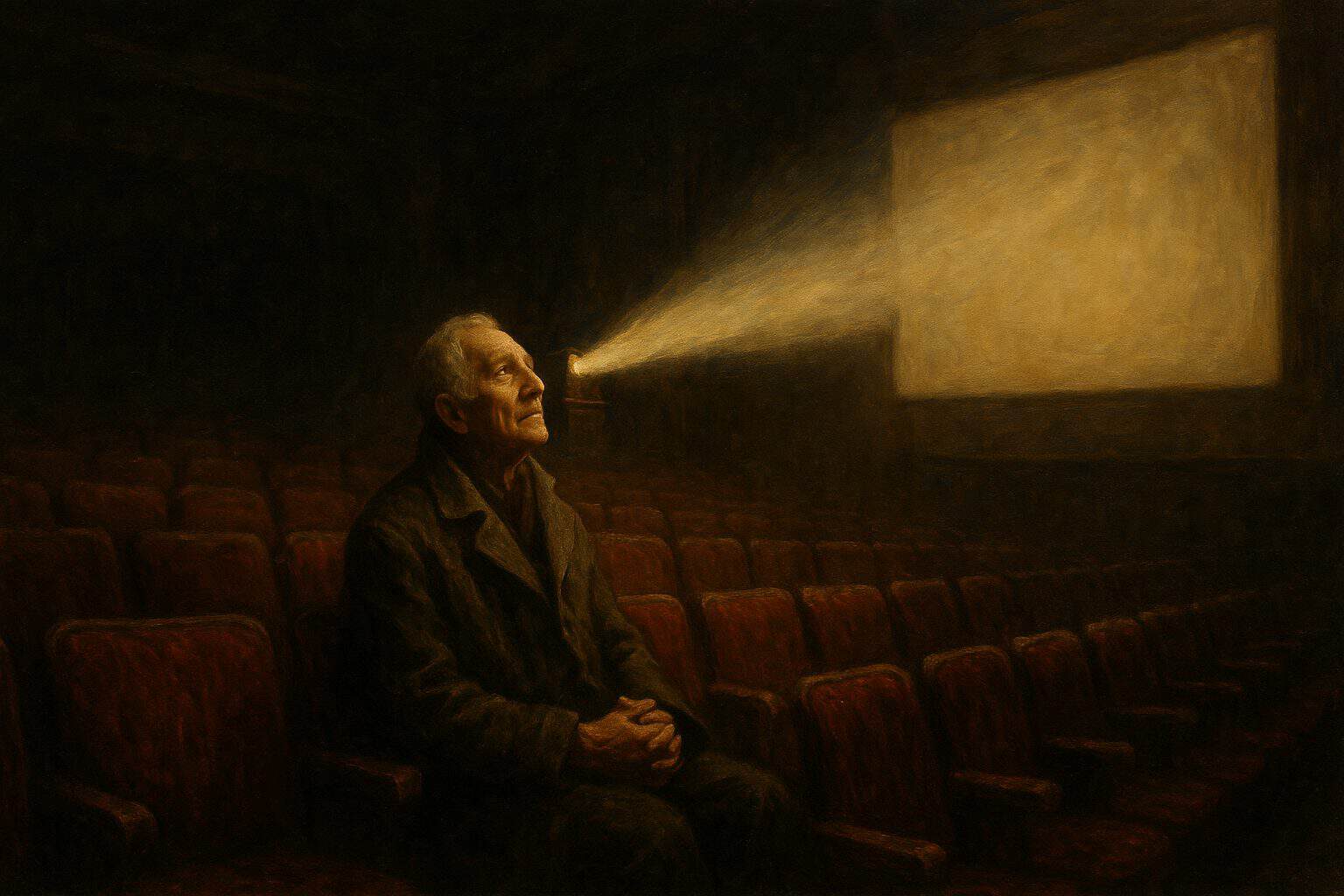
They become the book that no one will read, the song that no one will hear, and the film playing in an abandoned theater. This image from Fractions of the Soul gives itself first as melancholy—the artist’s fear of irrelevance, the lover’s dread of being forgotten. But stay with it longer, let it unfold in consciousness, and something else emerges: the peculiar dignity of performance without audience, of expression that requires no witness to complete itself.
The abandoned theater still is a theater. The film still plays, light still moves across the screen, images still unfold in their proper sequence. There is something here about hope that persists in divine silence—not hope despite the absence of response, but hope that discovers itself precisely in learning to continue without confirmation.
What He says and does in heaven is beyond the scope of our limited nature to perceive with clarity, therefore, we feel alone, small, and insignificant. The feeling arrives as a weight, a diminishment. Yet Adoré does not stop at the feeling. The silence is not empty; it is full of activity we cannot perceive. The theater is not truly abandoned—we simply cannot see who fills the seats.
The Multifaceted Silence
I learned that His silence is multifaceted. Sometimes it is hard grace that forces us to seek; other times it is sacred space He provides.
The silence gives itself differently in different moments. Sometimes it presses, sometimes it opens. Sometimes it arrives as wall, sometimes as invitation. The phenomenology here is delicate—the same absence can be experienced as abandonment or as gift, depending on how consciousness meets it.
Consider how silence works between lovers. She manufactured distance through long absences, leaving him to wake in an empty bed. The manufactured distance is one kind of silence—strategic, wounding, a withdrawal that speaks rejection. But there is another silence between souls who have learned to be together: the comfortable quiet of presence that needs no words, the pause between breaths that holds rather than separates.
Divine silence oscillates between these poles, or rather, consciousness experiences it now as one, now as the other. The “hard grace that forces us to seek”—here silence becomes productive, generative. It creates the space in which seeking becomes possible. Without the silence, there would be no search. Without the withdrawal, there would be no pursuit.
The Grammar of Consent
Consent is not a courtesy; it is how heaven moves. This truth from Confessions to the Empty Chair illuminates something essential about divine silence. Heaven does not impose; it invites. The silence is not indifference but a kind of supreme courtesy—God refusing to overwhelm, to coerce, to make belief mandatory through sheer presence.
The Kobayashi Maru—the unwinnable scenario—appears in Adoré’s work as the double bind of speech and silence. If I remained silent, Angela’s narrative would win. If I spoke, I would hand Jane the very tools to crucify me. But transpose this to the theological register: God faces His own unwinnable scenario. Speak too clearly, and faith becomes mere acknowledgment of fact. Remain silent, and faith seems to wander in darkness.
The divine solution is the multifaceted silence—speech that comes slant, presence that withdraws to create room for freedom, revelation that hides itself in ordinary things. Faith is something that cannot be proven; it is something that either one has or one does not have. The silence protects this essential structure of faith as faith—not knowledge, not proof, but the free movement of trust across an unbridgeable distance.
The Dead Who Do Not Care
Part of each person believes that death is unnatural and foreign to the Spirit; in one final act of rebellion against death, the living weep, feel defeated and impotent, and whisper prayers on behalf of the dead. The dead do not care, their work complete.
The dead do not care—not from indifference but from completion. They have entered fully into the silence that the living only taste in fragments. Their not-caring is not rejection but a kind of perfect rest, a silence that no longer needs to speak because it has said everything it came to say.
This is perhaps what divine silence also holds—a completeness that doesn’t need to keep explaining itself, a fullness that can afford to be quiet. The living interpret this silence as absence, as the book no one reads, the song no one hears. But perhaps it is simply that the dead—and God—have moved beyond the economy of recognition, beyond the need for their expression to be received in order to be real.
The Altar She Refuses to Tend
All that remains is for the man to acknowledge her absence and walk away from the altar she refuses to tend. The untended altar—what a precise image for hope persisting in divine silence. The altar remains even when the one who should tend it withdraws. The sacred space persists, waiting, holding its form despite abandonment.
But must he walk away? Or might there be another response—to tend the altar himself, to maintain the sacred space even in solitude? This is what hope does in divine silence: it continues the liturgy alone, it lights the candles no one will see, it speaks the prayers into the empty church.
Why did you wait so long to speak your passion to the grass and dirt when you had the opportunity to do so eye to eye, mouth to mouth, and chest to chest? The question haunts because it knows its own answer—we wait because we assume there will always be more time, another chance, a future conversation. Divine silence teaches us otherwise. It says: speak now, love now, give now. Not because God won’t hear you later, but because the silence itself is teaching you something about the preciousness of speech, the weight of words, the significance of saying what must be said.
Translation Through Flesh
Delight with me; translate your soul through flesh one more time. Our bond defies the cemetery’s silence in the valley of bones.
Here is hope’s ultimate gesture in divine silence—the refusal to accept silence as final. The call to “translate your soul through flesh one more time” is addressed to the absent, to the dead, to the God who seems not to answer. It is hope insisting that translation remains possible, that souls can still speak across the divide, that bonds persist despite the cemetery’s silence.
Ours is not to remain a disembodied soul in heaven but a reunited and purified body-soul in the New Jerusalem. The Christian hope is not escape from flesh but flesh transformed, not silence forever but speech renewed. The divine silence is temporary, pedagogical, a kind of epoché that brackets ordinary communication to make room for something else to emerge.
The valley of bones waits for the word that will make them live again. But first comes the silence, the long wait, the patience of bones learning to hope without evidence, to maintain their form in the dust, to remember what it was to dance even when dancing seems impossible.
The Shared End
Faced with this shared end, why then delay saying what must be said or doing what must be done? The question emerges from the confrontation with finitude, with the fact that we all become eventually the book no one will read. But this shared end is also shared beginning—we all emerge from and return to the same silence.
Divine silence teaches us that we are practicing for our own silence, learning how to be quiet, how to rest, how to trust that meaning persists even when no one is there to receive it. The film plays in the abandoned theater not because it hopes for an audience but because playing is what films do, because expression is its own completion, because beauty doesn’t need to be observed to be beautiful.
Hope in divine silence is not hope for the silence to end, though it includes that. It is hope that learns to live fully within the silence, to find in absence a strange kind of presence, to discover in withdrawal an invitation to deeper seeking. It is hope that tends the untended altar, that speaks love to grass and dirt, that translates soul through flesh one more time, even when—especially when—no answer comes.
The silence is multifaceted. Today it is hard grace. Tomorrow it might be sacred space. But always it is the medium through which heaven moves, respecting our freedom, refusing to overwhelm, waiting for the consent that alone makes love possible.