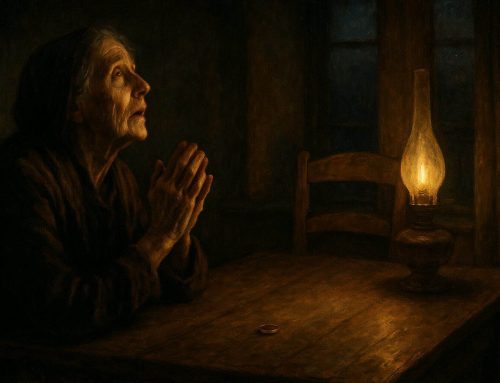
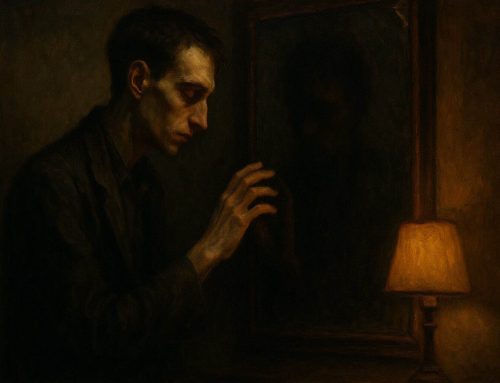
The phenomenologist’s first discipline: to render what appears as it appears, resisting the explanatory impulse that would dissolve the phenomenon into its causes.
The scalpel rests differently in the hand when wielded for description rather than dissection. This difference—between rendering what shows itself and accounting for why it appears—marks a fundamental threshold in how we approach the movements of consciousness, our own and others’. The observer who seeks to understand must first learn to see without explaining away what gives itself to sight.
The Explanatory Temptation
In ordinary life, we move through a world already interpreted. Someone withdraws from conversation, and immediately we supply reasons: fatigue, disinterest, calculation. The mind rushes to fill the space between appearance and understanding with causal accounts. This rushing—this inability to remain with the phenomenon as it gives itself—constitutes our most habitual way of missing what actually appears.
The scientific attitude intensifies this tendency. Armed with theories and frameworks, we approach human behavior as something to be decoded, reduced to underlying mechanisms. The person becomes a collection of drives, complexes, neural patterns. “Intelligence feeds awareness and awareness is the catalyst for change,” we declare, already having transformed the living flow of understanding into a causal chain. The phenomenon disappears behind the explanation.
Emotional, intellectual, and spiritual dissection requires a certain willingness on both the part of the observer and on the part of the observed.
Yet this willingness must first be a willingness to suspend the dissecting impulse itself—to let what appears remain intact in its appearing.
The Discipline of Staying With
Consider how differently the world gives itself when we resist immediate interpretation. A colleague approaches with unusual warmth. Rather than concluding “calculation” or “genuine affection,” we stay with the approach itself: the particular tilt of shoulders, the timing of the smile, the quality of attention in the eyes. Not yet asking why but dwelling in how—how this approach differs from yesterday’s, how warmth manifests in this specific gesture, this tone.
This staying-with demands tremendous discipline. Every fiber of practical consciousness wants to leap ahead, to secure meaning through explanation. We are commanded to interact with rocks and blades regardless of our personal weariness, yet the first interaction must be descriptive—feeling the weight of the rock, the edge of the blade, before theorizing about geological formation or metallurgy.
The phenomenological attitude begins here: in this epoché, this bracketing of our explanatory reflexes. Not to achieve some impossible neutrality, but to create space for the phenomenon to show its own structure. Like finding a sunlit clearing in the forest after wandering in theoretical undergrowth—suddenly the thing itself appears.
Breadcrumbs Without Deduction
“In order to understand others with fidelity, we must first collect and plot a series of their behaviors, named ‘breadcrumbs’ or ‘data points.'” But notice how quickly these breadcrumbs become threads in explanatory tapestries. We observe someone’s pattern of withdrawal and immediately weave a story about attachment styles, childhood wounds, defensive strategies.
The descriptive discipline requires holding these breadcrumbs without premature synthesis. Each gesture, each word, each silence gets preserved in its concrete particularity. The colleague who warns not to stare as she walks away—we note the warning, the walking, the implied watching, without yet deciding what narrative they serve. The accumulation itself begins to show patterns, but patterns that emerge from below rather than being imposed from above.
This is why emotion and reason require different instruments. “Emotion is the mountain; reason is the needle.” Description must render both the massive presence of feeling and the precise points where meaning crystallizes, without reducing one to the other. The mountain doesn’t explain the needle, nor the needle the mountain. They coexist in the landscape of experience.
The Look That Sees Itself Looking
“People tend to change their normal behavior in order to present themselves in a more positive light after they realize that they are being observed.” This phenomenon—the modification of behavior under observation—reveals something essential about the descriptive enterprise. The very act of attending changes what appears.
But rather than lamenting this as methodological contamination, we can describe it as it gives itself. The shift in posture when someone realizes they’re being watched, the sudden self-consciousness in gesture, the performed naturalness that replaces unreflective movement—these are not distortions of some “true” behavior but phenomena in their own right, worthy of careful description.
The observer, too, must be observed. “I operated as an observer, a scientist of the soul, demanding she provide the initial signal.” This demand, this positioning of oneself as observer, creates its own phenomenal field. The distance established, the waiting for signals, the very stance of observation—all these constitute the phenomenon rather than standing outside it.
The Psychological Attitude
When we adopt what Giorgi calls the psychological attitude while maintaining the reduction, we discover a unique region of phenomena. Not the transcendental structures of pure consciousness, not the causal mechanisms of neuroscience, but the meaningful patterns of lived psychological life as they actually appear.
“I did not pick up the scalpel of analysis because I wanted to; I picked it up because I was bleeding out.” The hemorrhaging that drives us to analysis—this too must first be described. The quality of the bleeding, the desperation in the reaching for instruments, the particular way necessity overrides preference. Before explaining why we bleed or how the scalpel might heal, we must render the experience of bleeding-toward-analysis itself.
This psychological attitude recognizes that “desire is not meant to be an end in itself… but instead requires an object outside of itself, ‘knowing,’ to pursue in order to actualize its purpose.” But rather than immediately theorizing about the teleology of desire, we describe how desire actually gives itself in experience: the reaching quality, the sense of incompletion, the way it organizes the perceptual field around its object.
The Structure Showing Itself
Through patient description, essential structures begin to emerge. Not because we deduce them or construct them, but because the phenomena themselves display invariant features across variations. The colleague who calculates rather than desires, the observer who demands signals, the wounded one who reaches for the scalpel—through all these particular instances, something essential about human understanding begins to show itself.
Keen observers begin gathering information from what they can see and deduce the immaterial framework from which it came through questioning.
But the “deduction” here must be understood phenomenologically—not as logical inference but as the way the immaterial framework gives itself through the material, the way essence shines through existence. The framework isn’t hidden behind appearances but manifest in them, awaiting description rather than explanation.
The Fidelity of Rendering
“I find it important to dissect human behavior with both a scientific and spiritual scalpel upon a stone table.” Yet before any dissection comes the task of rendering—placing the behavior intact upon the table, seeing it whole before any cutting begins. The spiritual scalpel especially requires this patience, this willingness to let the phenomenon maintain its integrity even as we examine it.
The descriptive discipline transforms how we encounter others and ourselves. Instead of immediately categorizing—”They are not interested in the evolution of their souls”—we attend to how disinterest manifests, what evolution might mean in this concrete situation, how souls appear or fail to appear in actual engagement. The judgment may eventually come, but first comes the seeing.
“All the while during the safe and mundane interactions, we are taking mental notes, collecting data points and breadcrumbs.” But these notes, when phenomenologically disciplined, record appearances rather than interpretations. The safety of the interaction, the quality of its mundaneness, the particular way attention divides between engagement and observation—all these get preserved in their lived texture.
The Gift of the Given
The phenomenological method that Giorgi inherits from Husserl and transforms into psychological research procedure ultimately serves a single purpose: to let phenomena give themselves as they are given. Not to explain them away, not to reduce them to something else, but to receive them in their full givenness and render that givenness with fidelity.
This is why “exclusion occurred not through overt declarations but through practiced gestures—an instinctive reassertion of an unnamed hierarchy.” The description captures precisely what appears: not the sociological explanation of hierarchy, not the psychological mechanism of exclusion, but the gestures themselves, their practiced quality, the instinctive reassertion, the absence of naming. Each element preserved in its phenomenal integrity.
The discipline of describing rather than explaining opens a different relationship to the world and to others. We become witnesses rather than prosecutors, rendering rather than reducing. The phenomenon—whether a gesture of withdrawal, a calculated approach, or our own reaching for analytical instruments—gets to maintain its own voice, its own way of showing itself.
In this discipline, we discover that description itself is a form of understanding—perhaps the most fundamental form. Before we can explain why things appear as they do, we must first see clearly what actually appears. This seeing, this careful attending to the given, constitutes the groundwork of any genuine human science. It honors both the complexity of what shows itself and our capacity to receive it without immediately transforming it into something else.
The scalpel of analysis may eventually be necessary. The bleeding may demand intervention. But first comes the task of description—rendering the wound as it gives itself, the reaching as it occurs, the instrument as it rests in the hand. In this rendering, we discover that the phenomenon itself teaches us how it wants to be understood. We need only the discipline to listen before we speak, to see before we explain, to receive what gives itself in the manner of its giving.