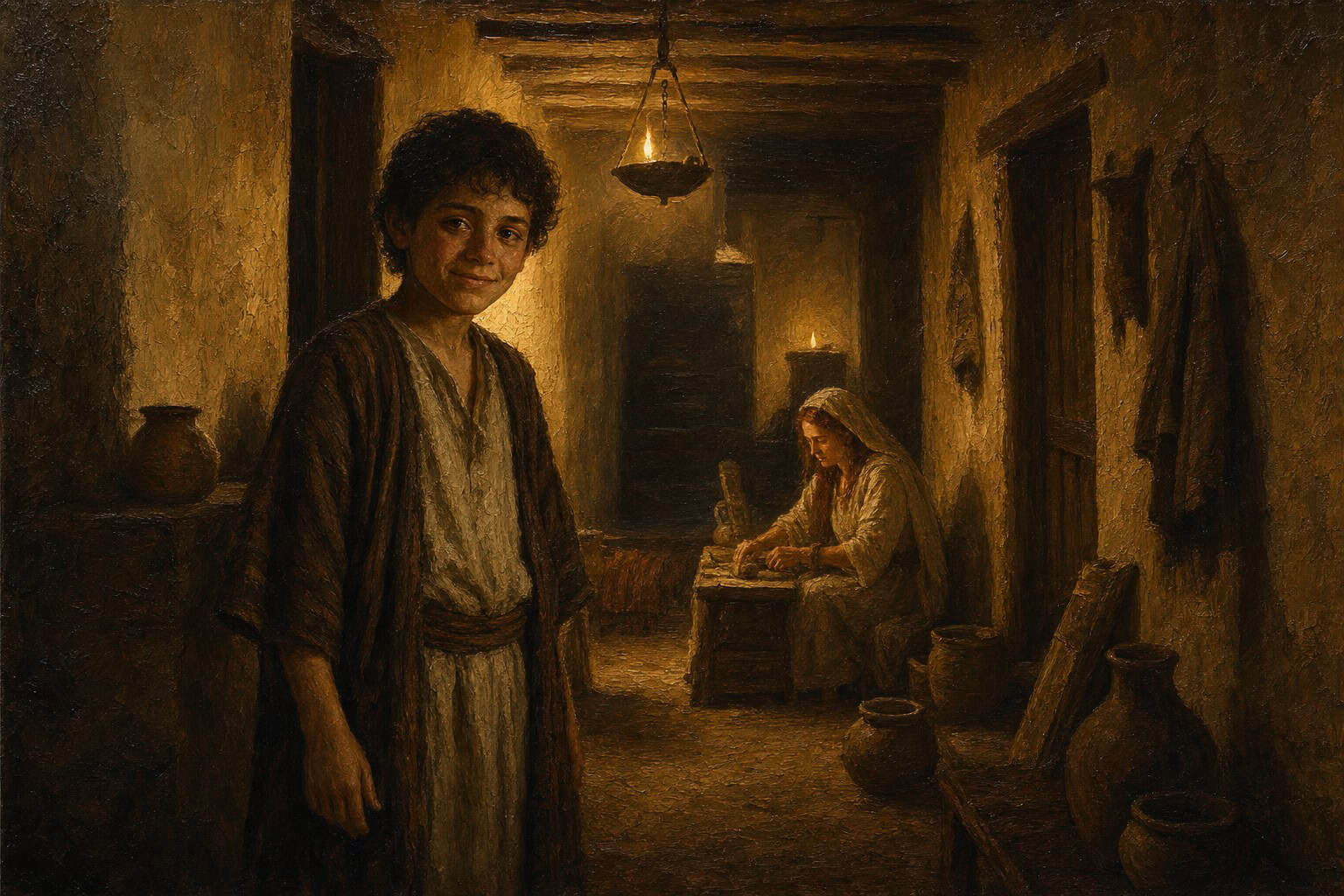
Hiding pain behind a smile? A memoir’s boyhood classroom shows what that mask costs the soul—and where God waits inside it.
A Blemished Lens You Carried Through the Door
You were small when you first learned that a face could be a weapon and a hiding place at once. Long before the magnet program, before the fall of 1984, an older battlefield in your own bedroom had already taught you that the world watched, and the world did not always mean you well. So you came to that new school carrying the only lens you owned, ground smooth by mockery, warped by intrusions you had no words for yet. I want to speak to you now, the boy walking in with your first-grade teacher’s endorsement folded in your chest like a permission slip you were terrified of losing. You believed you had earned your place through effort, not through wealth or an address, and you were right—but no one warned you that merit does not buy safety. The hallway smelled of floor wax and the metal breath of cold radiators, and the other children looked ordinary enough, backpacks slung, sneakers squeaking on the polished floor. What you could not see, and I see now, was the invisible inheritance some of them carried into that room: not just their parents’ money but their parents’ quiet contempt, handed down like an old family Bible no one bothers to open. You were already an archivist, filing away every slight, every gap between what the adults said and what the adults did. That filing was not cleverness, and I need you to hear me say so. It was survival, plain and unglamorous. You had learned, in your ribs before your reasoning, to read who was safe and who was not, and you called that reading normal because it was the only air you had ever breathed. This is where the second chapter of Confessions to the Empty Chair begins, and it begins with that lens, because a wounded child does not simply see the world—he decodes it, letter by letter, face by face. I wish I could reach back and tell you the lens would clear on its own with time. It would not. The pain did not heal into wisdom; it hardened into a way of reading every room you would ever enter. And the very first thing you did with that lens, poor brave boy, was practice a face in the bathroom mirror between classes. You practiced looking fine. You practiced the smile that told the watching children nothing was wrong. You had already understood, without ever being taught the words, that showing the wound only sharpened the knife in the other child’s hand. So you hid it. You hid it and called the hiding safety, and you were half right, which is the most dangerous kind of wrong.
The Classroom That Rehearsed Every Vice in Miniature
That school was supposed to be a place of learning, and it was—but not the way the district’s cheerful brochures promised. It was a proving ground, a quieter war than the one you had already survived, though no less real to your thin ribs and your held breath. The lessons that mattered were never on the chalkboard. They lived in the choreography of the lunchroom and the yard: who sat with whom, whose laughter carried and claimed the room, whose silence got read as weakness and marked for the taking. You watched the bright children of executives and professionals relive their parents’ scorn without knowing they were doing it, without a single conscious thought behind the sneer. Their cruelty wore good clothes and better grades. And here is the terrible thing I have to name for you, because you had no name for it then: that classroom was theology’s first laboratory. Long before you heard the words pride, envy, contempt spoken from any pulpit, you were watching them rehearsed in miniature by ten-year-olds, and worse, you were quietly learning your own lines beside them. You learned to shrink. You learned to fold your face into that smile so no one could see the boy underneath who was still bleeding from a wound they never even inflicted. You told yourself this was strength, and you carried the telling like a shield. Let me put the harder question to you, the one I have dragged behind me for decades: was the smile a shield, or was it already a small surrender? When you hid the pain, you also hid yourself, and something in you began, very young, to believe that a self worth hiding was a self not worth loving. That is the wound beneath the wound, the fissure under the fissure. The wealthy children did not do that final thing to you. You did that to you, with the very tools their contempt handed you—that is the contradiction I cannot spare you. I do not say this to pile more shame onto the pile you were already hoarding. I say it because I love you too much to lie to you across all these years. The scripts you practiced in that room—the flinch, the mask, the careful decoding of every powerful face—became, in time, the scripts of your adult sins, the choreography of grown grief. You would spend years wondering why you could not see any situation normally, no matter how hard you tried to heal. This is why. The lens was set right here, in this cafeteria light. The smile that hid your pain was the first stone in a wall you would keep laying long after this school was rubble in your memory. And God, whom you barely thought to call upon, was already there in the ache under your breastbone—closer than the children who looked straight past you, present not to rewrite the day but to stay with the boy that no one else was truly seeing.
The Mask Is a Cast-Out Face
Here is the turn I need you to sit inside, even though it is going to hurt, and I will not soften it. The smile you perfected did not protect the real you. It exiled him. Every single time you pushed the pain back behind your teeth, you sent a piece of yourself out past the walls of the city, into the wilderness beyond the gate, where no one could reach it—least of all you. That is what hiding pain behind a smile actually is: a small, daily act of exile, self-imposed and self-enforced. You believed you were raising a fortress against the executives’ children. You were digging a shallow grave for the boy who wept, and standing over it in your very good behavior, pretending the ground was level. The dread that drove your hands was the dread of being seen—truly seen, all the way down into your shame—as though to be exposed were the same as to be destroyed. So you chose invisibility. You chose the cool, obedient light of an early computer screen over the unpredictable weather of human faces. And it worked, the way holding your breath works. It kept you alive and it slowly starved you at once. The cruelest thread of it is that being unseen began to feel identical to being unwanted, and you could no longer tell which of them had come first. Were you hiding because they cast you out—or had they simply read a boy who had already cast himself out and were echoing back his own verdict? I still do not fully know, and I will not pretend to. I only know, from the far end of the years, that the smile was never the lie you feared it was.
The smile you wore was not a lie; it was the last wall left standing, and God stood inside it with you.
He was not waiting, arms folded, for you to strip the mask away before He would draw near. He was already there behind it, in the very act of hiding, in the small hot pressure of the tears you refused to let fall onto your desk. He did not sneer at the wall the way the children sneered at your clothes. He did not shame you for building it stone by stone. He simply would not leave the room. That is the strange, unbearable mercy of it: the exact place you went to disappear was the one place He never once looked away from. You were the exile, cast out past the gate—but He walked out into that wilderness after you, and He sat down beside you in the dust, and He did not speak of fixing anything.
The smile you wore was not a lie; it was the last wall left standing, and God stood inside it with you.
What the Smile Cost, Counted Slowly
I will not pretend the mask simply fell away one afternoon and the sun broke through. It did not. You wore it for years. You carried it out of that school and into every new room that followed, and the cost compounded quietly in the dark, the way debt does when you refuse to open the letters. This is the fallout I owe you honesty about: hiding your pain taught you to hide your need, and hiding your need taught you, in turn, to distrust every kindness that ever came toward you. When a friendship arrived from someone who had once stood in the crowd and watched you burn, it did not land as grace. It landed as a threat. Because kindness could resurrect the hope you had so carefully buried, and buried hope felt safer to you than a hope that might die a second time in the open. You learned to fear tenderness more than you feared cruelty. Cruelty at least confirmed what the lens had already told you about the world; it fit the file. Tenderness asked you to set the mask down on the desk, and you did not know how, and the not-knowing became its own long grief. Look plainly at what the smile cost you: it cost you the very capacity to be comforted. That is the bill no one warns a frightened child he is signing. And still—here is what I could not see then and can barely stand to see now—God did not resolve any of it. He did not lift the mask from your face like a magician pulling a coin from behind your ear. He stayed. He met you inside the very defense that was slowly killing the boy it was meant to save. Not once did He demand that you perform your pain correctly, on cue, before He would come close. He was in the tears you swallowed at your desk. He was in the cold obedient glow of the screen where you fled from faces. He was even down inside the small sins the exile bred in you—the resentments you filed and hoarded like an archivist, the contempt you learned to hand right back. He walked with you in your sin, not politely around it. That is not the comfort I once demanded of Him. I wanted rescue. I wanted the whole thing lifted, undone, the school unbuilt, the lens unground. What you were given instead, without ever knowing to be grateful for it, was company in the dark. And I have come to believe, slowly and against my own stubbornness, that the company was the deeper gift. A rescue would have taught you that God removes pain. His nearness taught you that He does not abandon the one who is drowning in it. Those are not the same God, boy. Only one of them turned out to be real.
The Boy Behind the Grin, Still Worth Finding
So let me speak to you plainly now, boy in the 1984 hallway with your rehearsed and careful face. You do not have to smile for me. I already know what is underneath it, I am not going to look away, and I am not going to flinch when the grief shows through. The mask you learned to wear was intelligent, and it was brave, and it was genuinely necessary, and it was also a small quiet betrayal of your own soul—all of those things at once, and I refuse to make it simpler than that for either of us. You are not a coward for hiding. You are a child who was taught by a fallen little world that his worth was transactional, that he was only as safe as he was invisible, and you ran the arithmetic the way any cornered creature does. But hear me on this one thing: the smile was never what made you loved. You were loved with the pain still showing on your face. You were loved before you ever learned the trick of tucking it away. The classroom lied to you about your value, and you believed the lie so young that it became the very lens through which you would read the world, and that lens has taken the better part of my whole life to begin grinding clear. It is still not clear. I will not promise you it ever fully will be, this side of heaven. What I can promise you is this: the ache you are hiding behind your teeth is not shameful. It is the truest thing about you, and God has been cupping it in His hands this entire time, gently, without a single condition, in the exact place you were certain no one could reach. This is the country Confessions to the Empty Chair keeps circling back toward: the long road home out of an exile you never chose, and the slow, staggering discovery that the One who numbers your tears has been sitting beside you in every room you ever tried to vanish from. You asked how to hide the pain behind the smile. I am telling you, from the far end of the years, that the real question underneath your question was always a different one. Not how to hide it more convincingly. But how to let it be seen at last—by the only face in all creation that will never turn away from what it sees. That road home is not tidy. It is not quick. But you are not walking it by yourself, and you never once were, not even in that cafeteria light, not even behind the grin. Set your face down for a moment, here, next to mine. He is already sitting right here in the dust with us.