Being someone’s second choice cuts deep. A reflection on why every choice excludes another, and what it means to be the path not taken.
The Small Machinery Under the Skin
Have you ever learned you were the fallback, the name reached for only after the first one slipped away? In the opening chapter of Fractions of the Soul, the narrator is not thinking about you yet. He is thinking about skin. He lists the small machinery of feeling that lives under it: the receptors that read pressure, the ones that read heat, the ones that hold the body upright and tell it where its own limbs are in the dark. He gives them their exact names, the mechanoreceptors and the thermoreceptors and the proprioceptors, and the naming itself is a kind of cold hand pressed flat against the reader’s chest. He notes that a dog outsmells us by a wide margin, that a seal reads the movement of water across its whiskers, that catfish and birds and pigs carry counts of taste buds we will never match. Whole rivers of information pour past us every second and we never catch a drop. It is a strange, cold way to begin a confession, and that coldness is the point. Before he tells you anything about his heart, he tells you that the heart is downstream of a body that only takes in a sliver of what is real. The particulars pile up until they stop being science and start sounding like an accusation leveled at the flesh itself. We do not touch the world. We touch a translation of it, the world turned into small sparks fired inside a locked room of nerve, sorted and shaped before we ever meet it. And here is where the searcher’s ache first stirs, though he has not named it. If the body itself is a narrow window, if it cannot even hold the whole of a single sound or the full reach of a smell, then what chance does anyone have of holding the whole of another person? The narrator is building a floor beneath a grief he will not say out loud yet. He is showing that limitation is not a flaw we could fix with more effort or a sharper will. It is the shape of being a creature, the price stamped on every living thing that has to feel its way forward through a body. Everything he perceives, he perceives through a lens already smudged, already colored by the early years that settled into him before he could choose. And so the question of being second, of being the one chosen after the better one, has to begin here, in the flesh, in the layers laid down before thought. The mood on the surface is clinical. Underneath it is raw, the way a man sounds when he has decided to tell the truth by starting as far from the wound as he can, circling in slowly so the blow lands soft.
How Little Passes Across the Gap
The chapter tightens now, moving from the single body to the space between two of them. The narrator does his cruelest arithmetic without ever raising his voice. A speaker holds only a scrap of the truth, filters it through a smudged lens, shrinks it down into a few clumsy words, and throws those words across a gap toward a listener who catches even less and then reshapes what little arrives into their own strange picture. Degradation, he calls it, one loss stacked on the next, and you feel it happen at every step, like water carried a long way in cupped hands. Each person is idiosyncratic, he says, bent in their own private direction, so that no two of us even bend the same way. He confesses that he is honestly baffled anyone ever reaches agreement or understanding about anything at all. This is where the searcher’s question begins to bleed through the science. To be someone’s second choice is to be measured, ranked, set below another name. And here he is saying that no one can truly measure anyone, because the machinery of contact leaks at every joint. The person who ranked you did so on scraps. They compared a shrunken picture of you against a shrunken picture of someone else, and both pictures were false, drawn in the dark. That should be a comfort. It is not. The wound of being chosen last does not live up in the mind, where logic could reach in and argue it down. It lives lower, in the very body he just took apart, in the flush that climbs the neck, in the sudden wish to leave the room, to step out of your own sight and stop being looked at. Shame does not wait for accurate information. It arrives whole and fast, the way pain does, before you have a single word to set against it. The narrator, turning the lens on himself as he always does, has to sit with the harder half of it. He was not only the one placed second at times. He also made others second. He gave his full attention to one person and let the rest go dim. He processed them all through the same broken machinery he just laid bare, the same limited words, the same partial sight. He is not standing outside this cruelty, watching it in others. He is inside it, on both ends of it at once, the one measured and the one measuring. The relational tension of the scene is exactly this: nearness that never quite arrives, two people leaning toward each other across a distance neither of them can close no matter how hard they try. Every word between them is a small miracle and a small betrayal in the same breath. He is asking whether love was ever more than two limited creatures guessing at each other in the dark, and whether the guessing was still holy for being all they had to give.
Every Door You Walk Through Shuts a Hundred More
Then comes the turn the whole chapter has been circling toward. The narrator sees that choice itself is built out of loss. To pick one thing is to refuse the others. To follow one road is to abandon the rest of the map, to let it fade behind you unwalked. He states it plainly and it lands like a stone dropped into still water, the rings spreading long after the sound. He had wanted to believe that refusing to choose kept every door open, that lingering at the entrance meant he still owned all the rooms behind it. But the body does not work that way, and neither does the soul. You stand in one place. You cannot stand in two. To desire every path while dreading the walls of any single one is not freedom at all. It is a slow surrender to a story that whispers there is never enough, that any yes is a theft from all the other yeses you might have said. And now the searcher’s wound and the narrator’s revelation meet in one flame. Being someone’s second choice hurts because you know, in your gut, that choosing you meant not choosing another, that you live in the space of what they gave up rather than what they most wanted. But he flips the blade toward himself and does not flinch. Every time he chose, he did the same thing to someone. He handed his body to one while his mind wandered off toward another. He split himself across relationships so that no single one could ever reach him whole, so that he never had to stand fully inside any doorway and feel it close behind him. This was not innocence. It was a way of never being caught, never being seen straight on, never being found wanting, because a man who never fully arrives can never be fully measured.
To be chosen is already to be measured against everything the chooser walked away from, and everything they did not.
He sees, with a clarity that costs him, that his fear of coming second was really a refusal to make anyone first. Not a friend. Not a lover. Not God. The understanding is unbearable and he refuses to soften it into something he can live with easily. He does not tell you it turns out fine. He lets the walls stand exactly where they are, close and solid and real, and admits that this is simply what it costs to be a creature who lives in one body, in one place, at one hour, choosing this and therefore not that, forever.
To be chosen is already to be measured against everything the chooser walked away from, and everything they did not.
What the Flesh Kept Score Of
After the turn, the ground does not settle so much as it opens and shows what was packed down inside it. The narrator sits in the wreckage of his own honesty, and there is nowhere left to look but down. He has confessed that he refused to choose so he would never be the one left behind, and that this very refusal made him the thing he feared, a man who left others standing in the space of second place. There is no relief in the naming. The shame that flushed his skin earlier does not lift now that he can explain it. Understanding was never going to lift it; he knows that now, and the knowing is its own weight. He describes flesh that remembers what the mind cannot reach, the way an old habit settles into the shoulders, the way a mark pressed into a child colors everything he sees before he has a chance to think. His body kept the score he spent years pretending not to keep. It knew he had used people as means to his own ends, that warmth he called friendship was quietly aimed at what he could take from it, that he had mistaken the gathering of knowledge for the changing of a heart. He wanted to be clever enough that no one could get close, and he managed it, and the managing is its own grief now. Here the theology of the chapter breathes through without ever announcing its name. God does not swoop down to erase the darkness. There is no rescue that lifts him out of the room and sets him clean on the far side of it. Instead there is a nearness in the dark, a sense of not being alone in the cramped, jolting car even as it grinds forward, uncomfortable, unfinished, that childish are-we-there-yet aching low in his chest the whole way. The presence does not fix the limitation. It climbs in beside him and rides inside it. It sits with him in the very sin he is confessing, present in each admission the way a hand rests on a shoulder without dragging the body anywhere it is not ready to go. This is the strange grace of the passage, and it is nothing like comfort. He is not told his walls are an illusion he can think his way past. He is told, quietly, without fanfare, that he is seen inside them, and that being seen, truly seen by the One his cleverness could never fool, is the exact thing he spent his whole life ducking. To be known is what he feared most, because to be known is to be measured, and to be measured is to risk being found wanting and cast down to second. And yet the presence does not turn away when it sees him whole. That is the fallout he cannot argue his way past or outrun. The seeing continues. The staying continues. And he is left holding the terrible gentleness of it in hands that do not know what to do with something so unearned.
The Kitchen Behind the Set Tables
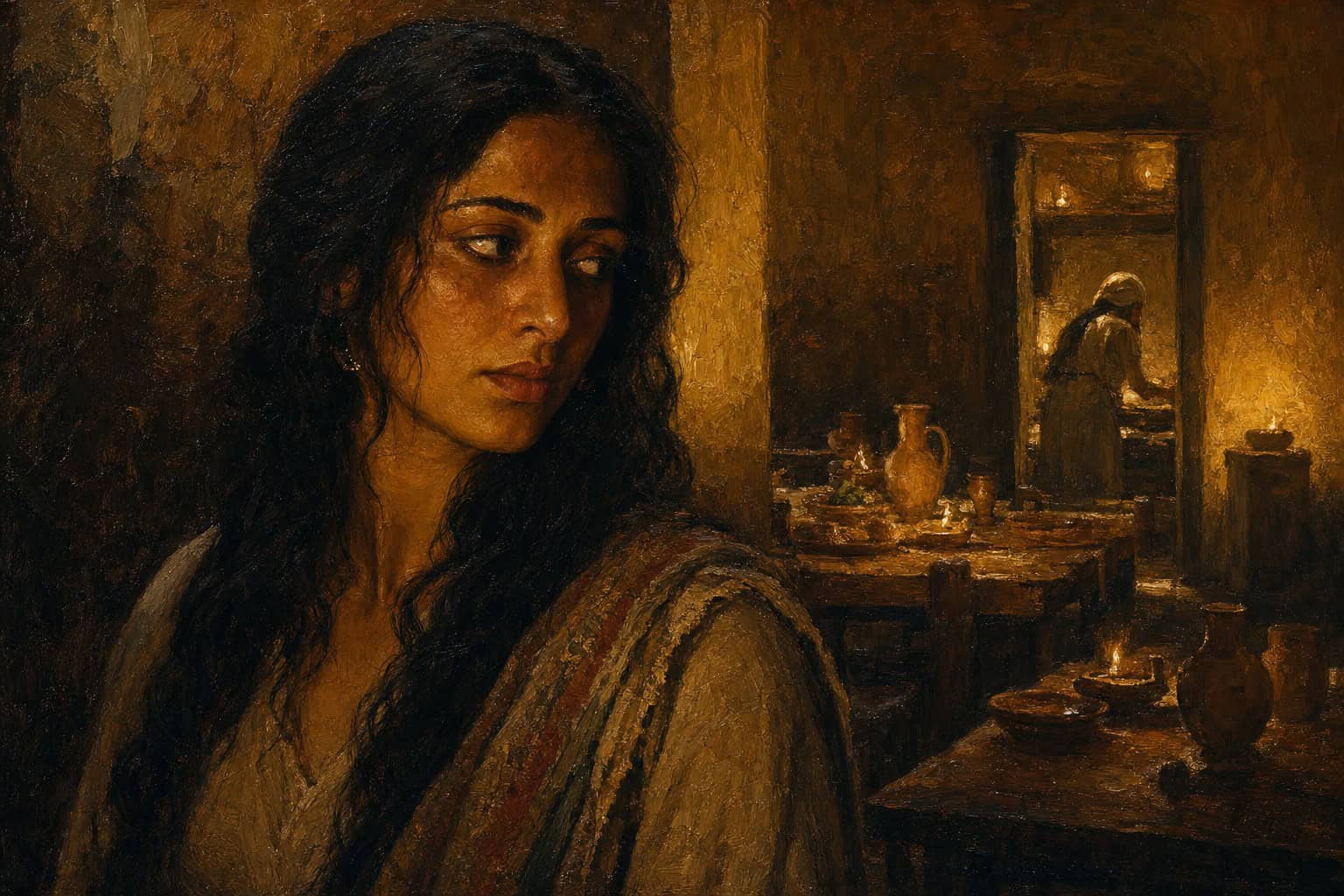
Where it settles is not a resolution but a way of standing that he did not have before. The narrator returns to an image of an entrance. From that threshold you can see the tables and the chairs, the arranged front of a thing, the version set out neat for strangers who will never come any closer. But there is a kitchen behind it, hidden, where everything is actually made, where the heat and the noise and the sweat of preparation go on out of sight of anyone who refuses to walk in. He knows now that he lived his whole life at that entrance. He looked at love from the doorway and called what he saw from there the whole of it. He looked at his own soul the same cautious way, and at God the same way too, taking inventory of the furniture, memorizing the front room, never once crossing into the space where the truth is cooked in risk. To move deeper is to lose your safe view. It is to surrender the very position that let him rank and compare and quietly keep score on everyone who came near. And the searcher who arrived here bleeding from the wound of being second finds that wound turned slowly in their hands until it shows a face they did not expect. Being second is a measurement taken at the threshold, by someone standing where you once stood, guessing with scraps at a person they never walked in far enough to know. It is real and it stings and the narrator will not pretend otherwise for a second. But he has learned that the ranking itself belongs to the shallow front room, that no one who has actually walked back into the kitchen of another soul is still counting places. The counting stops when the surrender starts. He does not claim to have made it all the way in himself. He is still moving, still uncomfortable in the jolting car, still asking whether he is there yet, and he knows the honest answer is not yet, not for a long while. What he offers in place of an answer is the shape of the hunger itself, laid open, and the quiet sense that limitation was never the enemy he took it for. Limitation is the only way through there is. You reach the world and each other and God only across the narrow, bruising walls of being one creature standing in one place at one time. This memoir opens here, in the cold science of the body, and it carries this question of the divided self through everything that follows without once reaching for a cheap way out. If you have ever felt the sting of coming second, or feared what it might cost to make anyone truly first, this chapter meets you there and refuses to lie to you about the price.