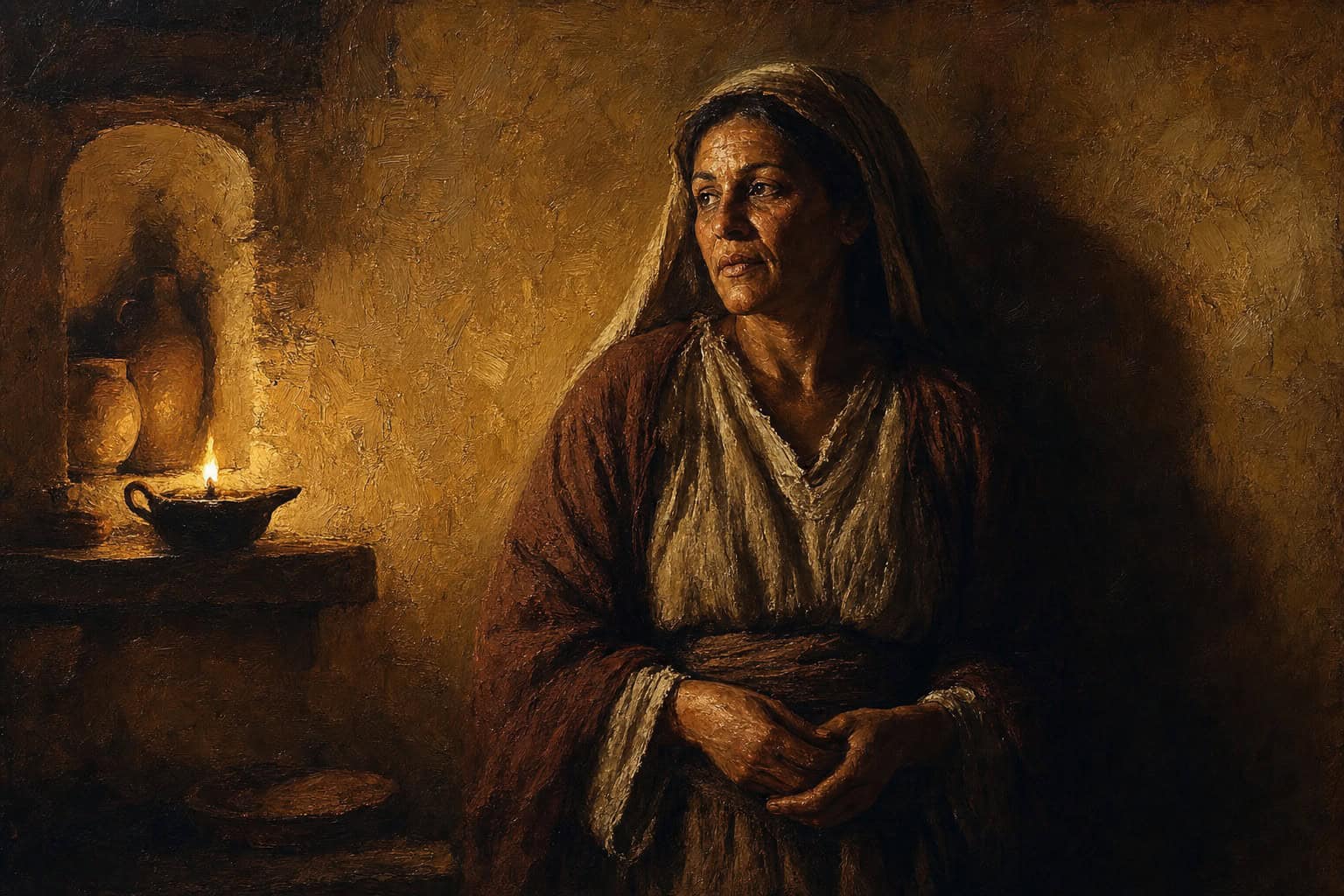
How does a sexually rejected woman behave? A memoir reads the quiet strategy of choosing smaller men to stay untouched and safely in charge.
The Small Man Who Made Her Feel Tall
Have you ever watched a woman shrink her whole world to fit a smaller man, and call it love? I have. In the second chapter of Fractions of the Soul I set down a woman who chose men she could stand over, and I have spent years since trying to read what I actually saw. She felt bigger beside his smallness — that was the thing I could not shake, and the thing that undid my flattering picture of her. At the time I thought I was watching a strong woman settle for less than she deserved, and I pitied the men she gathered. Now I see something colder and sadder: a person arranging the furniture of her life so that no one could ever look at her too closely. The lesser man was not a failure of judgment. He was the judgment. He was chosen precisely because he could not weigh her, could not name what she was doing, could not hold up a face bright enough to show her own back to her. Her shoulders dropped near him the way they drop in a room where no glass hangs on any wall. I remember reading her ease as happiness. It was relief — the relief of the one who has learned to stay hidden even while standing in the light. She had been passed over once, refused, left wanting, and she had drawn from it the lesson most of us draw when we are wounded that way: never again stand where I can be measured and found short. So she stepped down. She chose down, deliberately, the way a person chooses a chair that will not talk back. And she felt taller for it, which is the whole trick, the quiet mechanism the older man in me finally understands. The wound of being unwanted does not always make a person humble. Sometimes it teaches her to arrange the smallness of others so her own smallness never shows itself. I did not see that then. I saw a woman glowing beside a duller flame and I envied the flame its warmth, its nearness, the way she leaned toward it. What I could not read was the fear underneath the glow, the small flinch that had already decided she would never again risk the room where she might be truly seen and then set aside. Her cleverness was real. Her beauty was real. But she spent them both like a person spends a fortune on locks. I write this now not to convict her but to name what I refused to name while I stood inside the reach of that dim, safe light and told myself it was for me.
Cleverness Used to Keep From Being Caught
The thing I refused to understand was how her intelligence served her cowardice. She was quick — quicker than the men she gathered, quicker than me on my worse days. But her cleverness did not reach toward anyone. It curved back on itself and built walls I mistook for depth. Every word she spoke could be taken two ways, so that later, if the ground shifted under her, she could say she had meant the other one all along. Every gesture had a hidden exit built into it. I watched her say things that would have wounded a man for years, then open her hands in the air as if to prove they held no knife. She had trained her mouth to speak what her body would never carry, and her body had learned to forget the weight of what her mouth had done. There was a strange numbness in how her words came out — practiced, smooth, arriving through her lips without ever passing through her spine. This is the awful economy of the smart and frightened: the finer the mind, the finer the architecture of not-being-responsible. She could want a man without choosing him. She could take his attention without ever naming what she gave for it. The price of her was always hidden, adjustable, moved the moment he thought he had finally paid it in full. I mistook this for mystery. I called it depth. The older man reading it now calls it what it was — a refuge she built inside her own skull, a high place to stand above her choices so she never had to admit she had made any. And here the old rejection returns, because I think all of it grew from that first refusal. Once you have been the one set aside, you can decide never to be pinned again. You keep every door of meaning propped open. You let each action stay deniable, reversible, weightless. Then no one — not the man beside her, not the glass on the wall, not God — can walk up to her and say plainly: you did this, you are this. She had made herself un-namable, and it looked from the outside like a kind of freedom. It was the most elaborate cage I have ever watched a person build, wall by clever wall, and lock from the inside while insisting she held no key at all. I helped her believe it. I flattered the cleverness because it flattered me to be counted worthy of standing near it. That is my part in the thing, and I have stopped pretending it was hers alone. My admiration was another wall. My silence was another lock.
The Portfolio of Men Held Against a Crash
Then the true shape broke through, and it was not romance at all. It was accounting. She did not keep several men because she was rich in love and had too much to give. She kept them because she was terrified of running out. Each one was a stream she could not afford to lose, a hedge against the day one of them woke up and walked. I finally understood that I was not the one she loved with the others as distractions. I was a fraction. She gave herself out in pieces — a sixteenth here, a sixteenth there — while each of us walked around feeling like the whole warm sum of her attention. I felt like her one. I was her one-of-many, and the arithmetic of that still burns in the body more than in the mind, a hollow just under the ribs where I stored the belief that I was singular to someone. I can still feel the shape of that hollow when I read the chapter now. The cruelest part was not the number itself. It was that she had made herself less real in the dividing. A person split sixteen ways is not sixteen times as present anywhere. She is thinly there, a smudge of a self, owed everywhere and therefore fully given nowhere. And she had chosen this thinness on purpose, because to be wholly present to one man would mean being wholly seen by one man, and being seen was the very thing the old refusal had taught her to survive by refusing first. This is what I could not grasp while it was happening to me. I thought her distance was a puzzle I could solve with more devotion, more patience, more proof of my worth. I did not understand that her distance was the entire point, the working of the machine, not a fault in it. Every man she added thinned her further and made her feel safer, richer, less exposed to any single loss. She was not withholding love out of cruelty. She was rationing a self she was too frightened to spend all at once on anyone, because spending it all would have meant standing in one place long enough to be measured and possibly set aside again. I keep returning to that hollow under my ribs, because the body kept the record my mind kept trying to argue away.
She did not want a man; she wanted a mirror small enough to hold her image without ever asking her to change.
What the Fraction Cost the One Who Loved Her
After I understood the arithmetic, I had to live inside it, and that is where the shame arrived — not hers, mine. Because the truth I had to sit with was that I had wanted to be a fraction. I had preferred the smudge of her presence to the terror of a real one. If she had turned the full weight of herself on me, seen me down to the floor of what I was, I would have flinched the same way she flinched every time. We were the same animal in different clothes. She hid behind cleverness; I hid behind wanting to save her. I had cast myself as the sacrificial one, the man who would ruin himself pursuing her and call the ruin nobility. And she watched from behind her mask of I-never-asked-for-this, and let me spend myself down to nothing, and both of us kept our hands clean in our own eyes. The body remembers this better than the mind will allow. I can still feel the particular exhaustion of loving someone who would never quite admit to what she was doing — the way you begin to doubt your own eyes, the way the floor of the real keeps sliding when you put weight on it. Living with a person who has perfected deniability teaches your flesh to distrust itself. You feel the cut and are told there is no cut, and after long enough you start to believe the telling over your own nerves. That is the wound I carried out of that chapter, and it was not chiefly the wound of being unloved. It was the wound of having agreed to a fiction because the fiction let me hide too. God did not lift me out of it. I want to be honest that there was no rescue, no clean morning where the fog burned off and I woke up free of her. What there was, instead, was a strange nearness — a sense of being accompanied inside the confusion, walked with in the very sin of my own hiding, not scolded out of it and not dragged from it. He did not remove the dark of those months. He was simply in them, quiet, present in the hollow under my ribs, present in a tear I did not fully understand while I was still choosing to be fooled by her and by myself. That nearness did not fix anything then. It fixed nothing I can point to. It only kept me from being entirely alone in the cage I had helped build, hand over hand, with my own admiration for the locks.
What the Old Refusal Left in Both of Us
So how does a sexually rejected woman behave? I can only answer for the one I knew, and only from this far shore, years downstream of her. She does not rage in the open. She does not weep where anyone can see. She goes quiet and clever and careful, and she rearranges the world so she never stands in the measuring light again. She gathers men she can stand above, because their smallness makes her feel large and their dullness makes her safe. She parcels herself into fractions so no single person can ever hold enough of her to judge the whole. She learns to want without choosing, to speak without carrying the words, to take without naming the price out loud. And she calls all of this strength, because the alternative — walking up to a real other, being seen exactly as she is, with all her sharpness and all her fear laid bare on the table, and staying there anyway — is the one thing the old refusal convinced her she could not survive twice. I understand her now because I did the very same in my own key, with my own softer tools. This is not a story I can tie off with a tidy moral about her being the villain of it, because I was there beside her the whole time, hiding in plain sight, feeding on the fiction like it was bread. What I see now that I could not see then is that both of us mistook self-protection for love, and both of us paid the full cost of that mistake — the thin presence, the tired body, the years of doubting our own eyes and our own hands. If you have loved someone who divided herself and left you competing with ghosts you could never quite name, this chapter of Fractions of the Soul will not hand you the clean verdict you came looking for. It will give you something harder to hold: a mirror you did not ask to look into, and a question that will not lie down. Where were you hiding while you accused her of hiding? I have no clean answer to set beside the question. I have only the strange, unearned comfort of not being alone in the dark of it, and the slow, unfinished work of learning to stand still in a lit room and be seen without first arranging every chair.