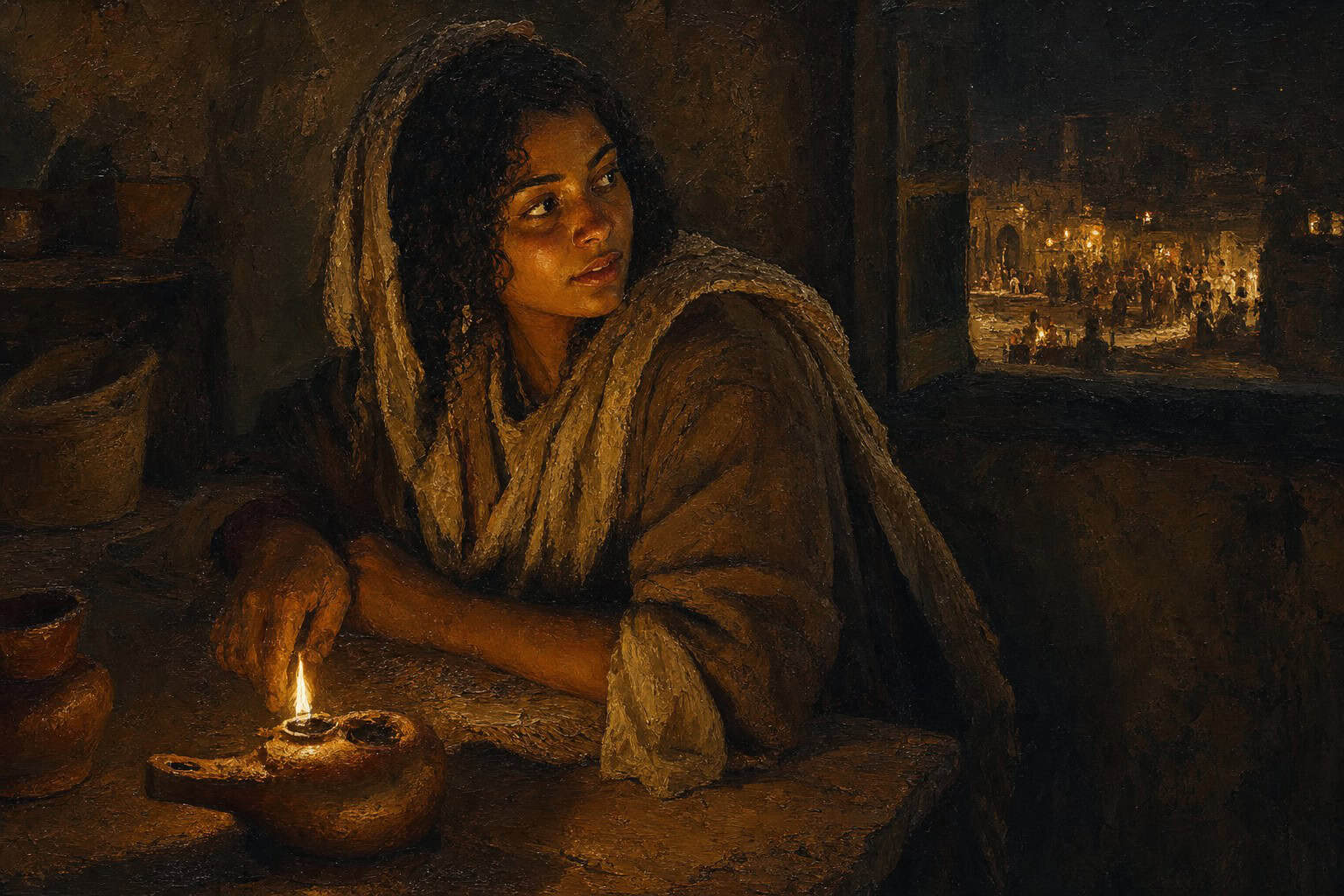
Feeling lonely at university? A reflection on invisibility, watching, and the strange gift hidden inside not being seen — through Confessions to the Empty Chair.
Counting Shoelace Knots Instead of Faces
You are surrounded by people and touched by none of them. That is the first thing to name plainly, because the campus lies to you about it every hour. The lecture hall is packed with warm bodies, breathing and shifting and leaning toward one another. The corridor is loud with names being called out, none of them yours. There is a dining table where laughter arrives from somewhere just past your shoulder, and you eat with your head down, chewing to a rhythm nobody shares. Loneliness in a place like this is not empty space. It is a crowd pressing in on every side while you go unregistered, a full room that somehow holds no seat with your shape in it. I remember the trick the body learns in that state, and I want to name it exactly, because you think it is nothing. When the eyes around you refuse to land on you, your own eyes drop. You start counting small things. The knots in someone’s shoelaces. The scuff on a floor tile. The crumbs beside a coffee cup, the little constellation of them nobody else notices. You count because it is safer than looking up and finding no gaze coming back. In Confessions to the Empty Chair a boy in an early chapter stands in exactly this posture. Long before any university, he is inside a school world of rigid schedules and locked hierarchies, and he learns a hard bargain: if he stops asking to be seen, he can begin to see. The surrender is real. He gives up the ordinary hunger to be looked at, and in its place he gains a strange, sharp vantage. He begins to read personalities through the smallest cues, to deduce who people are from the breadcrumbs they scatter without meaning to. You, sitting alone in your room tonight, are already doing this. You are becoming an observer. You watch conversation the way a scientist watches, tracking word choice and pauses, reading the ones who dominate and the ones who fold quiet. It feels like a skill, and it is one. But hear me, from further down the road, because I know what it cost you to build it. You did not choose the observer’s clarity as one gift among many, the way a lucky person chooses a hobby. You reached for it because it was the only workable gesture left when the room had already ruled you unreachable. Watching became the last way your body knew how to move toward anyone. That is not the same as freedom, though at nineteen it wears freedom’s clothes very well, and you will spend years telling yourself it was a calling and not a wound.
The Screen That Promised a Body Without Shame
Then there is the machine, glowing in the dark of a room where no one waits for you. For me it was an early text world, reached through a line that screeched before it connected, a place where a name told you nothing and everything had to be built out of words alone. For you it may be a message thread, a group you only lurk in, a game full of strangers, a forum at two in the morning. The mechanism is identical, and so is its promise. Here, the machine whispers, your body cannot betray you. Your skin, your awkward hands, your voice that cracks at the wrong moment — none of that reaches the screen. Only your mind reaches it. Only your wit arrives on the other side, your ability to be funny or comforting or serious, and the currency of the whole place turns out to be exactly the thing you are rich in: command of language, quickness, the accurate reading of what someone half-hides inside a sentence. Nobody there can see your face fall. They only see what you type. I understand the relief of it in my own hands, in the memory of my fingers finding the keys in the dark. In that world I first learned to read a person through their punctuation, to track their shifts across weeks of nights and weekends until I could type two words — what’s wrong — and be right. That was a real intimacy the crowded corridors never once allowed me. Do not let anyone flatten it into mere escape. Souls did meet there. People were comforted and known. But I owe you the fuller truth of what the screen was offering underneath the relief. It let your fingers reach toward people while your flesh was never reached back. You could touch and mean and never risk being touched or seen in return. The desire that had ached in your actual body got converted into pure reaching — clean, safe, running one direction only. A longing that could finally move because it no longer had to be embodied, and so could no longer be wounded. That felt like healing. It was closer to an anesthetic, a numbing you mistook for a cure. And beneath it, though you would never have said this to yourself at the time, there was pride. The quiet pride of a mind that has decided it can skip the humbling, ordinary, terrifying labor of being one human among humans, in a shared room, with a real face and a real body that other people have to put up with. You wanted communion without exposure. You wanted to be loved without being looked at. And the machine, kinder than the corridor, seemed for a while to give you both.
When Someone Asks What You Look Like
The lie holds only until someone asks the plain question. What do you look like. Where are you. Send a photo. In that instant the weightless paradise collapses, and you are thrown back into being a thing with a body — the skin you hate, the limbs that never sit right, the awkward physical fact of yourself you spent all those nights escaping. This is the turn I most want you to see, because it governs everything that comes after. The screen never abolished your body. It only postponed it. Every real bond you made through pure text eventually demanded that you become visible again, and every single time, the old dread came back exactly as it had been, as if no growth had happened at all — because none had. You had not learned to be seen. You had learned to delay being seen, which is a different thing wearing the same face. And here is the deeper deception, the one it took me years to name. The invisible ladders you thought you had escaped grew back inside the text itself. Typing speed. Technical skill. The knack for projecting confidence without a body to give you away. New hierarchies rose where the old ones had been cut down, and you climbed them just as anxiously as you had climbed the ones in the schoolyard. You had not left the marketplace of worth. You had only wandered into a marketplace where your particular coin happened to spend well. So the pride doubled — pride in the escape, and pride in quietly winning the game you pretended not to be playing.
The screen did not free you from being seen; it only taught you to fear the moment you would be.
What should I have wanted for you instead? Not the cleverness. The cleverness was never in doubt; it was the one thing the world always granted you. I should have wanted you to stay in the corridor a little longer with your unbeautiful face, to let one real person look at the whole of you before you fled to the machine where only the polished surface showed. That is the exchange you kept refusing — flesh answering flesh in the same instant, the risk of being read as you actually were and not as you performed. You built one dimension of yourself into a gleaming instrument, and you let the rest go unspoken, unarticulated, unreachable even to yourself. And an unspoken self cannot be loved. It can only be admired, from a distance you installed with your own hands, and then resented for the distance.
The screen did not free you from being seen; it only taught you to fear the moment you would be.
The Cold Clarity That Could Not Warm You
Consider what the observer’s gift actually did to you across the years that followed. You became astonishingly good at reading people. You could assemble a stranger’s whole truth from the crumbs they dropped without knowing — a hesitation, an odd word, the topics they circled and the ones they carefully avoided. You could sense grief in a person before they had named it to themselves. This looked like love, or at least like something standing close beside it. But watching is not communion. To read someone with perfect accuracy while you yourself stay hidden is not to meet them. It is to stand behind glass, warm on neither side of it. The very wound that made you a reader of souls also kept you from ever being read, and so you spent long seasons knowing everyone and known by no one — which is, I see now, only the loneliness of that crowded lecture hall again, grown clever and dressed up as insight. And where was God in all of it? I used to think He was simply absent from those glowing nights, that faith belonged to daylight and church and the people who got looked at, the ones who deserved a seat. I had the direction wrong. He did not rescue you out of the loneliness — that is not usually His way, whatever the tidy books promise. He was inside it. He was in the ache at two in the morning when the connection dropped and the cursor blinked and the full silence of the room came down on you like weather. He was in the very reaching of your fingers across the keys, that clumsy, disordered, one-directional reach that was still, under everything, a real hunger for the communion you were made for. Even your escape was a bent kind of prayer, and He did not despise the bentness of it. Reality kept offering itself to you not only as a field your clever mind could master but as a gift to be received in silence, with open hands — and you kept trying to master what could only be received. That was the whole ache of it. You wanted to earn the world before you would let it near you. The mercy, the thing I did not understand for years, is that He stayed anyway. He walked in the dark with the anxious, prideful, watching boy you were. He did not stand at the edge of the light waiting for you to become lovable first. He came into the room the campus forgot to seat you in, and He sat down.
The Face You Kept Refusing to Show
So here is what I carry back to you tonight, alone in that room. The loneliness is not a verdict on your worth. It is not proof that you are unlovable, though it counterfeits that proof brilliantly, and you will believe the counterfeit for a long time. What it is, if you will let it be, is a severe and unasked-for grace — an exile that forces you to grow a self no crowd could ever hand you, a self that must learn to stand without the shield of belonging under it. That much is true, and you should hold it. But do not do with it what I did. Do not mistake the wound for a calling. Do not let the safety of watching harden until it is the only way your body knows how to move toward another person, until every real face sends you back to the screen where a curated version of you lives safely behind glass. The clarity you are gaining is genuine, and it will serve you, and it will also, if you let it become your whole home, wall you into a solitude far colder than this one — a room with no draft, no weather, no one. The gift being offered underneath all of it is not analytical distance. It is the courage, someday, to be visible. To let a real face see your real face and not run to the version of yourself that exists only in words. You are more than the polished surface you can project. You are more than the wit that wins the room and empties out the moment the room goes quiet. The whole unspoken rest of you — the parts you have privately ruled unreachable — those are exactly the parts waiting to be loved, and they can only be loved if you let them be seen. I will not promise you that being seen will not hurt. It will. Someone will look at the real thing and flinch, and you will remember why you built the glass. But the mercy that met me in the dark of those glowing nights meets you now, before you have earned it, before you have fixed a single thing, while you are still only a lonely young person counting the small safe crumbs on the table instead of the faces around it. You do not have to become worthy first. You are already accompanied. If you want to know how the watching boy fared, and what it cost him to keep the glass between himself and everyone he read so well, Confessions to the Empty Chair is where I went to look at him honestly. Come find him there. Come, and while you are at it, find yourself.