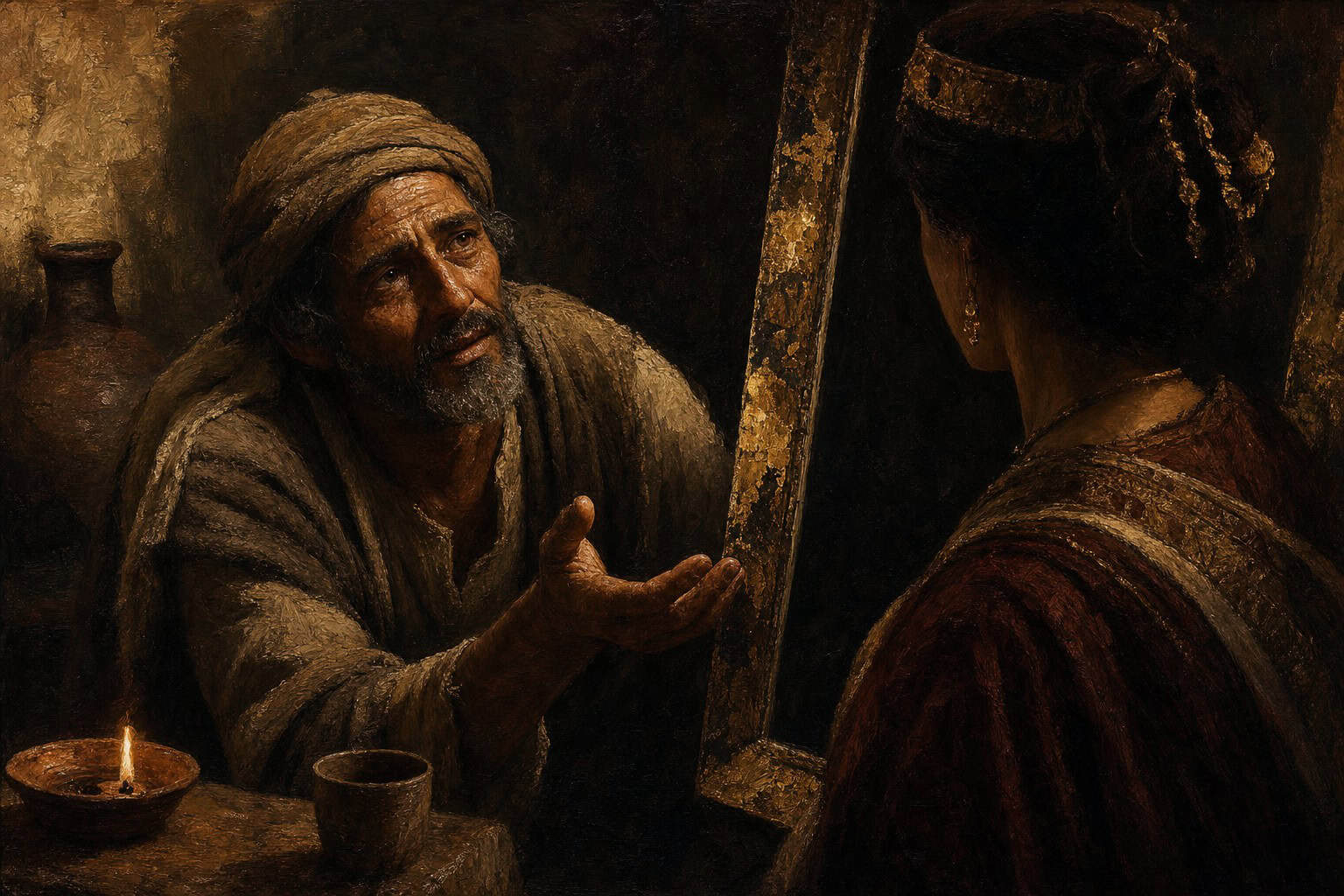
She appears to have been rich, and you fall harder for it. What that first impression really told you – and hid from you. A reading from Fractions of the Soul.
The Smile That Cost More Than You Had
You saw money on her before you saw her. Let me sit down beside you in that first minute, the one you still carry like a coin worn smooth from years in a pocket. She turned toward you, and something in the ease of her carriage read as wealth – the unhurried posture, the sense that she had never once been made to wait for anything, the way her attention seemed to be a thing she could afford to spend or withhold like a woman who had never counted change. You read all of this in seconds, faster than thought, and your body leaned before your mind caught up to what it was doing. This is the first thing I must tell you, and I tell it gently because you cannot yet hear it: the flesh commits before the reason arrives. Your shoulders had already turned toward her future. Your weight had already shifted onto the foot nearest her. Only afterward did your head go scrambling to dress the pull in decent clothes – admiration, taste, the recognition of a finer thing. You told yourself you were drawn to her quality, but quality was a word you needed more than a word you meant. In Fractions of the Soul the young man reads the beloved the way a starving man reads a menu he cannot pay for, tracing each line with a hunger that has nothing to do with the food and everything to do with the emptiness in him. I watch you do exactly the same, mistaking the intensity of your hunger for the depth of your sight, certain that because you felt so much you must therefore be seeing much. You did not know her. You knew the surface, and the surface said money, and money said she stood above you, and standing above you she became worth the long climb. Here is the small cruelty folded inside it. Her apparent wealth did not make you love her more. It made you examine your love less. A rich object seemed to justify a rich feeling, and so you never turned the lamp on the feeling itself. If she came from that world, then your wanting was not appetite but aspiration – upward, noble, clean, a thing a man could be proud of. So you never once asked the plainer question. You never asked what a woman who truly had everything would be doing looking back across the table at a boy with nothing in his pockets. You were too busy converting her into proof of your own worth, and a proof, unlike a person, does not need to be understood. It only needs to be held up to the light and believed.
Reading the Ledger You Could Not See
The trouble with a first impression of wealth is that it seals the very door it seems to swing open. You thought her polish made her legible – here is a woman of a certain kind, you told yourself, and I have taken her measure. But polish is precisely the thing that cannot be read. It is a surface built to be looked at and never through, a lacquer laid down to catch the eye and stop it there. As the days gathered into weeks, you kept adding entries to the ledger in her favor without once questioning your own hand. Her silences you filed under depth. Her withdrawals you filed under discretion. Her refusals to answer you plainly became the reticence of someone who did not need to prove a thing to a boy like you. Every ambiguity you sorted quietly into the column marked refinement. You were doing sums in the dark and calling every unknown a gain. I want to name what you refused to see, and I want to do it without shame, because you were young and the hunger was as real as bread. A person who keeps their meaning just out of your reach is not always guarding a treasure. Sometimes they are hiding an empty vault, and the guarding is the whole performance. The ease you read as inherited security may only have been the practiced ease of someone who had learned that ambiguity keeps every option open and settles no bill. You paid – in attention, in hope, in the slow drip of humiliation you told yourself was patience – for access to a certainty she never offered and perhaps never owned. And still you would not lower your estimate of her. To lower it would have meant admitting that the value was your own invention, that you had appraised her high because a high appraisal made your longing look respectable in the mirror. There is a word from the faith for this, and I use it because it fits, not to wound you: idolatry. You built her up into something that could justify your worship, and an idol, unlike the living God, must be kept alive by the very devotion it drinks. She grew richer in your eyes the more you gave, because your giving had become the only proof of her value you could point to. This is the closed circle desire draws when it starts feeding on itself instead of its object. You loved the ache of wanting the unattainable more than you could have loved a woman who simply sat across from you and told you, in plain words, who she was. That plain woman would have cost you nothing and been worth everything. The phantom cost you everything and was worth only what you kept feeding into her.
The Vault Was Always Empty and You Were the Deposit
Here is the turn you could not make then, standing so close to her that you mistook the glare for gold. What you called her wealth was never hers at all – it was the story you needed so your surrender would look like an investment instead of a fall. I say this and I feel the old ache rise in me, because the seeing came too late to spare you the years you spent on it. The truth is smaller and harder than money. She was not rich in the way you meant, not in any way you could have banked. She was, if anything, depleted – keeping her choices open the way a person hoards crusts when they suspect the shelves will not be filled again. Her availability to you, which you received as a windfall, was a sign of scarcity and not abundance. She was trading down and calling it warmth, and you took the discount for a gift and thanked her for it.
What you called her wealth was the price tag you needed her to wear so you could believe you had earned something.
The apparent wealth was a screen, and you were the light behind it. You threw onto her the completeness you lacked, and the more incomplete you felt inside your own skin, the richer she was forced to appear to balance it. A poor man does not truly fall for money. He falls for what money seems to promise him – that he will finally be enough, that mere nearness to plenty will fill the hole he was born carrying. You were not chasing her. You were chasing the version of yourself who could stand beside her and be believed. And here is the terrible mercy buried in the whole ruinous thing, the mercy I have only come to see with grey at my temples and my knees stiff on the kneeler. God was in that dark chase with you. Not lifting you out of it – He rarely does that, whatever the pamphlets promise. Not tearing the illusion loose before its appointed hour. He was simply there, unhurried, walking at the shoulder of a young man drowning in his own projection, present in the exact shape of the folly, close in the very sin of it, breathing the same stale air of the fiction. He did not spare you the discovery that was coming. He walked you toward it, step by step, and He did not let go of your hand while you refused to notice His.
What you called her wealth was the price tag you needed her to wear so you could believe you had earned something.
After the Appraisal Collapses
When the illusion finally cracked – and it does crack, always, though I will not tell you how or on what ordinary afternoon – you did not feel wiser. You felt robbed. That is the honest fallout, and I refuse to tidy it for you. To learn that the wealth was never there is to learn that you spent years laying tribute at an empty throne, and the coin you paid was your own believing heart, minted fresh each morning. There is grief in that, real grief, the kind that does not resolve into a clean lesson by nightfall or by the nightfall after. You had built a whole self around the climb toward her, brick by brick, and when the summit turned out to be a painted backdrop propped on sticks, the self you built went down with it in the same breath. Who were you, if not the man ascending toward the rich and radiant woman? You had made your very name out of the distance between you two, and when that distance dissolved you found nothing standing behind it but your own hunger, still open, still unfed, blinking in the sudden plain light. I want to move carefully here, because the easy move would be to tell you that at last you learned to see. You did not, not right away, not for a long while. Clarity did not arrive whole. It came in pieces, over years, at odd hours, ambushing you in the middle of failures that had nothing to do with her. The seeing that comes after is not a triumph. It is quiet and a little ashamed of itself. You begin to understand, slowly, that you never once looked at her – the actual woman, finite, mortal, afraid, keeping her own options open because she too was frightened of the closing of any door on her one short life. She was a subject and not a screen. She had a whole inside you never entered. She escaped your grasp entirely, and the deepest poverty is that you never even knew there was a someone there to escape it, never suspected the room behind the face. That is a poorer thing than her empty vault – the poverty of a love that never once touched its object, that loved past her and through her and around her but never her. And the strangest grace of the collapse is that it makes room where the fiction stood. When the false richness peels away, the space it filled is suddenly open for something true, or at least for the bare possibility of it. You are dwarfed, standing there, by the sheer measure of what you did not see. And being dwarfed like that is not only humiliation. It is the first honest breath of awe.
What Remains When the Gold Leaf Peels
So she appeared to have been rich, and you want to know what that appearance meant. It meant you were reading yourself the whole time and calling it reading her. The wealth you saw was the shape of your own lack, thrown outward onto the first surface smooth enough to hold the projection still. I do not say this to end your searching but to turn it toward a truer object. Stop appraising. The instant you assign a value to a person – rich or poor, above you or beneath you, worth the climb or not worth the trouble – you have already stopped seeing them and started spending them. Every ledger you keep on another soul is a wall you have built between you and them. And walls, you will learn to your cost and your rescue both, have tunnels running through them that you cannot find until you actually want what lies on the far side more than you want the safety of never knowing. Your desire was real. It was never the problem. It was only aimed at a phantom that could never refuse you because it was never there to refuse. Aim it at a living person and it turns terrifying at once, because a living person can turn you away, can disappoint you, can be finite and dying and wholly beyond your management. That terror is the toll charged for touching anything real, and it is the only toll ever worth paying with your one life. Here is what I carry back to you across all these years, to you sitting there young and hungry and certain you have stumbled onto your treasure at last. You will be tempted, again and again, to fall for the gleam of what seems to have everything, because that gleam lets you believe that merely wanting it has made you almost worthy of it. Resist the gleam. The gold leaf always peels; I have watched it curl off a hundred frames. What lies beneath it is either a real face – frightened, limited, holy precisely in its mortality – or nothing at all, and you owe your own soul the plain courage to find out which before you kneel your one life away at its altar. God was with you through the entire ruinous appraisal, unimpressed the whole time by wealth, real or imagined, His eyes never leaving the actual you while yours stayed fixed on the fiction of her. He saw you plainly – hungry, self-deceived, converting a stranger into a mirror – and He did not leave. That He looked on the true and shabby you and stayed anyway is the only richness that was ever in that room. In Fractions of the Soul the young man comes to this the long way, which turns out to be the only way there is. So will you. Let it hurt you honestly, and let the hurt teach your eyes at last to open.