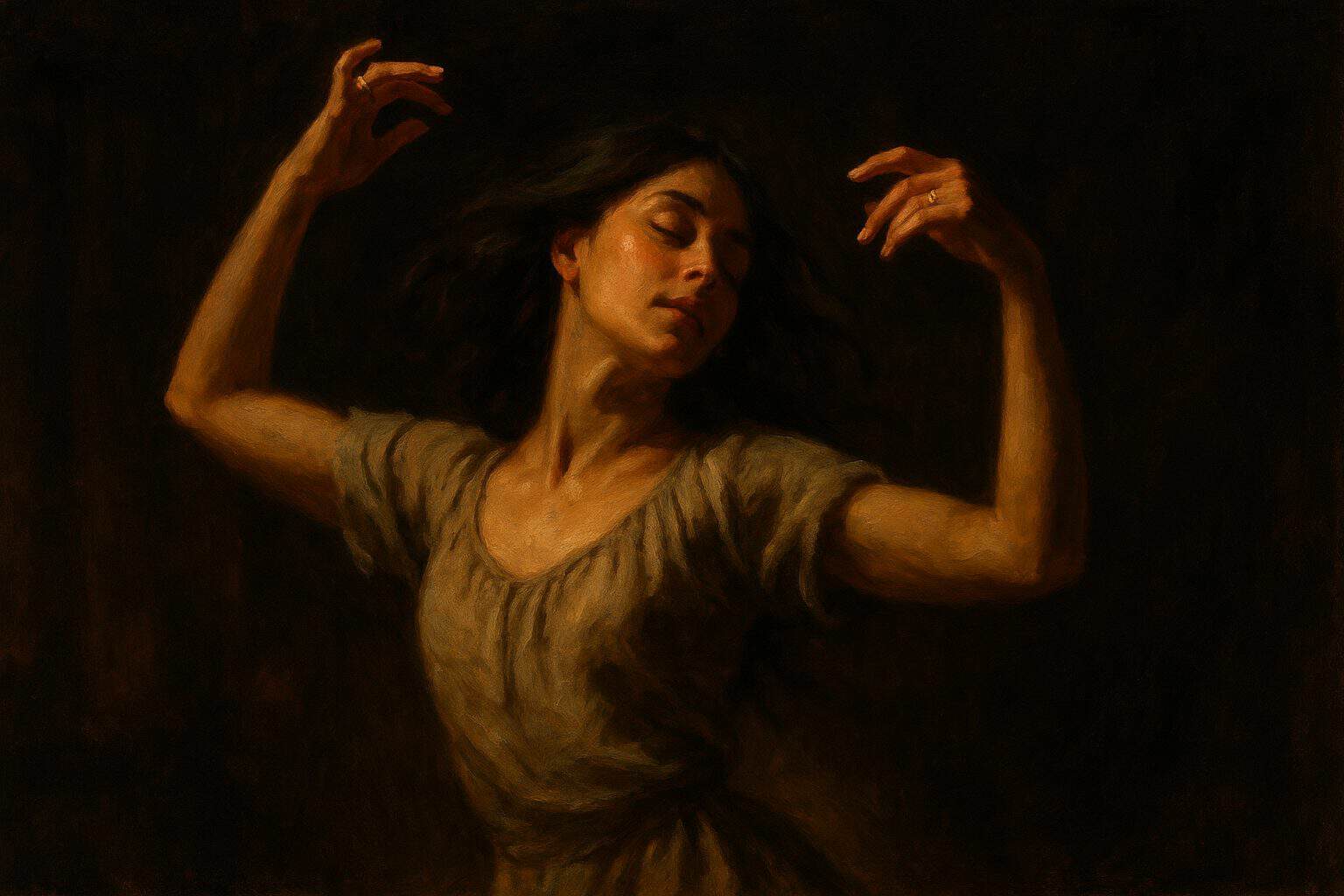
Where flesh and spirit meet, not as strangers but as lovers who have always known each other
The First Recognition
The body grounds our thoughts. The physical anchors the spiritual. This truth arrives not as doctrine but as lived discovery—in the moment when grief tears through us and we understand that we cannot feel without flesh. The tears that fall are not merely physical secretions; they are the spirit’s own language finding its only possible expression through salt and water. Unlike angels, we do not hover above our emotions in some ethereal observation. We are the trembling hand, the caught breath, the heart that literally aches.
Watch how this unity reveals itself in the simplest gestures. A mother reaches for her child—the movement begins somewhere deeper than decision, somewhere before the division of soul and sinew. Her arms know what her mind has not yet formed into thought. The reaching itself is the love, not its mere expression. Each brings their bodies with them to every act of consciousness, beginning and ending from the perspective of the first-person plural—not “I think” but “we reach,” “we yearn,” “we remember.”
The Dance Floor as Revelation
There she was, moving to The Crystal Method though she had never heard the song before. Yet the moment the music began, she adapted so naturally that it was I who felt out of place in my own soundtrack. Here was flesh responding to rhythm with an intelligence that bypassed all conscious mediation. The body knew. The body remembered something the mind had never learned.
This is how the unity shows itself—not in careful theological reflection but in the immediate response of limbs to beat, of breath to melody. The music that once served as a mechanism for self-torture, those love songs that carved out hollow spaces in the chest, transformed into something else entirely. Martin and Adam’s music, fixating on ‘the moment,’ sometimes mocking love and sentimentality with brazen lyrics, became a perfect counterweight. Not because it denied the body’s memory of pain, but because it called the body back to its own present vitality.
Get your body! Adamski commanded, and in that imperative lived a profound theological truth. Not “transcend your body” or “overcome your flesh,” but get it—claim it, inhabit it, recognize it as the very medium through which spirit moves in the world.
The False Division
“The spiritual part of me knows that everything will be okay, but the human part of me misses them.”
How often we hear this at funerals, this well-meaning but mistaken parsing of grief. They say these things assuming that spirit and flesh exist as some kind of mutually exclusive duality. They are not. The missing is spiritual. The ache in the chest where the beloved’s absence lives is the soul’s own testimony. We could talk about how the heart and soul yearn to have their existence acknowledged before death closes the door, but even this talking happens through tongues and breath, through the physical apparatus that makes confession possible.
Augustine knew this restlessness, this perpetual movement between dispersal and gathering. But notice how he knew it—through the very flesh that tossed and turned in his bed, through the body that walked the gardens of Milan, through the hands that wrote and wrote and wrote his Confessions. The spiritual autobiography required ink and parchment, required the physical act of remembering, the bodily posture of kneeling in prayer.
Touch as Theology
Touch becomes a separate dialogue, one that runs parallel to words but speaks its own irreducible truth. In the meeting of skin, something happens that no amount of verbal exchange can accomplish. Not because touch is “merely” physical, but because it is the place where spirit finds its most honest expression. This culminates in sensuality: the point in sex where the spirit of each resonates in the flesh.
Here Merleau-Ponty’s insight illuminates: the lived body as our primary opening to the world, not a container for consciousness but consciousness itself in its worldly engagement. The lovers do not have bodies that they bring to their encounter; they are the reaching, the touching, the interpenetration of flesh that speaks what words cannot hold.
But beware the subtle idolatry of making another human being your ultimate source—your lowercase “g” when only the uppercase “G” deserves that place. The unity of flesh and spirit in human love points beyond itself, transposes (as Lewis might say) into a higher register where the Incarnation itself becomes the ultimate validation of our embodied existence.
Memory in the Muscles
My heart recorded what my mind could not yet grasp: Jor-El’s soothing words to his son, concepts I would revisit years later. This is how wisdom often arrives—first as a bodily impression, a felt sense that only later unfolds into understanding. The body remembers what the conscious mind has forgotten or never quite caught. No one’s heart is a tabula rasa. We carry ghosts of who we were with others and ghosts of who others were with them—and these ghosts haunt the meeting of any two people in the present moment.
Joseph Lyons speaks of remembering-as-growth, where the lived body continuously develops by incorporating meaningful experiences that become integral to what the person is rather than what they possess. The memories are not stored somewhere; they are the particular way this shoulder curves, this gait developed, this gesture emerged. We are our history made flesh.
The Descent as Ascent
“Do not resent the descent; it is where the ascent finds its meaning and purpose.”
The spiritual journey does not leave the body behind but brings it along, transforms it, reveals it as always already sacred. John of the Cross knew this in his dark night—the soul’s purification happens through very physical trials, through the body’s exhaustion, through tears and trembling. The darkness is not abstract but lived as sleeplessness, as the weight in the limbs, as the constriction in the chest.
Viktor Frankl discovered meaning in the concentration camps not through pure thought but through the actual, physical choice to share his last piece of bread, to help another prisoner stand, to maintain his bodily existence as an act of defiance against forces that would reduce him to mere flesh. The will to meaning operates through the will to continue the bodily gestures of care, dignity, presence.
The Harmony
This harmony is not the victory of one music over the other; it is not the annihilation of Lilith’s “loud and vain” chord. Rather, it is the recognition that the loud and the quiet, the vain and the humble, the flesh and the spirit were never separate musics to begin with. They were always one symphony played in different registers, sometimes emphasizing the bass notes of bodily existence, sometimes soaring into the treble of spiritual aspiration, but always, always the same unified song.
The manuscript reveals itself as genuine and performative. Both. It was both. Just as exposure to diverse lessons provoked an intellectual evolution, the emotional evolution came through the same embodied student sitting in actual classrooms, walking across real campuses, carrying books whose weight mattered as much as their content.
The Woven Self
What is born of human nature is human; what is born of the Spirit is spirit. Yet in the living person, these births are not successive but simultaneous, not separate but interpenetrating. We are not spirits trapped in flesh nor bodies animated by alien souls. We are the weaving itself—the place where matter becomes articulate and spirit becomes tangible.
Peter Kreeft points to the Incarnation as the ultimate validation of this unity. God became flesh not as a temporary disguise but as the permanent revelation of what humanity was always meant to be. The supernatural breaks into natural existence not to destroy it but to reveal its deepest truth: that it was always meant to be the place where heaven and earth meet.
In awe, we recognize ourselves as this meeting place. Not despite our flesh but through it. Not beyond our bodies but as them. The woven self is not a problem to be solved but a mystery to be lived, a gift to be received with wonder. Every breath is both oxygen exchange and prayer. Every heartbeat is both hydraulic function and love’s percussion. Every gesture is both movement through space and meaning made manifest.
We are, astonishingly, exactly what we appear to be: embodied spirits, ensouled flesh, the impossible made daily, the eternal walking around in time. And in this recognition lives the awe—not at some distant divine reality but at the immediate miracle of our own woven existence, where every moment flesh and spirit refuse their false divorce and insist on their ancient, indissoluble marriage.