How to be a failure: when logic can’t win her back and God stays silent, you learn the hardest tenderness for the self you were taught to despise.
Two Years Laid on the Table Like Evidence
I keep returning to the moment I spread our whole history out like papers in a case. Three and a half months on her side, two years on mine — I said the numbers out loud, slowly, as if arithmetic could bind a heart. My logic felt impeccable that night. It felt like a proof no honest person could refuse. She met my eyes and then looked at the floor, and something in that small turning of her face told me more than any of my figures. I did not read it. I pressed harder, because pressing was the only thing my hands knew how to do. This is the picture I carry from Confessions to the Empty Chair: a man who believed his intelligence was a blade, drawing it against a person who had already gone quiet somewhere inside herself. The older man writing this sees the boy standing there, so proud of being right, so certain that being right was the same as being safe. The room held two people at wildly different distances. She was near enough to touch, and already across some border I could not name, and my whole body refused the news of it. I mistook nearness for having her. I confused the fact that she was still in the room with the belief that she was still mine. What strikes me now is not her leaving but my certainty — how I trusted my reasoning the way a small child trusts a parent’s hand, sure it would carry me across. It had carried me before, in colder rooms, in sharper arguments where I had learned to turn words into armor and touch someone without ever being touched. I had learned young that to win was to survive. And here I was winning nothing at all. If you have ever laid your case before someone who had stopped loving you, you know the exact chill of it: the more correct you become, the more alone you stand. The air itself seemed to thin. My voice grew steadier as her silence grew deeper, and I read that steadiness as strength when it was only fear wearing a suit. I want to be tender with that boy now. He was not cruel for wanting to be understood. He simply had not learned that understanding cannot be compelled, that love is not a debt you settle by producing better evidence than the other side. He was trying to stay alive the only way anyone had taught him. I look at him across all these years, kneeling in his own certainty, and I find I cannot despise him. I ache for him. I would put my hand on his shoulder if I could reach that far back.
Denomination Held Up Like a Locked Gate
Then she changed weapons. Catholic and Baptist, she said, as if the two words alone settled everything — as if a pair of labels could carry the whole freight of what she did not want to say plainly. And I did the thing I always did with a problem. I answered it. I told her that her church had roots in mine, that the Reformation did not spring from nothing, that it borrowed and split and traced its way back to a structure that came first. History and fact, I said, as though facts were what stood between us. In a way, I told her, you are already Catholic. I remember the small heat of pride in my chest, the pleasure of the man who knows the timeline and can lay it out clean. She turned her face away from me. That turning is the whole scene to me now, more than any sentence either of us spoke. She was not asking for a lesson in the history of a divided Church. She was reaching for any wall she could raise between us, and I kept insisting the walls were not real, that I could dissolve them with the right paragraph. The older man reading this sees what the boy could not bear to: when a person hands you a reason, sometimes the reason is a gate they need to keep shut, and your task is not to prove the lock is broken. I treated her denomination as an error in the record. I treated her whole quiet retreat as a mistake I could correct. What arrogance sat in that — and what terror underneath it. Because if her leaving was only a mistake, then it could be fixed, and if it could be fixed, then I was not being left. Correctness was my last shelter, and I would not step out of it. As long as I was winning the argument, I did not have to feel the floor tilting under my feet. I confess this now without flinching: I would rather have been right than have felt what was actually happening in that room. Being right kept my hands busy. Being right kept me upright for a few more seconds. But the distance between us widened with every point I scored, and I could not feel it widening because I was so pleased with my own mouth. There is a kind of faith that works by darkening the very cleverness we lean on hardest, emptying the mind of its confident maps so that something truer might finally get in. That night my mind was full and useless. I stood in a room that seemed to grow larger by the minute, clutching my facts, honestly bewildered that the woman I loved kept drifting toward the far wall no matter what I said.
The Flesh Kneels Before the Mind Will Sign
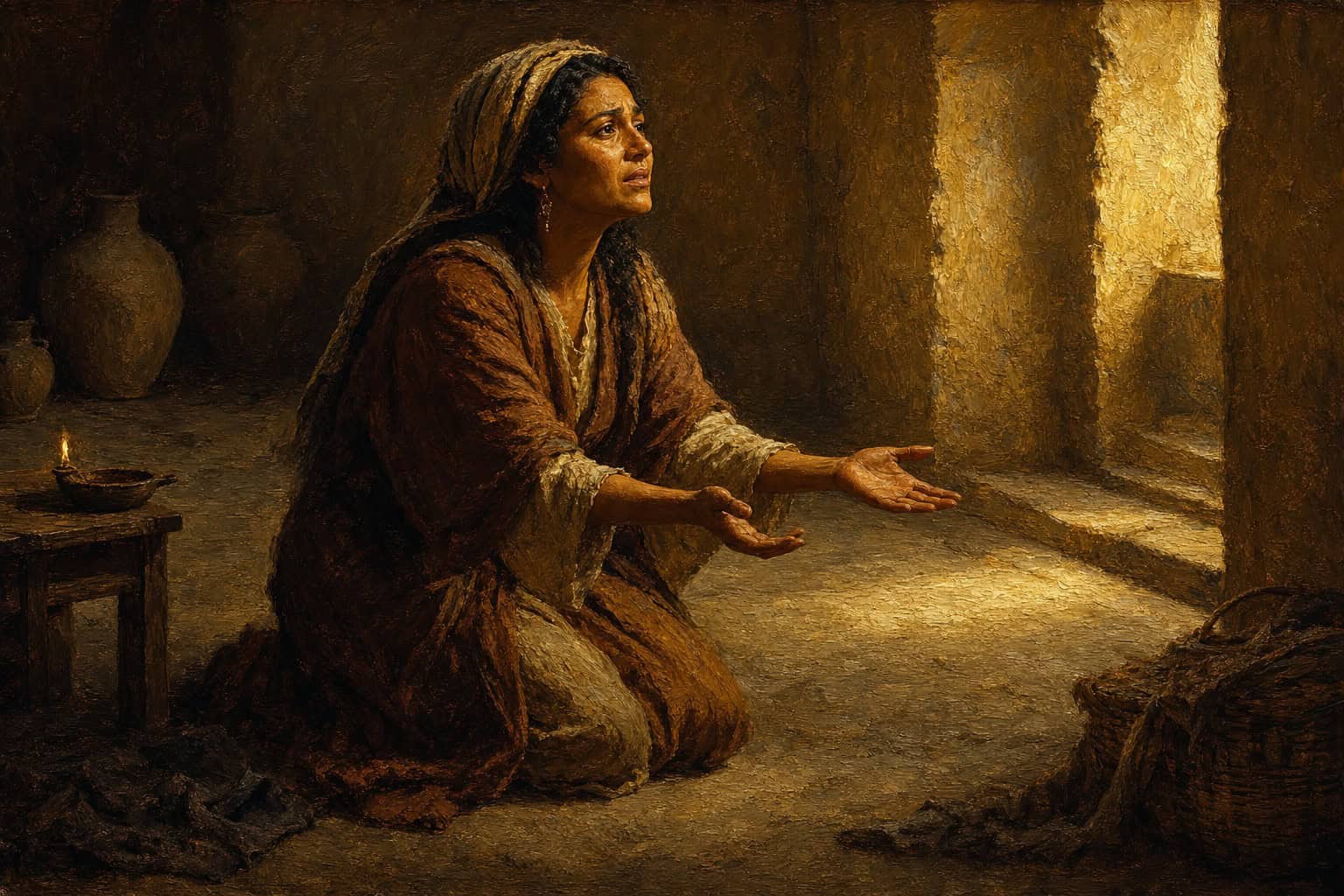
There is a moment the passage names that I could not have named while I was living inside it. A weight came down on my chest — a suffocating pressure, a heaviness that felt spiritual before it felt physical, the kind of thing that should have dropped a man straight to his knees on the floor. And yet my mind kept calculating. My mind was already assembling the next argument, the better explanation, the plea for a little more time to make her understand. But my body had stopped waiting for my thoughts to catch up. My body already knew. My chest admitted the death my reasoning still refused to sign its name to. This is the strange, terrible honesty of the flesh: it weeps the truth onto cold ground while the intellect is still doing sums in the corner. I have come to trust the body more than the clever part of me, because the body is less able to tell a beautiful lie. It felt the loss like a stone dropped into water long before I would allow myself to feel anything. My breath went shallow. My hands, which had been so busy laying out evidence, did not know where to go. Something in me was dying in front of a person who watched it happen with a face I could not read, and no argument I had ever won prepared me for the helplessness of that. I had built my whole life on the belief that if I understood a thing completely, I could master it. Here was a thing I understood and could not touch. Here I learned the tenderness I now most want to hand that younger man: the collapse of the body is not weakness or shame. It is honesty arriving ahead of the mind. It is the truest part of a person telling the truth before the proud part is willing to hear it. I do not scorn that kneeling boy. His knees knew what his tongue would not admit. And in that unguarded honesty of the chest there was something almost holy, some first crack in the armor I had spent years welding shut. The clever man could keep talking, but the body had already begun to pray, wordless and low, in the only language grief permits.
A correct argument cannot resurrect a dead feeling; you can be entirely right and still be left standing in an empty room.
Begging Heaven to Breathe Into a Corpse
What I did next I can barely watch, even now, even from this distance of years. I held onto her memory the way a parent holds a child who has already stopped breathing — rocking what I held, soothing it, refusing the limpness in my arms, certain that if God only saw the depth of my sorrow He would breathe life back into what had died. I bargained with the silence. I offered my grief up as though it were a coin heaven would have to accept. Where are You, I asked into the dark, and the dark did not answer. He remained silent when I needed Him most. That silence is the hardest thing I carry out of that night, harder than her turning face, harder than the crushing in my chest. I knew — I was sure — that God could have done something. I stood there and watched Him do nothing, and I decided in that moment that miracles were for other people and not for me. The older man reading this holds that conclusion gently now, the way you hold something a hurt child said in the middle of the worst hour of his life. It was not the whole truth. But it was the truth he could reach. Here is what I have come to see, and I say it plainly. God does not animate what has chosen its own death. He will not force a heart back into loving that has stopped, not even for the sake of a man rocking a corpse of a relationship and pleading. The silence itself was the answer, though I could not receive it as one. And yet — this is the thing I missed entirely — the silence was not absence. He was not gone from the room. He was there in every tear I let fall onto the floor, walking beside a foolish, arguing, kneeling man, present inside the grief He would not remove. That is the whole quiet spine of the book. Grace rarely arrives as rescue from the dark. Far more often it walks with you into the dark and stays. I wanted a miracle that would erase the wound. What I was given, though I would not see it for years, was company in the wound. He did not lift me out of that emptying room. He knelt down in it with me. I could not feel Him then. My cleverness was too loud, my bargaining too desperate. But looking back I can see the shape of Someone who did not leave when the person I loved did.
Learning to Fail With Open Hands
So how do you become a failure — a real one, the kind that cannot be argued away? You stop trying to win the room. You let the case fall out of your hands. You allow the numbers, the history, the theology, all the sharp tools you sharpened to survive a childhood of sharp arguments, to lie useless on the table where you spread them. You let the body kneel. You let the tears fall onto the concrete without narrating them or turning them into a better plea. This is where Confessions to the Empty Chair has led me, chapter by chapter — not to a technique for avoiding loss but to a slow, unwilling education in how to lose without disappearing. I was taught, somewhere far back, to reduce love to strategy, to make contact without exposure, to keep the words of love behind a wall while I managed the outcome. That wall never once saved me. It only left me alone in a widening room, right about everything and held by no one. The failure I feared was never the real danger. The real danger was building a self so armored that no one could reach it and no grace could get in. I know now that the void I ran from — the silence, the solitude, the being-left — was the very ground where a self could finally form, where the flimsy man made of arguments could be quietly unmade and something sturdier begin. I do not offer this as a tidy moral. The wound is real, and it stayed a wound for a long time. But I can be tender at last with the boy who wept on that floor, because I see what he did not: he was not being punished. He was being emptied so he could be filled. To fail is not to be abandoned by love. It is to discover, in the ruin of everything you tried to control, that you were held the whole time by hands you refused to feel. I would tell him this if I could reach him. I write the book, in part, so that someone still kneeling in an emptying room might hear it in time.