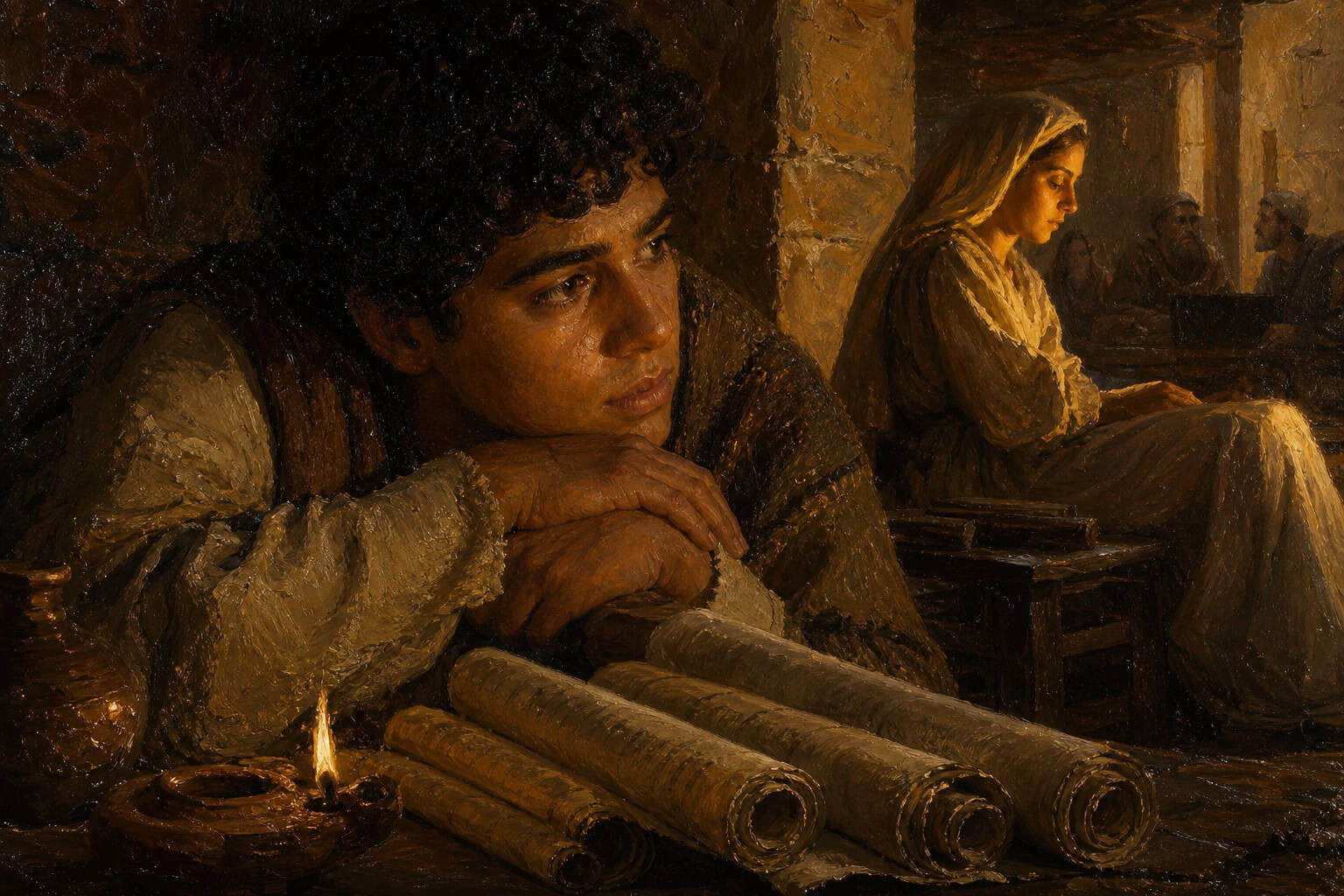
Struggling with the results of childhood abuse? A memoir’s scene shows how a wounded man meets true gentleness and recoils from spreading his darkness.
A Boy Who Counts the Exits Before He Learns the Faces
You want to know what abuse does to a child once that child grows up, once he is old enough to sit in a lecture hall and argue about Dante without his hands showing the tremor. The scene in Confessions to the Empty Chair answers you sideways, through a young man in a Literary Tradition class who arrives alone and leaves alone, on purpose, every single time. Watch him enter. He comes in and his eyes go first to where he could leave, then to the seat that puts a wall at his back, then to the distance between himself and everyone else. He has learned to measure a room the way other people breathe, without thinking, all reflex. Long before Kerri ever spoke to him, she watched him do this, week after week, from a few seats over, and she read the loneliness in it as a puzzle worth solving. What she could not have known is that the isolation she found interesting was built brick by brick in a childhood that taught him nearness was where the harm came from. A hurt child learns young that the people closest to you are the ones with the clearest shot at you, so the grown man keeps everyone at arm’s length and tells himself the distance is dignity. He sits there fluent in Milton, wounded in ways he will not name, presenting his ideas cleanly while the ground under them is split. The cruelty of it is how competent he looks. Nobody watching him take apart a poem, line by careful line, would guess at the machinery underneath — the constant scanning, the muscles half-ready to stand and go. This is one plain result of early abuse: the survivor becomes an expert at seeming fine, and the seeming hardens into a second skin harder to shed than the wound it hides. He has turned his solitude into a costume. Some days he wears it as devotion. Some days as intellect. Some days as a quiet monkish superiority over the loud, easy people around him. Underneath every version is a boy who never stopped watching the way out. The book does not let him off easy for this, and neither should you. It names the loneliness as a real injury and also, without flinching, as a defense he chose once and keeps choosing every morning he walks in early to claim the safe seat. So what abuse leaves behind is not only the damage done to a child. It leaves a whole grown structure, built with care, whose only job is to make sure the damage is never seen again. He enters every room already braced. That bracing, held tight for years, is the injury still alive in the man.
She Names Him After Heroes and He Cannot Explain Her Calm
Kerri does the one dangerous thing his world is built against: she comes close on purpose. She laughs at his jokes, really laughs, not to be polite. She names him after the books she catches in his hands, teasing him with the names of clever heroes, folding flattery inside play so lightly that he lets it land before he can stop it. And he likes it, which unnerves him more than any cruelty could. She is Catholic like him, but where his faith sits in him like a bruise, she seems to carry hers as light — a peace that rises off her the way warmth rises off skin. He watches that calm across the desks and cannot account for it. To a man raised in the wreckage of harm, real gentleness reads as an alien thing, a different creature altogether, and his first move is to explain it into something smaller. He decides her peace must be naïveté. Or inexperience. Or some lust she simply has not learned to feel yet, the same charge he has already leveled, silently, at every woman in the building. This is the tell, and it is a loud one. The abused mind cannot allow hope to be genuine, because if her hope is genuine, then his own darkness stops being a fate and becomes a choice — and that is unbearable. So he shrinks her. He turns a whole living woman into a theory about what women are, a specimen to file and label, because a specimen has no power to wound you and a person does. Here the book shows something merciless and exact about survivors: they build cold systems to get through warm moments. He meets her tenderness with analysis, and the analysis is armor pulled on fast. What passes between them at that desk is not an even trade. She approaches open, curious, wanting to know who this guarded man actually is. He receives her while quietly deciding she is too simple to be a threat, and the deciding lets him relax. And yet something slips past the guard anyway. He values her friendship. He enjoys her company in a way he did not plan for. He notices, against his own will, that her mind holds a stillness his has never once known. The older narrator, looking back at this desk, does not spare the younger one. He sees the arrogance in the reduction. He sees the fear crouched under the theory. He sees how he flattered himself by making her small. And he puts the hard question to himself, the one this whole chapter turns on: did he ever, even for a minute, let Kerri be more than a mirror or a threat? Did he see her at all, or only the version of her that kept his walls standing straight? A hurt man seated near a whole one — that is the tension the scene holds, and it will not smooth it over for anyone’s comfort.
The Cruel Mercy of Refusing to Ruin Her
Then comes the turn, and it is stranger than plain shame. He looks at Kerri, feels no pull toward her body at all, and finds inside himself a hesitation he almost cannot recognize as his. He does not want to touch her. Not from weakness. Not from some rule drilled into him at church. From a raw, sudden conviction that what he is would contaminate what she is. He sees his own depravity clearly, the way you see a stain, and he sees her purity just as clearly, and the thought of pressing the one into the other genuinely saddens him. Even at his darkest he knows there is one place he should not go, and she is that place — a whole person he has decided to leave uncrossed. This is the scene’s revelation, and it cuts in two directions at the same instant. On one side it is the closest thing to grace this chapter allows: a man steeped in ruin who still, against every habit he owns, refuses to carry the ruin over to someone clean. He holds back. He lets her stay unspoiled by him. On the other side it is its own quiet despair, because he names himself as evil so flatly, so without argument, that protecting her can only mean keeping her at a distance forever. He cannot picture being near her without infecting her. Nearness, to him, is transmission. That is exactly what early harm teaches a soul about itself, and the lesson goes deep. It teaches you that you are a carrier of something. It teaches you that closeness spreads a sickness. It teaches you that the love done to you when you were small was a wound, and so any love done by you must be a wound in turn, passed hand to hand like a fever. He does the decent thing here. He truly does. But the reason he does it is a verdict he has already passed on himself, and the verdict was handed down in childhood, in rooms he did not choose to be in. So the mercy is real and the mercy is a wound at once. He guards her purity by exiling himself from it. He calls that love, and part of it is love, and part of it is a sentence he has been serving so long he no longer feels the chains.
The wounded do not fear their own darkness most; they fear that someone clean will draw near enough to catch it.
He Calls It Kindness, Then Catches the Lie Underneath
He would like to leave it right there, wearing the restraint like a small crown. He kept his hands off the innocent one. He protected her. Good man. But the narrator, older now and unwilling to be flattered, will not let the pretty story stand, and this is where the book earns your trust on the very thing you came asking. Because right on the heels of the tender refusal comes the confession that guts it. His real reason, he admits, was never chiefly her purity. It was his own wish to sidestep emotional complication. He did not want someone clinging to him. He did not want the mess of being needed, of being known, of a woman staying in his life past the moment he could still control the exits. So the beautiful hesitation opens a trapdoor, and below it sits a second floor, and the second floor is fear wearing the face of virtue. He finds a new layer of his own dishonesty precisely inside the act that looked most decent. This is the terrible sight that comes to survivors who wander too near something holy: the closer the light draws, the more sharply they see what they actually are. Kerri’s calm was that light, unasked for, sitting a few seats away and laughing at his jokes. And in its glow he cannot keep the comforting picture of himself intact. He wanted to believe he spared her out of love. He learns he spared himself out of dread. The fallout is all inward, no scene, no confrontation — just a man realizing that even his mercy had a self at the center of it, that he had borrowed the language of protecting the innocent to hide from the plain risk of being seen. So what does abuse leave in the grown man? It leaves this doubled motion, where real goodness and self-protection are braided so tight he can no longer pull one strand from the other. He genuinely did not want to ruin her. He genuinely could not bear the openness she was holding out to him. Both are true at the same time, and the book refuses to hand him the clean version of either. It makes him sit inside the tangle without a knife to cut it. And the searching voice keeps asking the questions that have no soft landing: was any of my tenderness real, or was all of it one more wall dressed up as care? Did I love her friendship, or only love that it asked nothing of the self I keep buried? These are the questions the wounded eventually have to face, and this passage will not answer them on his behalf. It leaves him holding them, and leaves you holding them beside him.
Company in the Room He Would Not Let Anyone Enter
What settles over the scene at the end is not repair. There is no moment where the man is healed, no embrace that mends the childhood, no clean line where faith walks in and lifts the darkness off him like a coat. That is not how this book tells the truth, and it is far closer to your actual life than any comfort would be. What it offers instead is stranger and much quieter. God is near him in that lecture hall. Near him in the very act of reducing Kerri to a theory and dodging her open hand. Near him inside the sin, down in it, not standing outside waiting for him to wash up and become presentable first. This is the faith the whole memoir carries in its spine: grace rarely hauls the survivor out of his darkness, but it goes down and walks with him in it — present in the flinch, present in the false mercy, present in the exact minute he cannot yet love a soul. The nearness itself is the mercy, and it comes with no fanfare. He does not feel better for it. He may not even notice it happening. Yet the older narrator, looking back at that guarded desk, seems to know that even in the seat where he let no living person truly in, he was not, in the end, alone. So here it is, plainly, what childhood abuse leaves in the grown man: an expert loneliness worn as a virtue, a habit of turning people into theories so they lose the power to hurt him, a body that reads every room for the nearest way out, and a settled conviction that he is a contaminant who must keep the clean ones at a safe remove. It leaves him unable to tell his own tenderness apart from his own terror. It leaves him fluent and hollow, protecting others in ways that also protect his hiding place. If any of that lands close to home — if you feel worse the nearer you come to what is good, not better — this scene will not slide a solution across the table to you. It will do the rarer thing. It will set a man down exactly where you are standing, seen without contempt, watched over without being fixed. Confessions to the Empty Chair stays in that cold, careful room with the survivor and quietly insists the room was never empty. That insistence, unresolved and steady, is the hand that pulls you further in.