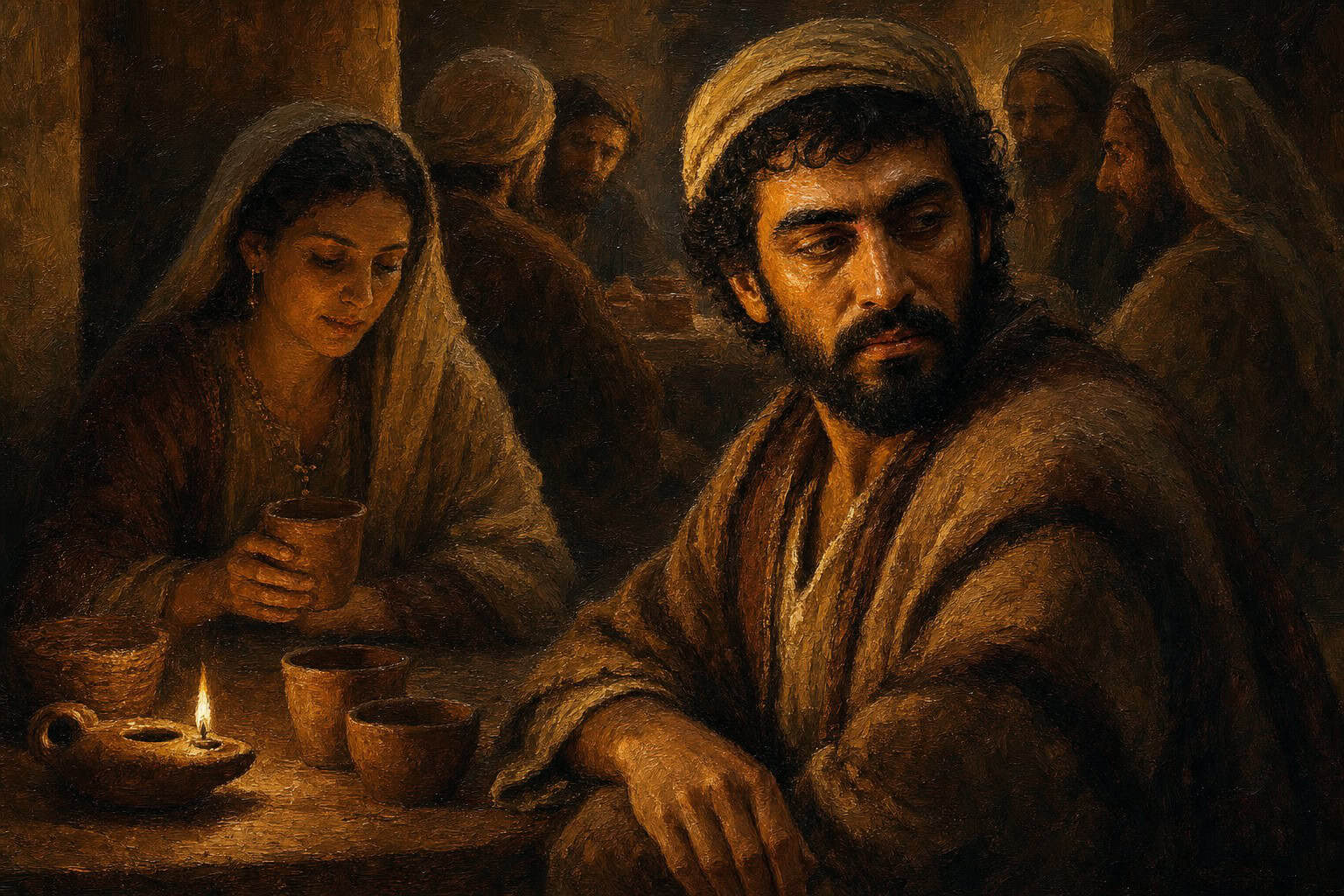
Social role playing games have hidden rules because you never meet a person alone. Here’s what really enters the room when two people meet.
The Chair Across the Table Is Already Crowded
Coffee steams between you and a face you barely know. You want this to be simple: two people, one small table, a clean start. Then your shoulders climb toward your ears at a word you did not expect to sting. Their laugh lands wrong and you cannot say why. Your cup is warm in your hands and your stomach is not. This is the ordinary secret behind every social role we step into: the meeting is never just two. The opening pages of Fractions of the Soul set this table plainly, in the first chapter, before any story has room to move. A person, the book argues, cannot be seen head-on. You catch them the way stargazers catch a black hole—not by staring at the thing itself, which gives off no light, but by watching how everything nearby bends. A beam of light drifts off its true path. A star wobbles where no star should. Something heavy is there, unseen, pulling. That is what a human being does in a room. You feel the pull in your own chest before you can name the mass that makes it. When you search for the rules of these social games—why one person must never be contradicted, why a certain tone snaps a conversation shut, why plain kindness sometimes reads as a trap—you are already sensing that gravity. The rules are real. They were simply written long before you pulled out your chair. The stranger across from you carries every hand that ever fed them, every voice that praised them, every back that turned away. Those figures are not old photographs filed in some drawer of the past. They are here, breathing, quietly rearranging the room. The book calls the smallest gestures breadcrumbs—the crumbs a person scatters as they move through the world, conducting the plain business of a life. Watch enough of them and you can walk the trail backward to the mind that dropped them. You do not need a confession. You need attention that does not blink. The tightening in your own shoulders is a breadcrumb too. So is the way you soften toward this person without once deciding to. This is the honest starting point the chapter offers, and it beats any list of tips on how to charm a room. You are not failing to learn the rules. You have joined a game already underway, seated among players you cannot see and were never introduced to. The first task is not to win. It is not even to understand. It is to notice that the rules exist at all, to feel their weight land in your body a beat before your mind catches up, and to stop mistaking the game’s difficulty for your own defect.
The Séance Nobody Announced
Lean in and the crowd only thickens. The chapter presses a stranger picture on us, and a truer one: every meeting is a séance. The moment two people begin to speak, the room fills with ghosts. Not the dead—the living history each one drags in on their coat. The mother who rationed praise like it cost her something. The friend who vanished without a word. The one who wounded and was never made to answer for it. These presences do not wait politely in the hall. They walk in and take up the choreography of the dance. You reach for a gentle word and an old hand seems to guide yours. Your companion flinches at warmth because warmth once arrived with a bill attached. This is why the games feel rigged with rules nobody taught. You are not playing against one person across a table. You are playing against a whole gathered assembly, and so, exactly, are they. The book insists that the observer who cannot see these ghosts sees nothing at all. That line should unsettle anyone who prides themselves on reading people fast. Quick reading catches only the surface player and misses the crowd standing behind the chair. Notice how a small favor makes someone tense instead of grateful, and you have glimpsed one of them. Notice how a compliment sends their eyes hunting for the catch, and another steps forward out of the shadows. The traces of old loves and old harms do not stay conscious and tidy. They slip past the guard at the door of the mind. They seep through into the waking self and demand a hearing even when a person is alone in a dark apartment at two in the morning. This is why solitude is never truly empty. The uninvited guests arrive on schedule. They pull up chairs. They talk. The one who feels most alone is often the most crowded of all. Here the chapter grazes something close to erasure—that slow dread of not being seen, of being not quite enough to be kept, of dissolving under another’s gaze. When you meet someone who fences off a certain subject with sudden frost, you are standing near a place where they once felt themselves disappearing. They learned a rule there to survive it: do not go here, or I vanish. You did not write that rule. You simply tripped the wire. The tension of any new bond is precisely this—two haunted people, each hauling in a full room of the invited and the uninvited, trying to feel out where the furniture stands in the dark. Every social game holds these hidden pieces. The board looks bare and is packed to the edges. Learn to feel the crowd, and the strange rules stop reading as cruelty. They begin to look like scars, and scars can be read with mercy instead of baffled hurt.
The Louder the Defense, the Softer the Thing Behind It
Now the turn arrives, and it rewrites how you sit at every table after this one. Watch where a person guards with anger or with tears. Watch the topic that hardens their voice mid-sentence, the joke that lands with far too much force, the subject that turns them silent and stiff as a held breath. The book teaches that these defenses are not walls to be shoved through. They are maps. The ground a person protects most fiercely is the ground where they are most tender. What we hide with the greatest fury reveals who we most truly are. This flips the whole game on its head. Most people treat resistance as a stop sign—back off, change the subject, do not press. The observer this chapter describes reads resistance as revelation instead. The stronger the guard posted, the more precious the thread it stands over. So when your companion snaps at a harmless remark, you have not stumbled onto their worst self. You have stumbled onto their most breakable one. The flash of anger is a hired guard planted in front of something small and frightened and unhealed. This is the moment the black hole gives itself away. You still cannot see the center; no instrument built reaches that dense heart, and none ever will. But the bending light tells you the mass is there, and now you know exactly where to look—not in what they show you, but in what they cover with their whole body. This is where the search for social rules quietly changes into something deeper. You stopped asking how to win the game. You started asking what each defended border is guarding, and why. The strict rule you kept tripping over was never arbitrary. It was posted by someone who once got hurt on that exact ground and swore never again. Read it that way and the whole table softens. The frost around a subject is not rejection of you. It is an old wound wearing armor. And the same is true, you will begin to suspect, of every place you yourself have quietly fenced off and marked do not enter.
We never meet a single person; we meet the whole crowd that made them, and they meet ours.
After the Guard Steps Aside
The knowledge works on you before it works on anything between you. Once you see defenses as maps of shame, you cannot un-see them, and the first face they reveal is your own. This is where the fallout settles, and it settles on both sides of the table. If the strongest reactions guard the tenderest truths, then your own strongest reactions are standing guard over yours. The finger you point swings slowly back toward your chest. That sudden heat when someone questions your work, your faith, your loyalty—that heat is a torch held over your own soft place. The game was never one-sided. You carried your ghosts in too, and they have been choreographing your steps since before the coffee cooled. The chapter names this without flinching: seeing yourself straight on is impossible. You cannot peer into your own center any more than you can peer into another’s dark mass. But you can study the distortion you make in the room. You can watch the exact way you bend the people near you off their paths. Who goes quiet the moment you arrive? Who braces without knowing it? Who softens and leans in? Those responses are your breadcrumbs, and they lead back to a self you will never catch head-on in any mirror. This is humbling work, and it ought to be. The book warns against the easy road, the gravity of the crowd that drags us toward the familiar the way a slope pulls water. Most people choose a predictable ache over the raw fear of real freedom. It is easier to curse the rules than to admit your own hand helped ink them. It is easier to brand someone difficult than to ask what your presence stirred awake in them. The comfort of the habitual mood is a trap dressed as a favorite chair. You sink into one fixed way of reading every new face, and then you meet no one new at all—only old faces wearing borrowed clothes. Repeated roles harden over the years into a mood that tints everything after, the way old smoke yellows a ceiling. If you were made small early, you will hear smallness aimed at you in rooms that hold none. If you were once left, you will scan every warmth for the door it will leave through. This is the shame the chapter refuses to look away from: the wish to cover yourself and vanish from your own sight. But covering changes nothing about the mass beneath. The light keeps bending around it. The game keeps running whether you watch it or turn your back. The only real decision left to you is whether you sit down awake.
The Soul That Gathers the Crowd
So where does all this settle. Not in a clever technique for winning the social games you came here asking about. The chapter reaches toward something older and far harder than tactics. It names the human person a kind of tabernacle—a vessel made to gather the scattered, quarreling crowd of every relationship and hold them together, and out of that holding to receive one single soul. This is the quiet promise buried under all the warping and haunting. You are not merely the sum of the ghosts crowding your table. You are the one who carries them, and in the carrying you become someone the crowd alone could never assemble. The book traces it back to the beginning: two people join, and a wholly new self is thrown into the world, needing a host of caregivers before it can want anything on its own. The many make the one. The parents’ togetherness writes the child’s separateness into being. That is the strange arithmetic of a person, and the chapter states it plainly. But the gathering does not happen by drifting. It asks for the very burden the easy road refuses—the burden of choosing, of standing awake in the room while the old choreography begs to run the dance for you. To decline that burden is itself a choice, the book says, and a fallen one. You are meant to be the one who draws the plan of what you become, and walking away from the drawing table is not innocence. It is a quiet abdication. Here longing steps in, unhurried and real—the reach toward a wholeness you can already name but cannot yet hold in your two hands. You want to meet someone cleanly, without the séance. You want to be met the same way, seen apart from your crowd, kept without the old fear crouching underneath. That wholeness is what the soul strains toward across the whole chapter, and the book does not pretend it arrives cheap or soon. Every meeting stays a séance. You will never count all the threads, yours or theirs; some connections stay guessed at, inferred from the bending light but never fully known. And still the invitation holds: notice the crowd, read the fenced-off places with mercy, watch how you bend the room, and let the weight of freedom shape you into more than the pattern you inherited. The social games you searched for are real, and their rules are strict as any doctrine. But Fractions of the Soul will not stop at the rules. It asks who is playing, and who you are turning into as you play. It leaves you there with the cup gone cold in your palm, suddenly aware of how many have quietly gathered around one small table—and aware that the crowd is yours to answer. That waking is where the book truly begins.