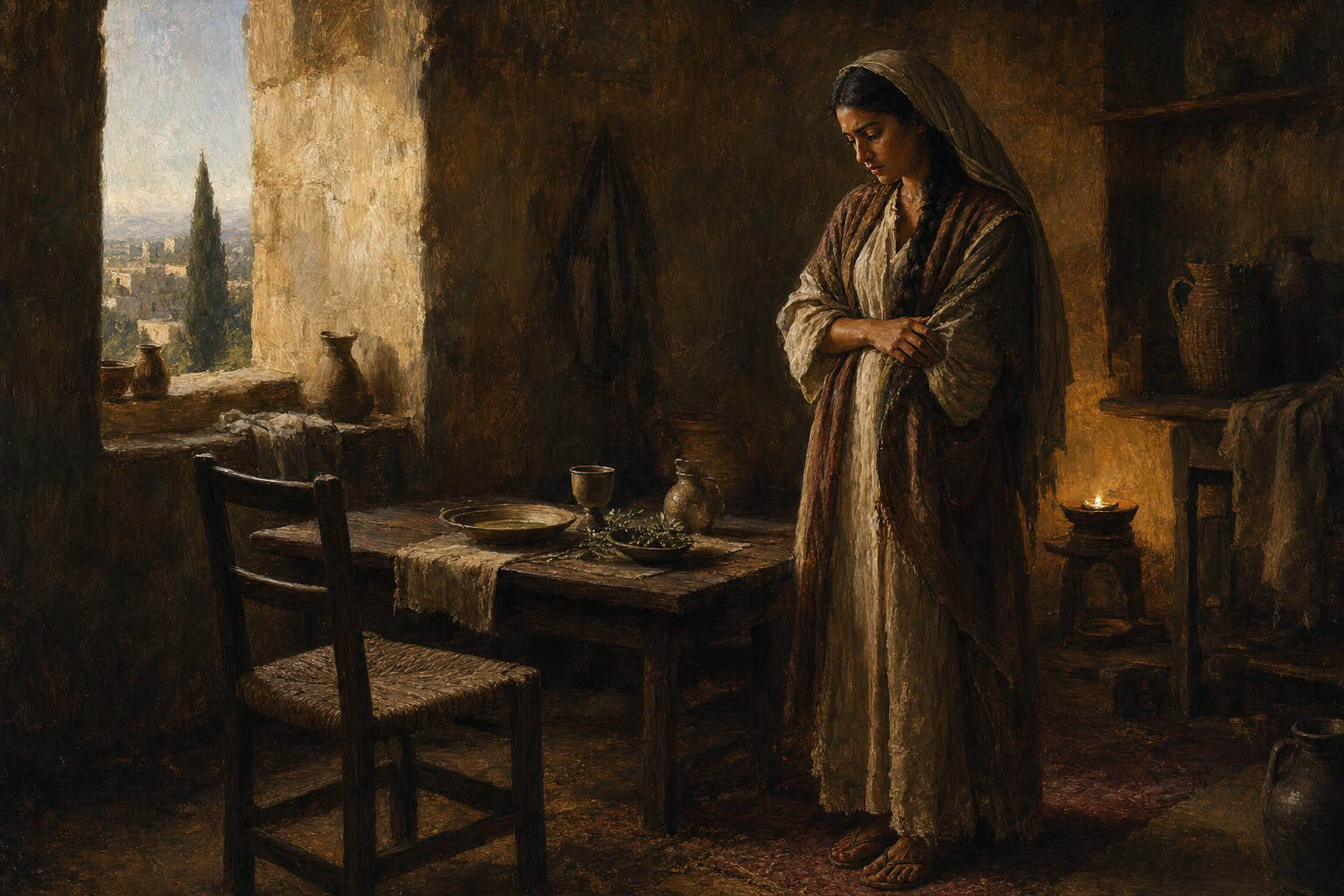
Why did he leave me? The ache lives in the body long after. A reflection on absence, mood, and the mercy that hides inside abandonment.
The Coffee Went Cold and You Did Not Know Why It Mattered
You keep going back to the place he used to be, the way your tongue keeps finding the socket where a tooth was pulled. There is the chair he sat in, still holding a faint memory of his shape in the cushion. There is his side of the bed, cold now on both halves because you have stopped crossing over. His absence has actual weight; it presses on your chest at four in the morning when the house has gone honest and there is no daylight left to lie to you. You hold the question in your mouth like a stone you can neither swallow nor spit out. Why did he leave me. You have turned it over so many times the edges are worn smooth, and still it cuts you somewhere behind the ribs. Your mind wants one clean sentence, a reason small enough to hold in a fist, something that would close the wound and let you sleep through a whole night. But the leaving was never a sentence. It was a change in the whole air of your life, a pressure drop you felt in your teeth before you understood it, and you stood under it with nothing to cover you. You remember the last ordinary morning before you knew. The coffee going cold on the counter. Some small argument that meant nothing then and means everything now, its exact words lost, only the sour taste of it remaining. You did not know it was the last of anything. That is the particular cruelty. Final moments never announce themselves. They wear the plain clothes of any Tuesday, a spilled thing, an unwashed cup, a door that closed a half second too hard. So you replay them. You hunt for the sign you missed, the flatness in his voice, the way his eyes slid off you and onto the window. You have become a detective of your own ruin, collecting evidence for a trial that will never be held, in a courtroom that does not exist. And underneath all the searching lives the thing you will not say out loud. Maybe the answer was never out there in his choices. Maybe the question is a mirror turned toward you. Maybe why did he leave is only what is wrong with me wearing kinder clothes so you can bear to look at it. You feel the tears push up behind your eyes and you swallow them down, because somewhere long ago you learned that to weep openly is to lose. So the crying goes underground. It seeps. It stains the light in every room a shade darker, and you begin to live inside that tint without ever noticing you put it on.
A Feud Between Two of Your Own Selves
Notice how the grief splits you clean down the middle. One self keeps functioning. It pays the electric bill, answers the door, says fine when the neighbor asks, carries the groceries in without dropping them. The other self lies awake in the dark building airtight cases, one hour for why none of it was your fault, the next hour for why all of it was, switching between the two like a man moving from seat to seat on a boat that is going down either way. Both selves belong to you. That is the true terror of it. You are not one person mourning; you are a divided household, and the two halves have stopped trusting each other. Your daytime self despises the nighttime self for its weakness, its rehearsed speeches to an empty room, its thumb dragging up through old messages at an hour that shames you by morning. Your nighttime self despises the daytime self right back for its lies, its clean competence, its terrible pretending. And in the gap between them the real ache goes unattended, like a child left crying in a house where the parents will not stop shouting. You want the reason he left because you believe the reason would hand you a tool. If you could just name the flaw, you could fix it, or forgive it, or file it somewhere it would stop bleeding. But your wanting and your reasoning are not on the same side in this. The longing for him is a bodily thing, low and animal; it does not care about your dignity, it wants only the return of his particular warmth, his particular voice saying your particular name. And the reasoning part of you looks down on the longing with contempt. Calls it undisciplined. Calls it beneath you. You catch yourself hating the wanting even as it drags you across the kitchen floor at midnight. There is a specific, scalding shame in being reduced to someone who waits by a phone that will not light up. You believed you were built of sterner stuff. You are ashamed to find out that you are not. And that shame doubles the loss, because now you have lost him and you have also lost the picture of yourself as someone who does not come apart. The two campaigns wage on inside your chest, the flesh that keeps reaching for what is gone and the mind that keeps sneering at the reach. Neither one ever wins. You are only the ground they fight over, and the ground is what gets torn up. This is the war no one sees when they tell you how well you are holding up. You are not holding up. You are the field, and every single morning you sweep the same wreckage into the same pile and call it a fresh start.
The Silence That Answered Was the Answer
There comes a night when you stop building your arguments and simply ask. Not him. The dark itself. You lie flat on your back and send the whole raw cry straight up through the ceiling, why, why him, why this, why me, and then you wait for something to come back down. What comes is silence. Not a cruel silence, not one that mocks you, but a silence so full and complete it feels like the room itself has drawn breath and is holding it. This is the exact moment that breaks people or remakes them, and you cannot yet tell which one it will be for you. You were told, somewhere, that if you called out sincerely enough an answer would arrive, a warmth in the chest, a settling, a sign you could point to. Instead the silence only deepens, and something inside you cracks along a seam you never knew was there, a hairline fracture you can almost hear. Here is the turn you were not looking for, and it arrives so quietly you nearly miss it. The silence is not empty. In the very hollow where you begged for an answer and got none, something is present with you. Quiet. Not speaking. Not fixing anything. Simply there in the dark while you weep into the pillow. It does not tell you why he left. It does not repair the cold arithmetic of the loss, the subtraction that keeps not adding up. It does the far stranger thing of staying. And slowly, without any words, a suspicion begins to form that you cannot prove and do not want. That the absence you are mourning might itself be a mercy folded into a shape you cannot read.
The absence you cannot forgive may be the one wound teaching you a language you would never have learned in his company.
The thought is unbearable and you shove it away hard, because it feels like an insult flung at your grief. How dare anyone suggest the loss was for your good. And yet the suspicion keeps coming back, softer each time, not as a lecture delivered from above but as a hand laid on your shoulder in the dark. You start to sense that the leaving stripped away a story you had been telling yourself for years, a story in which your worth was a debt someone else owed you, payable on demand, guaranteed by his staying. When he left, the debt you thought he owed turned out never to have existed at all. You had built your whole standing on a floor that was never yours to stand on. This is a devastation. It is also, obscurely, in some place below the pain, a freedom. You do not feel the freedom yet. You feel only the cold coming in through the crack. But the cold has swept something bare.
The absence you cannot forgive may be the one wound teaching you a language you would never have learned in his company.
The Afternoon Light Learned a Grayer Color
After that night the grief does not pack its bags and go, but it changes its texture in your hands. It stops being a wall you keep slamming into and becomes instead a weather you live inside, all day, every day. The sadness settles down into the ordinary hours. It tints the way the afternoon light comes slantwise across the kitchen table. It softens the edges of every joy so that even good news arrives wearing a gray coat, real and welcome and somehow already mourned. You go to the wedding, the birthday, the crowded family dinner, and you smile, and the smile is not fake, and underneath it the ache keeps its quiet residence like a lodger who has paid through the year. You have stopped waiting for it to end. This is not defeat. This is a kind of honesty you simply did not have before, when you still believed grief was a task to be completed. You notice, one afternoon, that you no longer ask why he left with the old clawing desperation. The question was never answered. You have outgrown it instead, the way a child outgrows a coat rather than wearing it through at the elbows. You are beginning to understand that some questions are not doors to be forced open but rooms to be lived in until the living changes you. And you have been changed. You are gentler now toward other people’s private ruin, because you have walked through your own with your shoes off. You catch the tightness around a stranger’s eyes. The too-fast fine. The way someone rests a hand on the empty side of a table without knowing their hand has gone there on its own. You have been drafted into a company you never once wished to join, the company of those who were left, and you find, to your surprise, that it is not a lonely place. There is a strange, wordless solidarity among the abandoned. Your loss ties you to a vast and silent gathering of people across every century who have sent up the same cry into the same dark and been met with the same nonanswer. You are not the first to lie awake like this. You will not be the last. You are not, as you had come to believe, uniquely and shamefully broken beyond the rest of them. That isolation was the deepest wound of all, and it turns out to have been, at least in part, a lie you told yourself. What remains is not the man. What remains is the person his leaving made of you, someone carrying less certainty and more depth, someone who has learned how to weep and, stranger still, how to be accompanied while weeping. You would never have chosen this schooling. No one signs up for it. But you can no longer pretend you learned nothing in it. The light in the room is a different color now, and you have finally stopped fighting the difference. You live under it. You know its temperature by heart.
What the Empty Chair Was Teaching You to Hear
You will not get the answer you wanted. Let that land plainly on the table, because every false comfort anyone has handed you has tried to soften it, and the softening only stretched the ache out longer. Why did he leave you is a question that may never be answered on this side of anything, and the sooner you stop demanding the reason as the ransom price for your own healing, the sooner the healing can start without waiting on your permission. What you can have is something stranger and, in the end, better than a reason. You can have the slow discovery that the leaving was not the end of you after all. The self who swore she could not survive it did not survive it, that much is true, and a different self is standing here in the swept wreckage. Quieter. Harder to wound in the old places. No longer building her worth out of another person choosing to stay. The absence taught you something his presence never could. In his company you were content, and contentment is a fine anesthetic; it kept you from ever asking who you were apart from being loved by him. His leaving forced the question up out of the floor, and though you would never have walked willingly into that surgery, you are more truly yourself now than you were when he was still here filling the chair. This is the severe grace hidden inside the loss, and it does not feel like grace. It feels like the coldest room in the house, the one you keep the door shut on. But you are learning, day by day, to sit in that room without needing it warmed, and something sits down there with you that does not wait for you to be repaired before it will stay. If you want this ache met with unflinching honesty, without the cheap balm, without the tidy moral that insults your grief, you will find it living in the pages of Confessions to the Empty Chair, where the leaving is never explained away but walked straight through, and where the one who stays in the silence is not a trick of the mind but a presence keeping watch. The empty chair does not fill. That was never what it was for. It waits there so that one day you can finally hear the room, the whole of it, the low hum of the refrigerator, the settling of the walls at dusk, and running under all of it a nearness you kept missing because you were too busy listening for the wrong voice. You are still here. That is the answer you never thought to ask for, and it turns out to be the only one that holds its shape when you lean your whole weight against it.