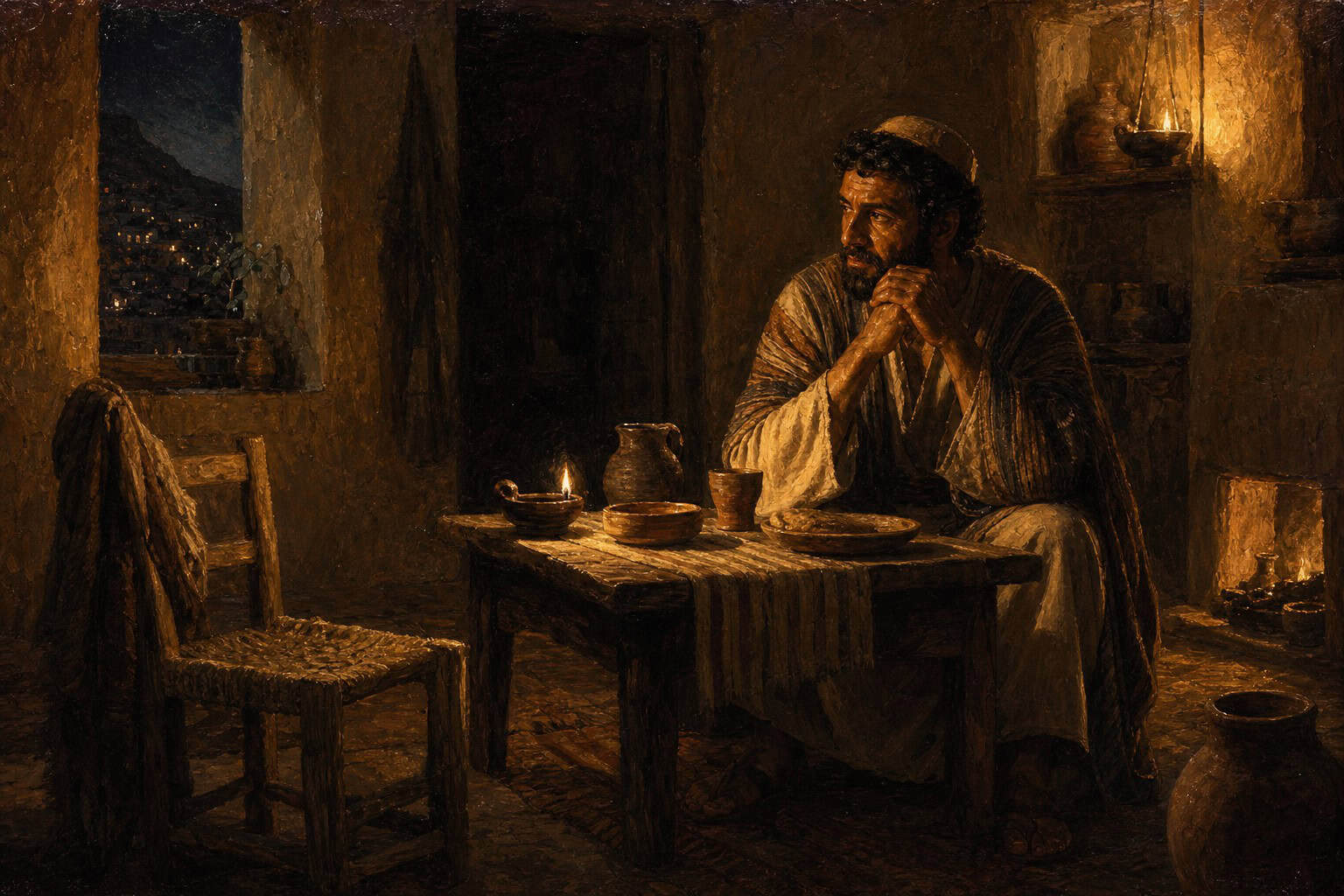
What does silence say about a person? A raw reading of a man who withheld his presence, and what his quiet actually confessed.
Loading the Camel One Straw at a Time
He remembers it as a test he never named out loud. Woman after woman had come and gone from his life, and each time he told himself the same story. They left because they could not bear him. They could not carry his complexity, his stubbornness, his refusal to bend the knee to anything but God. He wore their leaving like proof of something noble. So when Leigh arrived, he did the thing he always did. He added weight. He revealed more of himself, the holy parts and the profane parts both, and he watched her face for the flinch he was certain would come. In his own words he pictured it as straw piled on a camel’s back, one strand at a time, and the phrase gives him away completely. He was not offering himself to her. He was loading her. He was measuring how much she could hold before her knees buckled and she confirmed the verdict he had already reached about every living soul. This moment sits in the fifteenth chapter of Confessions to the Empty Chair, and it is quieter than any fight, but it is not peace. It is a man running an experiment on a person who believed she was being loved. He asks himself, plainly, how much of me can she take. That question sounds like honesty. It sounds like a man laying himself bare. It is neither. It is a wall built in advance, brick by careful brick, so that when she finally fails the test he can grieve without ever having risked a thing. The older man writing this can see the trick now. He sees the boy hiding inside the strategy, the boy who learned somewhere early that existence must be justified before it is permitted to stay. If you make them prove they will remain, you never have to admit you were afraid they would go. And so he talks and talks and talks, revealing depths, staging confession after confession, and in all that talking he stays perfectly silent about the only thing that matters underneath it. He wants to be kept. He cannot say it. The camel does not know it is being loaded; it only feels the growing ache spreading through its legs. And he, watching from a safe distance, calls that ache a diagnosis of her, never of himself. This is where the question of silence begins. Not in a man who says nothing, but in a man who says everything except the one true thing, and then dresses the withholding up as wisdom he can be proud of.
A Moat Built From the Line of David
Listen to the way he defends himself, and you can hear the fortress going up around him. He is a son of Solomon, he says, standing in the spiritual line of David, a man who delights in women the way the old kings delighted in them. But he draws his boundaries with pride. He will not murder for a woman. He will not raise temples to foreign gods to please one. He will never worship Aphrodite. He bends the knee to Yahweh alone, and to Yahweh alone will he ever answer or beg for mercy. Read as a prayer, these lines could pass for real devotion. Read as they actually function inside this scene, they are a moat dug wide around his heart. His pride in his lineage, he admits without shame, is a wall that women cannot climb. He almost says it with satisfaction, as though the unscalable wall were an achievement. The very thing meant to pull him toward the sacred is being spent, coin by coin, to keep another soul at a safe distance from him. This is the sickness the chapter lays open without once raising its voice to accuse. A man is using God as the reason he cannot be reached. He funnels every feeling through cold reason, and when a woman weeps in front of him his logic dries her tears the way a sharp gust of air blows straight into the face of a newborn. That comparison should stop us where we stand. He likens his effect on a crying woman to the shock of air forced into an infant’s first breath, and he offers it not as confession but as evidence of his depth. The older self writing this now sees the cruelty he could not see back then. Faith was never meant to be a cave to hide inside so that no one could touch you. The God he claims to answer to is the very God who came near, who let Himself be touched by hands and by grief, who wept at the mouth of a grave. But this man has taken his theology and made it into something that repels contact. He has taken the most intimate bond a person can have and twisted it into proof that no ordinary human being deserves his surrender. There is real spiritual pride here, and to his credit he does not pretend otherwise once the years have passed. He reckons with it later, hard. To invoke the divine not to draw closer to what is holy but to excuse your refusal to be seen is a blasphemy that borrows the clothing of reverence. His silence toward Leigh, then, is not the silence of a monk in his cell. It is the silence of a man who decided in advance that no one would ever pass the wall, and then baptized that decision so it would feel like holiness instead of fear.
The Woman Who Read the Soul Beneath the Words
Then something breaks the pattern, and the whole scene turns on it. Leigh does not buckle. He keeps adding straw, keeps offering the depths he means to frighten her with, and she does not flinch and she does not run. She leans in closer. She wants more of him. She finally tells him she has met no one like him in her life, that the things he says out loud are things she has carried in silence since childhood but never found the words to hold. Then she speaks the sentence that quietly dismantles his whole machine. She has always been the strong one, she tells him, the one who gives advice to her friends, the steady voice of reason inside everyone else’s crisis, the one people lean on. But with him, she says, you are to me what I am to them. Sit with what that admission costs her. She has just handed him her rarest confession. She has said out loud that she has finally found someone she can rest against, someone who sees deeper than she herself sees. She has offered him the exact thing he swore no human being could ever offer. She saw straight past his words to the soul speaking them, which is the thing every guarded man both longs for and dreads. And here comes the terrible pivot of the chapter, the point where his reckoning turns around and burns him. He does not receive her grace. He interprets it. He asks himself, coolly, whether God, who blinded all the others who came before her, might now be permitting this one to see. Even her love becomes data on a page. Even her sight becomes a test she happens to be passing, rather than a gift he could simply take.
We invoke the divine not to draw closer to the sacred, but to excuse our refusal to be seen by the one person who could actually touch us.
That is the wound at the dead center of the scene. She saw him, truly and without terms, and instead of letting himself be seen he stepped back to study the seeing. A man who greets your love with analysis is telling you something in his silence far louder than any word he could arrange. He is telling you that presence frightens him more than absence ever did. He was safer when they left him. Her staying was the true crisis. And what a man does with his silence in a moment exactly like this one, whether he lets it be filled by another or grips it like a weapon, reveals more of his soul than any speech he could ever compose.
Silence is never empty; it is a sentence we speak in the only language cowardice can afford.
The Language He Named and Still Turned Against Her
He knew all of this. That is the part that is hardest to bear. At the close of the passage he sets it out almost like a lecturer at a lectern, calm and precise. How a person speaks and how a person listens reveal how they read the world, the inner one and the outer one both. Word choice. Vocal inflection. Body language. The silence resting between one thought and the next. He understood that silence was a language with its own grammar. He could name it. He could take it apart and lay the pieces on the table. And still, understanding it perfectly, he turned it as a weapon against the one person who had refused to leave his side. This is the honest accounting the chapter forces on him and on us. When his circumstances overwhelmed him, when the life he was holding grew too heavy to carry, he did not shout and he did not throw the first blow. He went quiet instead. He pulled his presence back into himself and made the other person live inside the empty space he left behind. He made her wonder what she had done wrong while he privately scrambled to get his footing back. That is not retreat, whatever it looks like from the outside. It is a slow, cold way of ruling another human being. The cruelest power a person can hold is the one worked through calculated absence, forcing someone else to bear the whole weight of a struggle you flatly refuse to name. His silence toward Leigh was never empty air. It was a complete sentence. It said: I do not trust that you will stay. It said: I will keep the upper hand even if keeping it means losing you. It said: I would rather stand as the diagnosis of everyone who leaves than become the man who risked asking one woman to remain. The older self writing this refuses to soften any of it. He will not reach for the easy comfort that he was only wounded, only afraid, only a son taught a crippled way of loving by a family that made him bargain for his own right to exist. All of that is true. None of it excuses what he did with it. A wound explains the hand that strikes. It does not forgive the blow. So the silence between his thoughts, the very thing he prized as proof of his depth and his richness, turns out to be the clearest confession in the whole chapter. It confessed a man who could read every soul on earth except his own, who mistook his self-protection for holiness, and who called the quiet sabotage of love a kind of faithfulness to God.
An Ache No Reasoning Could Dissolve
Here, then, is what silence finally says about a person when you read it through this scene of Confessions to the Empty Chair. It says what he is most afraid to lose. A man who withholds his presence is guarding something, and the thing he guards is almost always the very love he insists he does not need. This narrator’s quiet was never the peace of a soul resting in God. It was the strategy of a soul terrified of being kept, wearing the costume of pride in a divine lineage. And the mercy of the chapter is not that he wins his argument or gets rescued from his coldness. He does not. The despair here stays raw and unhealed. He does not suddenly learn to love well between one page and the next. He shows you a man caught mid-failure, narrating his own fortress with a clarity so sharp it convicts him as he speaks. Yet there is a nearness inside that darkness the older writer cannot bring himself to deny. God does not break in to lift him out of the sin. God comes near within it, quiet, walking step for step beside a man busy shoving away the one person sent to see him. Grace here is not a rescue mission. It is a presence that keeps staying even in the void he built with his own hands, the way Leigh kept staying, the way something older and larger kept refusing to walk out the door while he did everything he could think of to earn his own abandonment. If you came here asking what a person’s silence means, the answer this chapter hands back is severe and plain. Silence is rarely empty. It is the mother tongue of the frightened, and it points straight at the place where a person hides the one thing they cannot bear to risk. When someone goes quiet on you and leaves you holding all the wondering, they are not withholding nothing at all. They are speaking their fear in the only tongue their pride will let them use. And when someone hands you their love and you answer it with analysis instead of surrender, your silence has already spoken the worst truth about you before you say a word. This man will spend the rest of the memoir reckoning with what his quiet cost him, sitting inside questions he cannot tie off with a neat bow, facing the woman he chose to study instead of hold. What he did with her staying, and what her staying did to him, is the raw place the book refuses to close too soon. Read it, and you will never again mistake a person’s silence for peace.