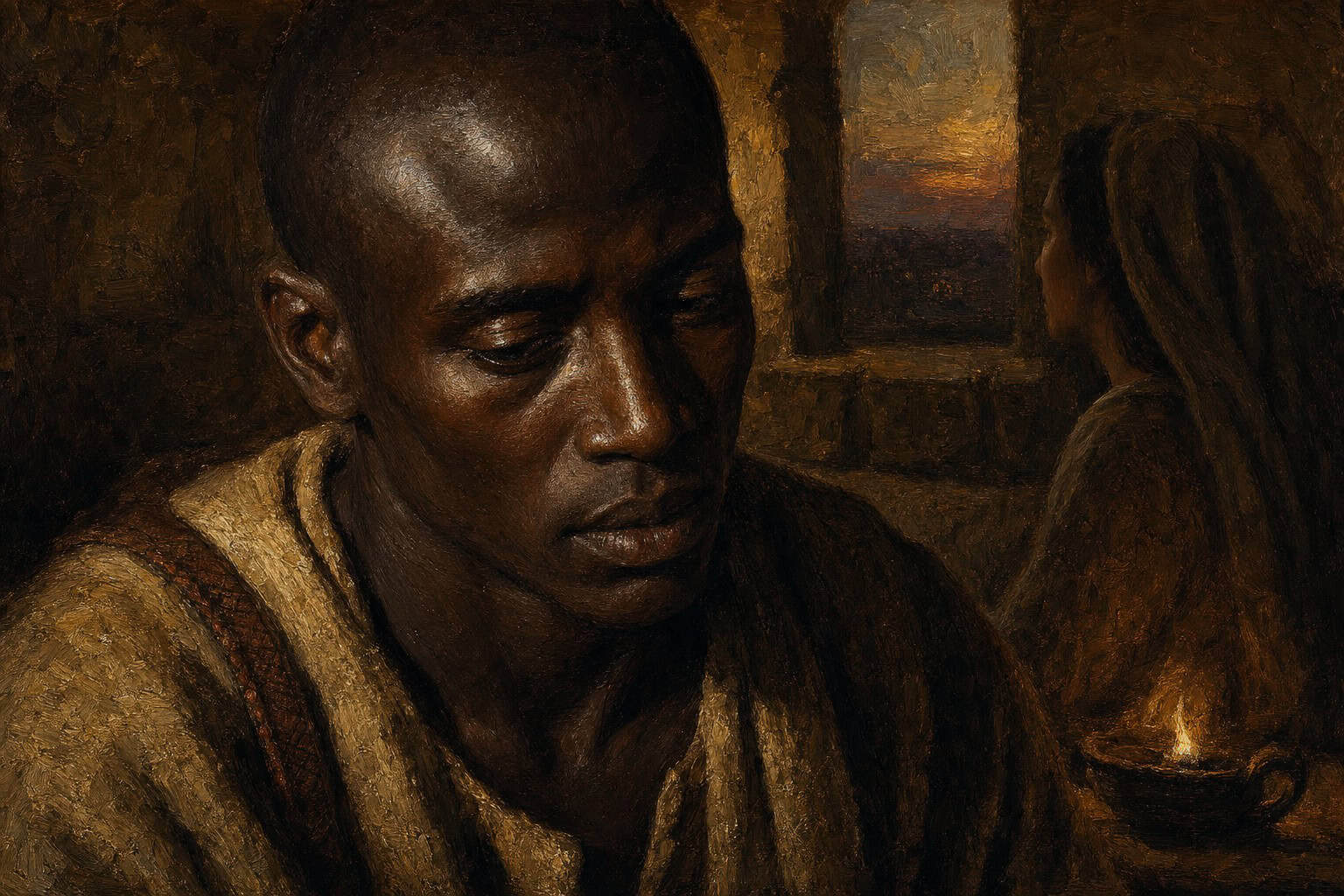
The guy screaming in his car meme, read seriously: what the private rage actually is, and what it costs the soul that hoards it.
The Boy at the Edge of a Table He Was Never Handed
You know the picture before you scroll to it. A man alone in his car, windows up, face folded, mouth stretched wide, and not one thread of the sound escaping the glass. The joke works because we recognize the seat. We have all gripped a wheel that goes nowhere and let something loose that we would die before letting anyone witness. Long before there is a car, in Confessions to the Empty Chair, there is a boy standing a little too far from a lunch table he was never invited to join. He is three years old when he first meets the thing he will later stop calling confusion and start calling hatred, and it thickens across every schoolyard after that. He watches the rich kids move by rules nobody handed him. He watches the pretty ones pair off with no real conversation between them, drawn together by skin alone, and he stands at the cold rim of that easy warmth like a creature crouched outside a feasting hall, starving for the light and disgusted by it at once. He describes obsessive, circling attention, a mind that cannot stop investigating the ease it does not have. The screaming man in the meme is that same boy, only grown, only sealed inside metal instead of standing in a corridor. The sound stays trapped because there was never anyone outside the glass who spoke the language of it. What the meme offers us gently, the memoir lays out bare. The rage is not random weather. It is the residue of years spent on the wrong side of a warmth other people seemed born inside. He is not screaming at the traffic. He is screaming at a whole arrangement of the world that set his chair too far from the food. And the part the joke hides, the part that turns the stomach, is that the boy has begun to believe the distance is his own doing, a stain on him, something the others can smell across the room. He tries to obey what the church taught him. He tries to love the world he is told to stand apart from without hating it. And every single time he reaches toward it, the reaching stings. He asks for bread and closes his fingers on a stone. He reaches for a fish and finds a snake coiled in the sack. This is where the silent scream begins. Not from softness, not from weakness. From a wound that splits open again each time he is brave enough to open himself. The camera would only see a man losing it in a parking lot. The book sees a three-year-old who never got up from the cold edge of that table, still leaning toward the light, still flinching.
Envy and Disgust Braided Into a Single Rope
There is a species of hatred only the excluded ever grow, and no meme can film it, because it lives below the twisting face. It is envy and disgust plaited into one rope, and you cannot pull one strand without the other tightening. The man in the car wants the very thing he sneers at. He aches for the effortless connection he keeps watching others enjoy, and in the same breath he tells himself their connection is hollow, thin, beneath a man of his depth. Both feelings run at full volume together, and that is exactly what makes them poison. In the memoir the narrator watches the popular ones couple and uncouple and calls it a game of musical chairs, bodies traded for bodies, everyone drifting on to fresh meat the moment the pleasure thins out. He is not entirely wrong. Something real is missing in what he watches. But he is not yet honest about why he watches so hard, why he memorizes the choreography of a feast he claims means nothing. You do not stare that long at a table you truly do not want. He circles it. He studies the seating. He tells himself the distance is a choice, that his depth lifts him above their beautiful emptiness. The older narrator, rereading these pages, will not let the younger man keep that flattering coat. He turns the question on himself with no mercy. Was I actually above them, or was I simply never picked, and did I build a whole tower of contempt to cover the plain fact that I wanted in and was not called? He sees the dehumanizing run both directions now. The girls, he once said, made him less than human. But his own hunger and fear flattened them too, turned real and frightened young people into symbols he could safely despise from the shadows. The screaming man in the car does the same trick. He decides the world is stupid and cruel, and then he treats his own suffering as proof that he sees more clearly than the happy fools who never scream at all. There is the trap, snapping shut. The contempt feels like strength. It feels like the last thing he still owns after everything else was withheld. He grows fluent in a bitterness that answers no prayer and eases no ache, and the more he feeds it the more it whispers that his isolation is a badge instead of a sentence. He becomes so gifted at explaining why the world shut him out that he never catches himself shutting the world out. The rage idling in that parked car is not the enemy at the gate. It is the guard he hired to hold the gate closed, and the guard has stopped taking orders, and now not even the ones who came to help can get past him.
The Walls You Built Are Now the Room You Live In
Here is the turn the meme never reaches, the thing that only clears years after the screaming quiets. Every wall the excluded boy raised to keep the pain out became a wall he now lives inside. It is a cruel arithmetic of self-defense, and the narrator of this book names it with no anesthetic. He built his defenses honestly. Each one made sense the day he laid it. If the world would hand him stones when he asked for bread, then he would stop asking for bread. If the girls would treat him as less than a person, then he would stop needing the girls at all. If the rules he learned each Sunday only delivered conflict and misunderstanding, then he would build his own quieter kingdom, a place no one could reach and nothing could sting. And it worked. That is the horror lodged at the center of it. The walls held. The glass sealed. Then one ordinary day he lifted his eyes and understood that the fortress and the prison were the same structure, poured from the same concrete, standing on the same ground. The car with the windows cranked up keeps the noise of the world outside, yes. It also keeps the man inside. And the man is screaming precisely because no one can hear him, and no one can hear him because he is the one who sealed the glass. The freedom he tasted while he was building those walls is the identical freedom that now sickens him. He is free, wholly and terribly free, alone in that sealed box, and the freedom is a falling with no floor under it, a giddiness in the gut when you look down and there is nothing. This is the vertigo humming beneath all the rage, and it is worse than any complaint against the world. It is not that the world locked him in. It is that he can walk out and will not. The door of the car is unlocked. It was unlocked the whole time. He could stop the screaming, lower the window, walk back across the lot toward the table with its light and its noise. But that walk costs the one thing the walls were built to spare him, the raw risk of being seen again in the open, wanted or refused, where it can still cut. So he stays. He calls the staying strength. He calls the sealed glass peace. And the space that once felt like a shelter has quietly become the exact dimensions of a man who cannot forgive himself for still wanting in.
Contempt is not strength. It is a wound that has learned to talk.
The Silence That Sends No Whirlwind
And where is God in the sealed car, breathing the same fogged air? This is the question the memoir will not release, and it refuses every soft answer that reaches for it. The narrator prayed. He tried to stand apart from the world exactly as he was taught, to love without being pressed into its shape, to keep his mind clean in the middle of the endless swapping of bodies. He did the very thing the church asked of him. And the answer he received was not comfort. It was silence. Not the silence of an empty house, which is only nothing. The harder silence, the kind that comes from someone who is present in the room and will not speak. He is not the man from the old story who hurled his complaint into the storm and got the storm roaring back at him with answers. There is no whirlwind for this narrator. There is a quiet so complete that it tastes like abandonment, like being handed a snake and told it was the fish he begged for. The older narrator, reading these same wounds now, sees what the younger man could not make out through the fog on the windshield. The silence was not absence. It was a severe form of nearness, presence sharpened to an edge. God did not lift the dark off him. God came and sat down inside it. The starving prayer, the ache that never got its answer, the scream ringing off the inside of the glass with no ear to catch it, none of these were proof that heaven had turned its back. They were the shape a presence takes when it chooses to teach through hunger instead of through the meal, to walk with a man inside his own bitterness rather than yanking him up and out of it. This is not a comfort that repairs anything, and the narrator will not pretend otherwise. The pain stays put. The exclusion stays. The wound keeps splitting open every time he dares to open himself. But into that sealed, screaming space, one strange truth arrives and will not leave: he was never actually alone in the car. The one he accused of dealing him stones had been riding in the passenger seat the entire drive, silent, declining to explain himself, present in each tear that blurred the glass. There is no miracle here, no window rolled down by an unseen hand. Those breakings-in are rare, and the book keeps them rare, holds them as the exception that startles rather than the rule that rescues. What there is instead is company. A God who does not answer the scream and does not step out of the car. And that, the older narrator slowly learns, is a harder and truer mercy than any rescue, because it stops asking for an exit and starts noticing who was always sitting there in the dark beside him.
What the Unlocked Door Still Asks of Him
So the meme is funnier and sadder than we let ourselves feel. We laugh because we know the man in the seat, and we keep it a joke because the recognition, if we held it too long, would start asking things of us. This memoir refuses to keep it a joke. It climbs into the car and sits down and asks the questions the narrator spent years steering around. Who were those people he studied from the shadows, really? Were the popular kids the shallow enemies he cast them as, or ordinary young people he never once let be more than that? Did the girls truly dehumanize him, or did his own fear and hunger reduce them to symbols he could resent in safety from across the room? Which stones in the wall were honest defense, and which were pride wearing the costume of depth? He does not answer these cleanly, and that unfinished honesty is the spine of the book. He does not land in a tidy peace where the rage turns out justified, nor in the neat guilt where it turns out simply wrong. He lands somewhere stranger and more true, where the rage was both a real wound and a slow toxin, where the exclusion was genuinely done to him and where he also chose, over and over, to seal the glass with his own hands. The book hands you no method for climbing out of the parked car, no five clean steps to the door. It offers something rarer than a method. It offers a companion who has occupied that exact seat, who screamed the identical silent scream, who knows the grit of a stone where the bread should have been, and who is willing to tell the whole truth of it without flattering himself and without letting you flatter yourself either. If you have ever sat in a car going nowhere and let loose something no one could hear, this is a book that will neither laugh at you nor rush to fix you. It sits down. It lowers nothing. It stays. And in the staying, without fanfare, it turns your face toward the one thing the man in the sealed car most needs to hear and most refuses to believe. He was not sentenced to that seat. The lock was a story he told himself. And the terror of being seen, held up against the far colder terror of dying unknown, is smaller than it has ever felt in the dark.