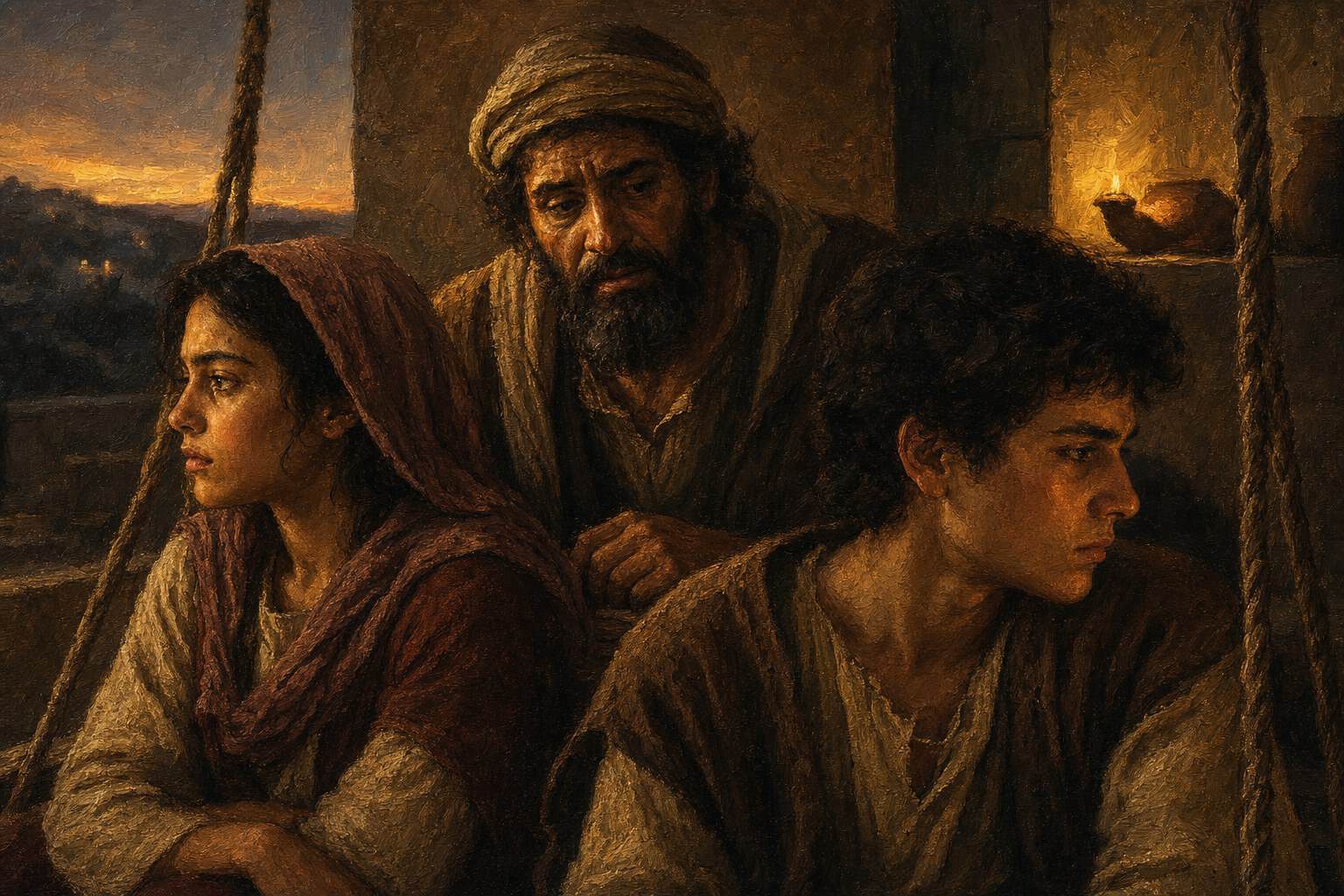
How do you heal childhood wounds? A raw look at how the body remembers what the soul cannot say – and what real healing may cost.
Two Sixteen-Year-Olds and a Radio Left On
A Christian station played low through the whole afternoon, the kind of soft music meant to bless a house and instead just filling the quiet between two teenagers who did not know what to do with each other. It was days before she left for Mexico on a church mission trip, and the air in that small room carried the ache of an ending nobody had named out loud. They sat huddled on her narrow bed, backs against the wall, whispering. She was afraid of the trip. He listened. The conversation moved in low tones, the way conversations do when the real subject is too large to say directly, when what you are actually talking about is that you will soon be far apart. He was sixteen. She was sixteen. Neither owned the words for what was rising in them, so their bodies started to speak before their mouths could, the way flesh takes over when the mind runs out of language. If you have typed a question about healing childhood wounds into a screen at two in the morning, you already know this scene from the inside, even if your details differ. You know the tenderness that turns urgent without asking permission. You know how comfort and hunger braid together until you cannot pull them apart. In the memoir that holds this memory, the moment sits in the sixth chapter, early enough that the boy still half-believes a girl might save him instead of God. What gives the scene its ache is not the desire by itself. It is what the desire was carrying underneath, unseen, like a current under still water. He had built a wall around his heart, one refusal at a time, over a full year of guarding himself. That wall was not made of stone. It was made of the decision not to be touched, not to be seen, not to let anyone close enough to leave. And here was a girl reaching toward him with no weapon in her hands, only warmth and a real fear about a country she had never visited. The radio kept singing its gentle promises into a room where two children were about to learn how little they understood themselves. The man who writes this down now knows what the boy could not: the fortress you build against pain is never designed to survive kindness. It can hold off cruelty for years. It falls at the first honest hand laid flat against it. That collapse is where any true reckoning with old wounds has to begin, and it begins here, with a radio nobody thought to turn off.
The Wall That Fell at the First Warm Hand
What took a year to build fell in an instant. The narrator says it that plainly, and the plainness is what cuts. He had spent months making himself unreachable, and one deepening kiss undid the whole engineering. This is the thing nobody warns you about when you carry an old injury: your defenses are magnificent against everything except the exact thing you need most. Contempt bounces off them. Neglect only thickens them. But let someone look at you with genuine interest, let someone enjoy your company, let someone see the thing others walked past without a glance, and the mortar turns to water. The scene tightens here, because the collapse felt to him like peace. A lifetime of held tension drained out of his body in a single stretch of minutes. For once he let himself feel good without the sting of shame chasing the feeling down and killing it. Who could blame him. He had been starving at a table where no one else seemed to notice he was there. He tells us she found in him what others overlooked, and he was glad it was her, glad they were both young, glad there seemed to be a long stretch of time ahead to explore what their bodies could do. But the older man writing this turns the harder question on himself, and does not let go of it. Was this healing, or was it anesthesia. Was the peace real, or was it only the numbness of a wound touched at last by something soft enough not to hurt for one merciful hour. Here his body steps forward as the only honest witness in the room. His hands remembered what they had been denied. The tension that drained from him had lived in muscle and breath for years, a whole buried history stored below thought, in the way he braced when someone came near. This is what makes the search for healing so cruel and so misunderstood. We imagine the wound is a memory we can talk our way out of, a story we can revise if we tell it enough times. It is not. It is a shape pressed into flesh, a way the body has learned to reach and to flinch and to want, all at once. You cannot reason with a shape. You can only live inside it differently, slowly, over years the boy did not yet know he would have to spend. The girl was not a mistake. She was, in his telling, warmth that came near. But warmth that lands on a wound is not the same as warmth that heals it, and the whole distance between those two is the subject of a life. He did not know that yet. He was sixteen and grateful and undone, and gratitude and wholeness can feel identical in the dark of a small bedroom while a radio hums low against the wall.
He Thought God Had Sent Her as Medicine
Then comes the temptation that runs beneath every wounded person’s search for love, and the narrator names it without flinching. Part of him wanted to believe God Himself had sent her, a living antidote to the coldness, to the venom he felt festering somewhere inside him. She was providence. She was rescue arriving in the shape of a girl. With her, he thought, he had no more use for evil, no more room for it. This is where the reckoning turns sharp, because the reader recognizes the move at once, having made it ourselves. When we are in pain we do not want a person. We want a cure, and we quietly baptize the person into that role without asking whether they consented. We read the hand of God into whoever makes the ache stop, because it is unbearable to think our damage might carry no cosmic meaning, that it might just be damage that happened and left its mark. The old self writing this sees exactly what he did. He took a sixteen-year-old girl, a real consciousness with her own fears about a foreign trip, her own faith, her own reaching in the dark, and he made her into a theology. He turned her nearness into a sacrament he had no right to administer to himself. This is the danger for every wounded person who confuses relief with salvation. She could not save him, because she was never sent to be swallowed. If she was sent at all, she was sent to be met, face to face, as another whole person. Yet the book refuses to throw out the real thing hidden inside the false one. His longing for her was not only the strategy of a hurting animal, and it was not only appetite wearing the costume of prayer. It was the true thirst of a creature made for union, reaching toward one particular warmth, this face, this voice, this body and no other, because that is how love actually moves. The tragedy is that the true longing and the false theology were tangled in the same embrace, breathing the same air, and he could not tell them apart. Neither can most of us, when we are young and wounded and half-mad to be seen by someone.
The body keeps the record no confession can erase, and healing begins only when you stop asking it to forget.
That is the hinge the whole chapter turns on. He was not wrong to want her. He was wrong to ask her to be God, and to be surprised when a girl could not carry the weight of the divine. The wound underneath was old enough that he could not yet see the difference between wanting and worshipping, between being fed and being saved.
The body keeps the record no confession can erase, and healing begins only when you stop asking it to forget.
The Question on the Porch Swing
Weeks passed, and the urgency wore itself smooth. Even the most charged closeness settles into a rhythm, and theirs did, the way the extraordinary quietly becomes the ordinary when you live in it long enough. Then, on a porch swing, she asked him a question. She motioned with her head toward her own body, wanting to know why he would never do that to her, why the exchange only ran one direction. It is a small moment and it splits the entire story open. He stammered. For long minutes he could not push out an answer, the swing rocking under them both. And then he told her the thing he had never told anyone: what his babysitter did to him when he was a toddler, a sixteen-year-old girl and a small child, decades before this porch swing was ever built. Here the falling action reveals the buried architecture that held up everything above it. The wall he built. The peace he mistook for healing. The way he could pour out warmth but could not receive it back. The one act his body would not perform no matter how he trusted her. All of it traced back to a shape pressed into him before he owned a single word to name it. This is what the search for healing keeps walking past. The wound was not an event he could remember, sort, and set down. It was a deformation in how he lived inside his own flesh, a permanent structure that decided what his body could and could not do, even in love, even in safety, even with someone reaching toward him with open hands. Notice what it took to bring it into the light. Not a counselor’s office. Not prayer alone, though he still loved God through every hour of this. It took another body reaching for him, asking an honest question, refusing to be satisfied with only half of him. The relation forced the buried thing into speech because it could no longer stay abstract, hidden, deniable. His hesitation had a history, and only real intimacy could make that history finally say its name. The older narrator sits down inside this and refuses to tie it off with a bow. He does not tell us the confession fixed anything. Offering his shattered self was, he says, an act of something profound, and the sentence breaks off before the last word can arrive. That broken-off honesty is the truest thing in the whole chapter. The confession did not heal him. It did something both smaller and larger than that. It let another person hold the shape of his wound for a few rocking minutes, which is not the same as taking it away. The evening settled around them. The words came out at last. And a boy learned that the thing his body could not do had been written into him in a language his flesh had learned before he was old enough to refuse the lesson.
What It Costs to Be Held Without Being Swallowed
So how do you heal childhood wounds. If you came for a method you will leave hungry, and I would rather leave you hungry than feed you a lie. This chapter offers no clean answer, because there is none, and pretending otherwise is its own quiet cruelty. What it offers instead is the truth that the wound lives in the body, not only in the memory, and so it cannot be talked away or prayed away in a single hour of grace. Direct rescue does happen. God does break in, sudden and undeniable. But those moments are rare, the exception that stuns you and then recedes, never the dependable machinery of getting better. Far more often what you receive is company. God does not lift the boy out of the small room or off the porch swing. He sits down in it with him, present in the confusion, present even in the misdirected desire, present in the very sin, walking beside a boy who does not yet know he is being walked beside. That is not a consolation prize handed to you instead of the real thing. It is the actual shape of how the dark gets survived, one hour at a time, with someone near. The scene teaches something else for the person still searching in the small hours. Your defenses will fall to kindness long before they fall to insight, and that is exactly why healing feels so much like danger. The instant someone truly sees you is the instant your fortress turns useless, and the body panics before it can be grateful. You will confuse relief with salvation. You will make idols of the people who make the pain stop, and you will wound them by asking them to be more than any person can be. This is not weakness. It is what a starving creature does with the first food it finds. The work, if there is work, is learning to let warmth land on you without demanding that it be God, learning to be seen without needing to be devoured or to devour, learning that the shape pressed into you as a child may never fully smooth over, and that living well means learning to move through the world in that shape rather than waiting to be free of it. The narrator of this second memoir does not arrive at peace when the chapter closes. He arrives at a question left half-spoken and a body that finally told its buried truth to another person. If you want to sit with a man who refuses every easy comfort about his own wounds, who turns the lens on himself without mercy and without contempt, Confessions to the Empty Chair is waiting there, the swing still moving, the last light going, the question still hanging in the air that you have not managed to answer either.