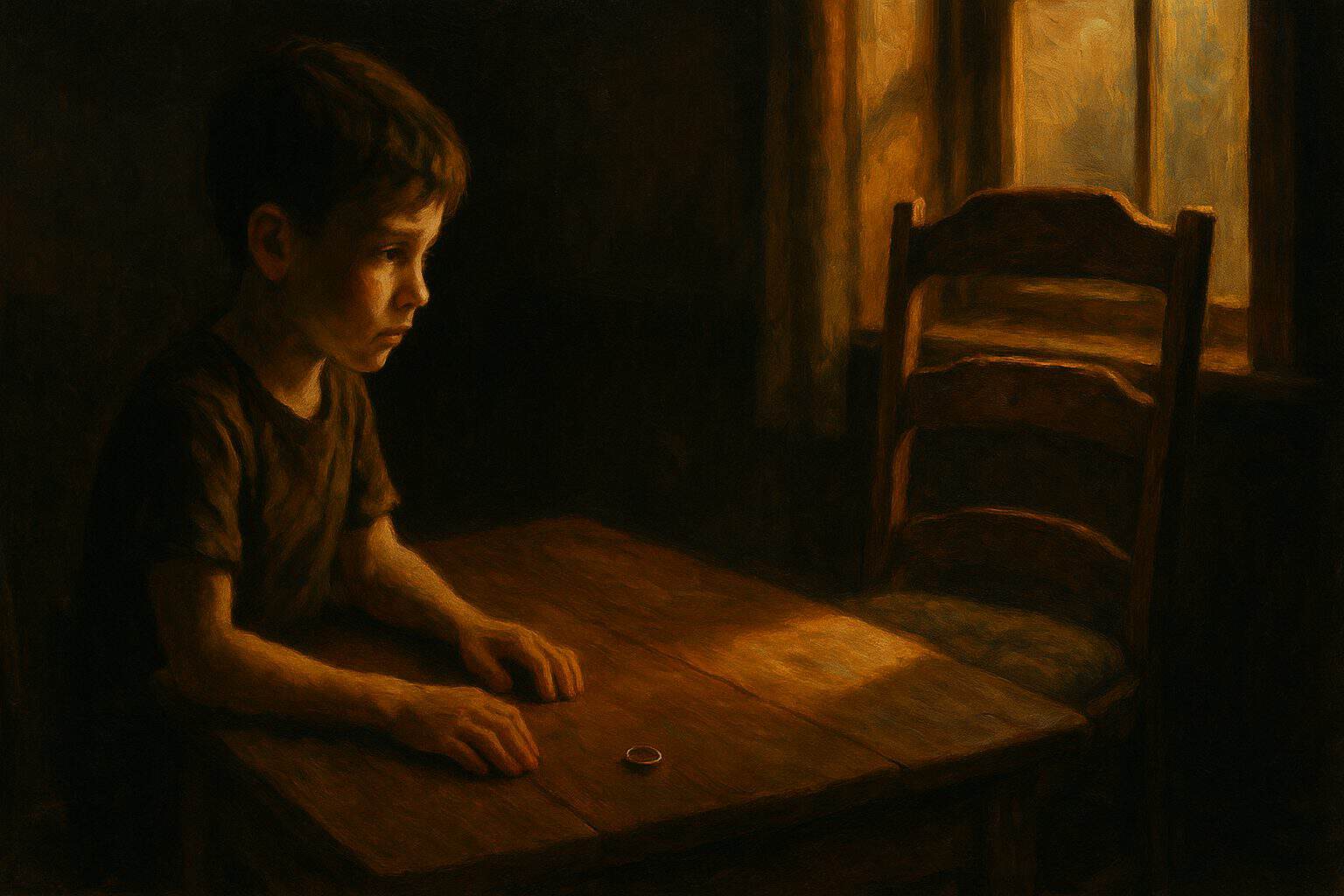
The presence that haunts through its withdrawal, carving the soul’s deepest chambers
The morning light falls across an empty chair at the breakfast table. A child’s eyes trace its worn arms, the slight depression in the cushion that holds the shape of someone who isn’t there. This is not merely physical absence—it is a presence-through-withdrawal, a weight that presses upon the chest precisely through what it withholds. The absent father lives more vividly in the spaces he doesn’t fill than many present fathers do in their daily arrivals home.
The Architecture of Absence
In Fractions of the Soul, Anthony writes of waking to an empty bed, but the phenomenon extends beyond the marital chamber. The absent father permeates the house like a ghost made of negative space. His study door stays closed, not because he’s working inside, but because no one can bear to see the desk where he doesn’t sit. His tools hang in the garage, each hammer and wrench a monument to hands that won’t teach their use. The child learns to read absence like a text—this is where father would stand to shave, this is the hour he would return, this is the laugh that would fill the kitchen.
The phenomenon gives itself first as disorientation. “My spirit writhed in futile protest before collapsing,” Anthony writes, “succumbing to a new desolate sorrow… the disorientation of being thrown back into the world.” But thrown back into which world? Not the world as it was before father’s presence, but a world now structured by his absence. The child discovers that absence has its own gravity, bending all trajectories toward the void where father should be.
The Manufacture of Distance
“She manufactured distance through long absences,” appears in the memoirs, but the gendered pronoun masks a deeper structure. The absent father too manufactures distance, though perhaps not through intention. Sometimes absence emerges from fear—”His fear of a life without Eve was stronger than his trust in God.” The father flees not from his children but from his own inadequacy, from the weight of a role he cannot bear. He becomes absent even while physically present, a specter at his own dinner table.
The child watches father’s eyes drift during conversation, sees how his attention slides away like water from glass. This is not the absence of departure but the absence of withholding—father’s body remains while his soul retreats into private chambers no child’s love can unlock. The manufactured distance becomes a teaching: that love itself might be a burden too heavy for some to carry.
“Adam’s loneliness was pure, without evil, and that it was something woven into the human soul by God.”
This primordial loneliness, Anthony suggests, predates even the wound of absence. Yet the absent father transforms this pure loneliness into something else—a loneliness with evil, tainted by abandonment, colored by the question that no child should have to ask: What did I do wrong?
The Inheritance of Weakness
“And all of his sons since inherited his original weakness,” Anthony writes of Adam’s choice. The absent father passes down not just genes but gaps—spaces where strength should have been modeled, where courage should have been demonstrated. The child inherits an empty toolbox, must learn to build a life with implements that were never provided.
Watch the child-become-adult fumble with intimacy, unable to trust what might disappear. They love with one foot always toward the door, having learned that fathers leave, that presence is temporary, that the heart must armor itself against inevitable departure. “A messy heart translates into conflict with significant others,” the memoir observes, and indeed the absent father creates a template for all future absences.
The grown child finds themselves repeating the pattern, manufacturing their own distances. “Trauma, abandonment, being misunderstood, frustration, injustice, anger, sadness, and emotional chaos force them to recluse into themselves.” The absent father lives on in his child’s withdrawals, in their inability to remain present when presence is most needed.
The Paradox of Presence Through Absence
Yet here emerges the strangest aspect of the phenomenon: the absent father often looms larger than the present one. His absence becomes a presence-of-absence, more defining than many fathers who show up daily but remain unseen. The child constructs an elaborate father-phantom from fragments—a remembered smell of aftershave, a photograph’s frozen smile, stories told by others who knew him when.
“I know my internal states; this was not generated from within,” Anthony writes of an encounter with the divine, but the same might be said of the absent father’s haunting. His absence impresses itself from outside, reshapes the interior landscape through external withdrawal. The child’s psyche reorganizes around this absence like flesh around shrapnel—the foreign object becomes part of the body’s architecture.
The Hunger That Seeks
“He allowed my soul to hunger in my youth so that hunger itself would force me to look for Him again.” This theological insight reveals the possible redemption hidden within absence. The absent father creates a hunger that mere presence could never generate. The child seeks everywhere for what father didn’t give—in books, in mentors, in God himself.
“The Idol of Solitude broke when I finally realized the silence I fled to was, in fact, the one Presence I had been seeking all along.”
The absent father inadvertently becomes a teacher of negative space, showing through withdrawal what presence means. The child learns to read absence as a photographic negative, discerning the shape of love through its outline. Every absence points toward a Presence that cannot withdraw, a Father who remains when earthly fathers fail.
The Architecture of Suffering
“I was and am the primary architect of my suffering,” Anthony confesses, but the absent father provides the blueprint. He teaches through withdrawal that love is conditional, that presence must be earned, that one might never be enough to make someone stay. The child builds their life according to these specifications, constructing relationships that confirm the original abandonment.
“All my ideas were incomplete and misshapen, like sketches of paintings or scribbles of poems littering the floor.” This creative incompletion mirrors the incompletion of the father-child bond. Without father’s finishing touch, the child’s works remain drafts, their achievements somehow unreal because unwitnessed by the one whose witnessing would make them real.
The Veil of Melancholy
“His perceived absence after that encounter brought tears to my heart, casting a melancholy veil through which I now viewed the world.” The absent father doesn’t just leave; he leaves behind a way of seeing. The world appears through absence-tinted glass, every joy shadowed by the possibility of loss, every connection haunted by potential departure.
This melancholy veil becomes a kind of knowledge. The child of the absent father sees what others miss—the fragility of presence, the effort required to remain, the courage needed to stay. They recognize fellow children of absence by a certain quality of vigilance, a way of watching doors, a habit of loving with careful reservation.
Time Before the Fall
“We also inherited faint memories of a time before the fall, now blurred through the veil of death and sin.” Perhaps every child carries a cellular memory of perfect presence, of a Father who never withdraws. The absent earthly father makes this memory ache like a phantom limb. The child knows something is missing because they remember—not consciously but somatically—when nothing was missing.
The absent father thus becomes a teacher of exile, showing through his withdrawal what Eden’s loss means. “Death did not just take a child but also took away all the years they would have had living and every small and great feeling threaded to it.” Similarly, the absent father takes away all the years of being fathered, all the small teachings and great affirmations that weave a child into wholeness.
The Moment of Choosing
“There comes a point in each person’s life when they can no longer blame others for personal decisions, a time when things left unchanged are, in fact, chosen.” The child of the absent father faces this threshold with particular intensity. Will they repeat the absence, becoming absent to their own children? Will they overcorrect, suffocating with presence born of panic? Or will they find some third way?
The phenomenon of the absent father ultimately poses a question about presence itself. What does it mean to be present? Is presence merely physical proximity, or does it require something more—an attention, an attunement, a willingness to be affected? The absent father, through his withdrawal, teaches that presence is a choice renewed moment by moment, a gift that can be withheld or given.
The Wound as Opening
“My descent exposes the same paradox Scripture reveals, a bruise I felt long before I could name it.” The absent father creates a bruise that becomes a kind of opening. Through this wound, other presences can enter—teachers, mentors, friends who father in fragments. The wound of absence becomes paradoxically a space of possibility, though purchased at terrible price.
“Experience carves out their presence in the world, announcing itself to others, revealing a particular situatedness or attunement.” The experience of the absent father carves deeply, creating chambers in the soul that wouldn’t otherwise exist. These chambers ache with emptiness but also resonate with unique sensitivity to presence when it appears.
The Mirror and the Shadow
“She is both the person standing in front and behind the mirror, herself and her replicant, and her shadow and its source.” The child of the absent father lives this doubling—they are both the abandoned child and the one who must parent that child, both the one who waits and the one who cannot wait any longer.
The absent father casts a shadow that the child mistakes for their own. They move through life trying to escape this shadow, not realizing it isn’t theirs but his—the shadow of his absence falling across their path. Only when they turn to face the absence directly does the shadow resolve into what it always was: not a prediction of their future but a record of their past.
The Light Between
“When one or both live an unexamined life, the light between them dims.” The absent father often lives the most unexamined life of all, fleeing from consciousness into absence rather than facing what presence demands. His withdrawal dims the light not just between himself and his children but within the family constellation itself.
Yet this dimming also teaches about light. The child of the absent father becomes a student of illumination, noticing how presence kindles brightness between people, how attention feeds the flame of connection. They learn to tend light carefully, knowing how easily it can be extinguished.
The Desire That Seeks Its Object
“Desire is not meant to be an end in itself… but instead requires an object outside of itself, ‘knowing,’ to pursue in order to actualize its purpose.” The absent father creates a desire that cannot find its proper object. The child desires not just a father but this father, the one who isn’t there. No substitute fully satisfies because the absence is particular, unrepeatable, irreplaceable.
This impossible desire becomes a teacher of transcendence. Unable to find its earthly object, the desire must either die or transform, seeking what cannot absent itself. The absent father thus becomes, paradoxically, a pathway to the Father who cannot leave—though this alchemy of absence into presence requires a lifetime’s work.
The Final Presence
The absent father never fully absents himself. He remains in the negative space of his withdrawal, in the questions never asked, the lessons never taught, the affirmations never given. His absence becomes a kind of permanent presence, a defining feature of the landscape like a mountain that shapes the weather patterns around it.
Perhaps this is the final teaching of the absent father: that absence and presence are not opposites but different modes of relation. The absent father relates through withdrawal, speaks through silence, touches through withholding. The child must learn to read this negative language, to hear what isn’t said, to feel the touch that doesn’t come.
In the end, the absent father poses the ultimate question about human existence itself: Can we transform absence into presence, wound into opening, abandonment into a deeper finding? The child of the absent father lives this question not as theory but as the very structure of their being, the architecture of their soul carved by the presence that wasn’t there.