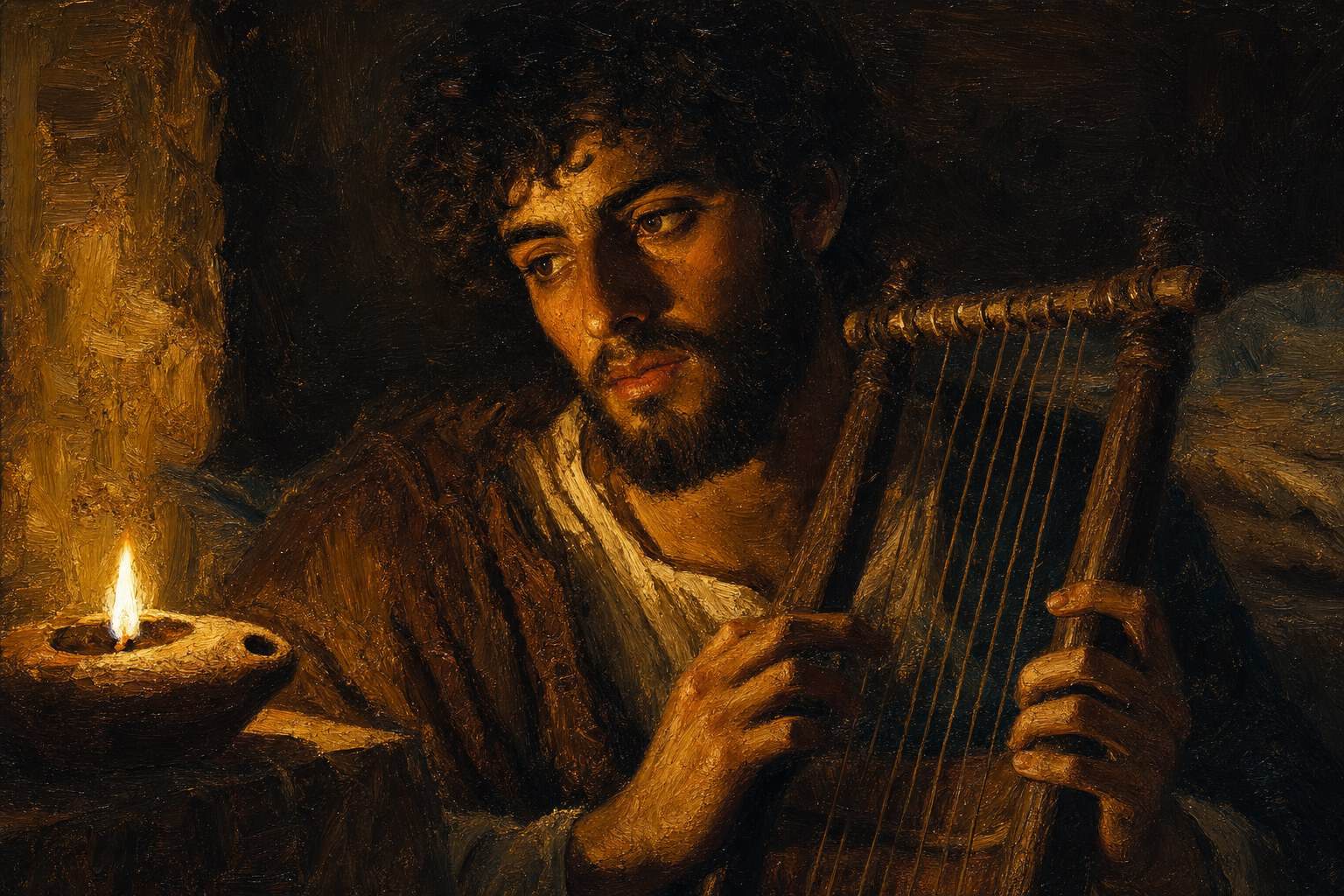
Why is it easier to talk to people online? A boy at a dial-up bulletin board finds belonging only where his body cannot be seen, until someone asks what he looks like.
The Hum of the Modem in a Dark Bedroom
A boy sits in the blue wash of a monitor, fingers on a plastic keyboard worn smooth at the vowels he strikes most. The house has gone quiet around him. The modem has finished its harsh scream of connection, that ugly music of static and tones, and now there is only the soft click of keys and the slow scroll of text rising up from strangers who cannot see his face. This is a scene near the heart of Chapter 3 of Confessions to the Empty Chair, and it answers a question people still type into search engines late at night, alone in their own blue light: why is it so much easier to talk to people online than to the faces in front of you. For this boy the answer arrives almost by accident. On the bulletin board there are no faces, no clothes, no way to tell if the person typing is thirteen or forty. Age and looks dissolve into word choice, punctuation, the rhythm of a sentence pressed into the wire. A name reveals nothing at all. Everything must be earned through language, through the ability to be funny or gentle or serious with nothing but letters arranged well. He has spent his junior high days counting shoelace knots on the tile to avoid meeting anyone’s eyes, and here, for the first time, the counting stops. No one can see the acne he studies each morning in the mirror. No one can see the awkward arms, the body he has learned to apologize for by making himself small in every doorway. He can simply speak, and be met by the speaking, and the speaking is enough. Belonging, he begins to sense in his chest before he can say it, is not being let into a room. It is being understood by someone who bothered to read you closely. The screen offers him a place where his mind can arrive first, ahead of the flesh that always seemed to ruin the introduction, always seemed to talk over him. And yet, even now, older and trying to be honest, he does not call this pure escape and leave it there. He remembers the relief too clearly to lie about it. He also remembers, with a wince, the price. The whole comfort of that dark bedroom rested on one hidden condition: that the body stay out of sight, offstage, unmentioned. What kind of belonging is that, which requires you first to vanish from your own skin before anyone will love your words? He does not answer the question in the glow. He lets it sit there, warm and uneasy on his lap like the machine itself, and keeps typing into the dark where someone, at last, is typing back to him.
Reading the Breadcrumbs People Leave
Night after night, weekend after weekend, through summers and holidays when the house emptied and the phone line was free, he returns to the same handful of names on the board. They become as familiar as neighbors. Over time something forms that the school hallways never once allowed him: a baseline, a felt sense of how each person sounds when they are whole. He learns how one of them writes when cheerful, the loose jokes, the exclamation marks. He learns how their sentences shorten and go clipped when something is wrong at home. He learns to catch the shift the way you notice a friend’s odd silence across a dinner table. When a familiar voice on the screen suddenly goes flat, he can type the two words that matter most between people—what is wrong—and actually mean them, and be believed. In the tiled corridors of junior high there was never time or space for that kind of attention. The bells rang. The crowds surged toward lockers. The rankings held, fixed and cruel, and no one paused long enough to be read. Here, freed from all of it, he becomes a reader of small traces, an assembler of scattered breadcrumbs into a truth people rarely say out loud about themselves. He calls this, with unsparing honesty about his own coldness, the beginning of his training as a scientist of the soul. It is a genuine gift, and it is also a wound wearing the mask of a gift, and he knows it. That is the quiet reason talking online feels easier: he sees so clearly precisely because he is no longer seen. The exile that shamed him in the hallways also sharpened him at the keyboard. Standing forever outside the circle taught him to study the circle from the edge. That cold, almost mathematical clarity felt, for a while, like a kind of power he had never held. But he presses himself now on what it cost him as a person. A boy who watches this closely has already stepped back out of the room. He is quietly collecting people instead of standing among them, shoulder to shoulder, at risk. He spoke their language, he admits without flinching, mimicking their safe and familiar routines while his own inner world stayed entirely unmapped, hidden even from the ones who believed they knew him best. He belonged, yes, in a fashion—but strictly on his terms, from behind glass, always the one doing the reading and never once the one being read all the way through. There is a loneliness inside perfect observation that no amount of insight ever repairs. To perceive another person’s need and answer it gently is a real tenderness; it stands close to love, almost touching it. But to perceive that need only from a distance you fully control, to comfort another while never risking your own exposure, is something colder and more guarded. He does not name it yet. He only feels the strange doubleness of those long nights: genuinely nearer to these strangers than to anyone at his school, and yet more hidden than ever before, a mind reaching to touch other minds through a wall he had no intention of ever lowering. The keys keep clicking under his hands. The care in his questions is real. So is the wall he crouches behind.
The Moment Someone Asks What You Look Like
Then it happens, as it always eventually happens on the board. Someone in the chat, easy and idly curious between other lines, types the plain question. What do you look like. How old are you. The words appear on the screen and scroll up like a hand reaching straight through the wall he had believed was solid stone. In an instant the whole quiet paradise inverts on itself. The boy who had become pure voice, pure wit, pure quickness of mind, is thrown back down hard into his own skin without warning. The acne returns to his awareness. The awkward limbs return, the arms he never knows where to put. The shame he thought he had left folded at the door of that bright text-room comes flooding back up through the keyboard into his fingers, because now he must either lie about himself or make himself visible, and both roads feel like defeat, like losing the one place that had held him. This is the turn the whole scene has been building toward without ever announcing it: the discovery, sudden and physical, that the body cannot finally be outrun by cleverness. He had built an entire self out of language and let it float free of the flesh, weightless, and for a good while it worked beautifully, better than anything at school. The ease of the screen had always rested on this one thing. But belonging that depends on never once being fully seen is not belonging at all. It is a hiding place that happens to have good company inside it. The screen had promised him a clean escape from being a thing with a face and a wrong body, and the promise turns out to have been a lie all along, because every real connection eventually, quietly, demands that you become visible again to the other person. He feels the truth of it low in his stomach before his mind will consent to admit it—the flesh always knows first, ahead of thought. The very fingers that had taught themselves to touch others without ever being touched back now hover, suddenly clumsy and useless, above a question they cannot answer without cost to the whole fragile thing he built.
Belonging is not being welcomed into a room; it is being read correctly by someone who has learned your handwriting of the soul.
After the Question, the Old Mirror Returns
The cursor blinks on the empty line where his answer should go, and the small bedroom he had almost forgotten reassembles itself around him. He becomes aware again of his actual weight in the chair. He becomes aware of the bathroom down the hall with its unforgiving mirror, the same mirror he studies each morning and turns away from. For a while the screen had let him live outside that mirror entirely, a mind without a reflection, and now the question drags the reflection back and sets it down beside the keyboard. What strikes him, remembering it, is how instantly the joy soured. One moment he had been held, understood, met word for word; the next he was covering himself, wanting to shrink out of even his own sight. He wonders now whether he had misread the whole arrangement from the start. Was that closeness ever really closeness, or was it a performance he controlled so tightly that no one could get near enough to reject him? He had comforted others, read their sorrows, typed his careful concern into the dark—but he had never let a single one of them read the acne or the fear or the boy who counted knots on the floor. He gave them a self scrubbed clean of the body, and they loved that self, and the love landed just to the side of him. He asks himself the hard thing plainly: is a love that never touches your shame a love that ever touched you? He does not have a clean answer, and he refuses to invent one to feel better. What he sees instead, looking back with older eyes, is that God was not absent from that blue-lit room, not off waiting for him to grow up and stop hiding. God was there in the very hiding, quiet beside the trembling boy who could only meet others through a wall, present in the real tenderness of his questions even as He grieved the wall itself. There was no rescue that night, no voice from the machine, no lifting of the shame. There was only a nearness in the dark, an accompaniment inside the very sin of self-concealment, patient as the modem light. That, he comes to believe, is often how grace comes—not by removing the body he wanted to escape, but by refusing to leave him alone inside his refusal to be seen.
The Wall He Would Spend Years Learning to Lower
He never fully answers the question that night, and in a sense the rest of the book is spent answering it. What settles over him, long after the modem has gone silent and the board itself has vanished into obsolescence, is not a tidy lesson but a stubborn suspicion he cannot shake. The screen had taught him something true and something false in the same lesson, tangled together so he could not tell them apart. True: that a person is more than their skin, that wit and gentleness and the ability to read another’s grief are real and can be love. False: that you can offer only the mind and keep the ashamed body safely offstage, and still call the result belonging. Real belonging, he begins to understand in the slow years after, asks for the whole of you—the face you would rather hide, the arms that never sit right, the sins you would erase if you could type over them. It asks you to be read by someone you cannot control, and to survive the reading. That is far more terrifying than any question a stranger ever typed. The boy at the keyboard had found a way to be understood without being exposed, and it was a genuine mercy for a while, a shelter for a soul that could not yet bear the daylight. But a shelter is not a home. He looks back on that hunched figure in the blue light with something gentler than contempt now, closer to grief and even to gratitude. He was learning to see others with a strange and lonely precision, and one day, painfully, he would have to let himself be seen the same way, all the breadcrumbs of his own life gathered up by someone else into a truth he had never spoken aloud. Confessions to the Empty Chair follows that boy out from behind the glass, into rooms where hiding was no longer possible and belonging cost him the one thing he most wanted to keep covered. The question of why it is easier to talk to people online, and what that ease costs, is where it begins. What he does with the answer, and what it does to him, is the long road the book actually walks—and it does not let him off easy, and it does not let him off alone.