How the soul trades its terrible gift for the comfort of not having chosen
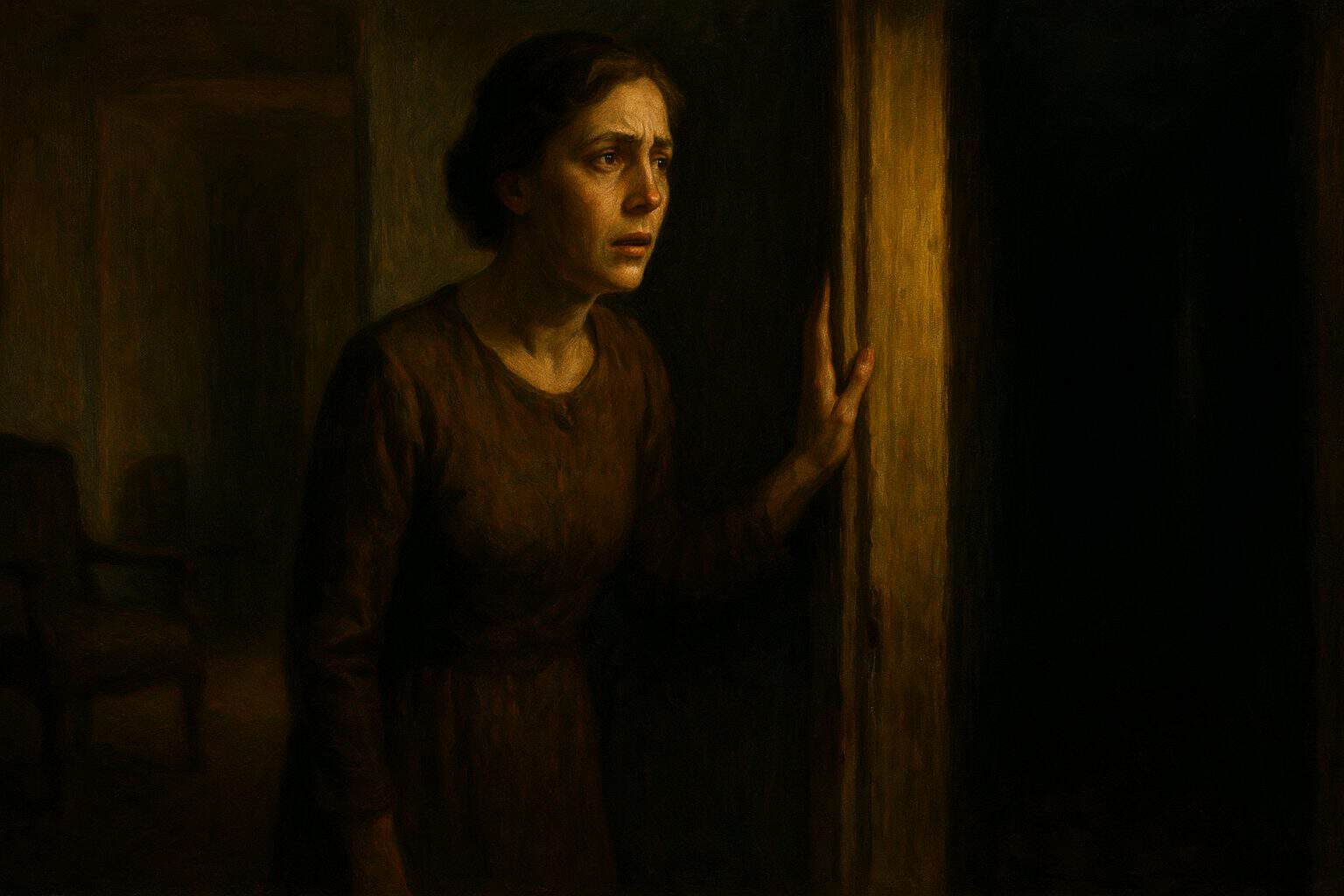
The woman stands before the open door, hand on the frame. Behind her, the familiar room with its known shadows, its predictable drafts, the chair that holds her shape. Before her, the hallway stretching into uncertainty. She has stood here before—yesterday, last month, five years ago. The door remains open. The choice remains unmade. This hovering at the threshold has become its own dwelling place.
The Weight of the Possible
Watch how it happens: the moment when choosing becomes too heavy to bear. A man receives the job offer in another city. The envelope sits unopened for days, then opened but unread, then read but unanswered. Not because he cannot decide—but because deciding would make him responsible for everything that follows. “Better to deal with the devil you know,” he tells himself, but even this is not quite choosing. It is letting the familiar choose him.
The structure shows itself everywhere. In the woman who continues the relationship “for its physical benefits, despite the clear emotional liabilities”—a calculated choice that is also a refusal to choose the harder thing: solitude or genuine seeking. In the man who, knowing “death is coming,” still cannot live with “precious urgency” because urgency itself demands choosing how to spend what remains.
“Being human is a choice and all choices limit themselves to the horizon within which they appear.”
This limiting is what we flee. To choose one path means not choosing others—each yes carries within it a thousand nos. The consciousness that might expand trembles before its own possibilities. Fear drives most “to make the choice of not making any choice at all.”
The Familiar Ache
There is a particular Stimmung that settles over a life of unchosen choices—an “oppressive void” that leeches warmth while providing the cold comfort of the known. The soul chooses “the ache I knew over the grace I did not,” held in place not by virtue but by something more insidious: the ghost of hope that someone or something else will choose for us.
Watch the phenomenology of this abdication. The woman asked to “choose a partner for the night” experiences the feigned courtesy of refusal as more terrifying than compulsion. At least under compulsion, she is not responsible. But given freedom—even corrupted freedom—she must own what follows. The weight is unbearable. She chooses not the partner but the path of least resistance, which is its own choosing while pretending otherwise.
The man whose beloved exists within a hierarchy knows that “if all men were privy to their placement within her hierarchy, most if not all, would disappear.” But knowing this, he remains. Not from hope of ascending the ranks, but because leaving would require choosing himself over the familiar diminishment. Solomon “chose to please his wives over obedience to and trust in God”—not because the wives were worth more, but because disappointing them was a smaller choice than disappointing the Infinite.
The Contaminated Ground
We make our choices “already contaminated by sin,” unable to choose anything outside this imposition without grace. This is not theology but phenomenology—the lived experience of freedom that comes pre-compromised. The decision space we inhabit is already “within the boundaries and limits of the flesh,” a restricted platform where every option carries the taste of mortality.
The consciousness that would be pure spontaneity, creating values ex nihilo, discovers itself always already situated, thrown into a world where choices come pre-weighted with consequences we did not author. “Choices made or not made all carry consequences”—but we did not choose the law of consequence itself.
Here the terrible mercy reveals itself: “Humans never choose with such clarity.” We are spared the absolute freedom that would make us absolutely responsible. Our choices emerge from a murky middle ground where determination and freedom interweave so tightly we cannot say where one ends and the other begins.
The Transferred Agency
Watch what happens when we hand our freedom away: “Their choices are inauthentic insofar as something else, other than their own consciousness, determines their personal agency.” But this inauthenticity brings relief. The employee who “just follows orders,” the spouse who “had no choice,” the citizen who “goes along to get along”—each has found a way to exercise freedom by giving it away.
This is more subtle than simple cowardice. It is a metaphysical strategy, a way of being human that reduces the unbearable weight of possibility. The one who “would not destroy the world if I had the power” has already begun the transfer—imagining power as something external that might be granted or withheld, rather than something that emerges from within the choosing itself.
“Faith, full-hearted and half-sure, is needed to step into the void of the unknown and deal with the resulting consequences.”
But faith itself becomes another place to hide. We wait for certainty before acting, knowing certainty will never come. We demand signs, confirmations, guarantees—not because we need them to choose, but because their absence gives us permission not to choose.
The Violence of the Extreme
“Real change in contrast reflects an extreme response following an extreme stimulus: death or the threat of mortality, loss… or profound betrayal.” Only when the familiar structure collapses does genuine choosing emerge. The diagnosis that allows no denial, the betrayal that permits no return, the loss that cannot be undone—these violent intrusions of reality strip away the luxury of not choosing.
In such moments, we discover what Adoré calls the power in choosing one’s pain: “This time, I would choose my pain, not have it chosen for me. Choice felt like power, even when the only choice was how to hurt.” This is freedom reduced to its essence—not the grand selection among glorious possibilities, but the simple insistence that even in constraint, something remains that is irreducibly mine: the how of my response.
The one who “must be willing to be alone in this world, preferring to stand with loneliness than to kneel with companionship in subjugation” has made the extreme choice. Not because solitude is better than companionship, but because chosen solitude is more human than unchosen subjugation.
The Return of the Possible
“Both death and love either open up new possibilities to do something different and believe in something different or they will remind one to play it safe.” The structure shows itself: extreme experiences create a clearing where genuine choice becomes possible again. But even this clearing fills quickly with the old furniture of evasion.
“One part of me back then wanted to fall in love again—I hated myself for that; love would make me vulnerable, dulling my senses and intellect.” The hatred is not really for the desire but for what the desire reveals: that even after choosing strength, something in us wants to hand our freedom away again, to let another’s presence become our excuse for not choosing.
The “revelation of new possibilities aggravates fear and anxiety due to the awareness of the profound responsibility.” Each expansion of horizon brings not liberation but vertigo. The more we can choose, the more we are responsible for choosing. No wonder we return to the familiar, where at least the cage has known dimensions.
The Courage of Limitation
“Either you will or you won’t, regardless of whether another man is in the picture. The choice is yours.” This stark formulation strips away the elaborate scaffolding of excuse. But notice: even in its starkness, it offers the comfort of binary. Either/or is easier than the infinite gradations of maybe.
Perhaps this is why we create artificial constraints, why we bind ourselves with vows and contracts and deadlines. Not because we are naturally faithful, but because limitation makes choosing possible. The infinite freedom that consciousness might claim becomes, in lived experience, a paralysis. We need horizons to choose against.
“I have the power to love, she has the power to reject. Such rejection heightens the potential for emotional death.” But this asymmetry of power is also what makes choosing possible. If acceptance were guaranteed, would choosing to love mean anything? The possibility of rejection creates the space where genuine choice emerges.
The Handed Freedom
In the end, we discover that handing our freedom away is itself a choice—perhaps the most human choice of all. Not the abdication itself, but the recognition that we are the kind of beings who can abdicate. The consciousness that might expand chooses contraction. The soul that might venture chooses safety. And in this choosing not to choose, we exercise the very freedom we claim to surrender.
The woman at the doorway turns back to the room. Tomorrow she will stand here again. But today, turning back is what she chooses. Not because the room is better than the hallway, but because choosing the room is easier than choosing the journey. She hands her freedom to tomorrow’s self, who will hand it forward again.
This is how we live: in the space between absolute freedom and absolute determination, making choices we pretend not to make, exercising agency we claim not to have. The freedom we hand away returns to us as the structure of our world—the familiar walls we build from our own refusals, the known shadows cast by our unlived possibilities.
The gift remains terrible in its giving and in its refusal. We are condemned to be free, as Sartre knew, but we are also free to pretend otherwise. And in this pretending lies both our tragedy and our mercy—the human way of being that is neither pure spontaneity nor pure submission, but something more difficult: the daily negotiation with a freedom we can neither fully claim nor fully escape.