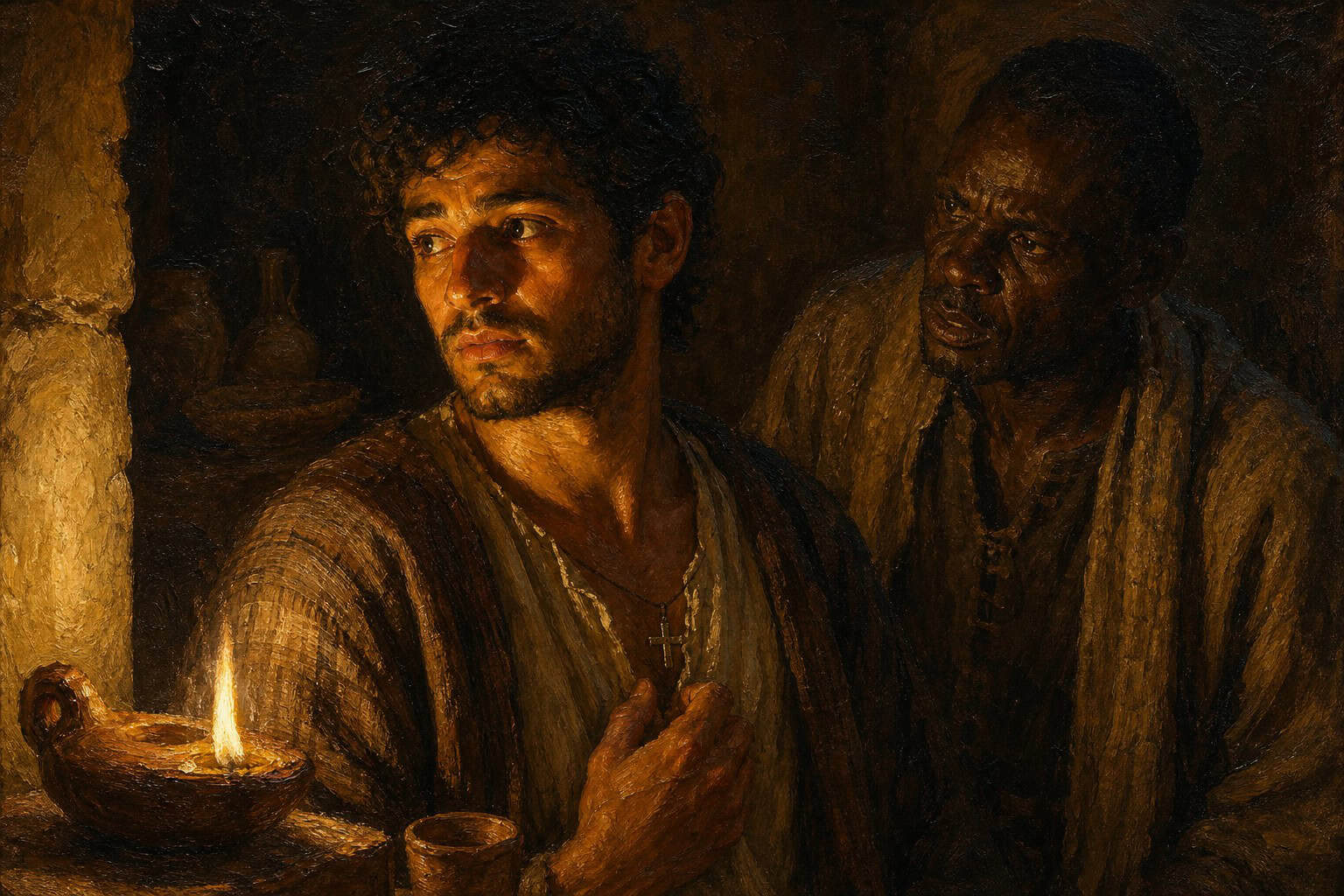
Want to talk to someone lonely and feel unseen doing it? A reflection on being present when your own presence seems not enough to keep.
The Crucifix She Tucked Beneath Her Shirt
You want to talk to someone lonely, and you feel invisible while you do it. I know that ache now far better than the young man in this scene knew it. There was a time I wore a small crucifix against my skin, hoping the metal would quiet the thing that had moved in me since childhood. Movies had taught me that evil should flee a glowing cross, that darkness should shrink from the shape of Christ. Nothing fled. My thoughts stayed exactly where they were. My behavior did not change in any way I could point to and measure. There was no discernible effect, none, and that word has haunted me for years, because I wanted the object to work like a switch. So I passed the necklace to a girl named Jeannètte, telling myself it might guard her, though I could not guard myself. She tucked it under her shirt, out of sight, because it showed Christ still nailed there, and her Protestant world would ask the old question: why is He still on the cross if He has already risen. That hidden metal, warm against a young chest, is where I want to begin. It is the exact shape of trying to reach someone lonely while you yourself feel unseen. The cross could not be shown. The tenderness behind it could not be named. Both stayed pressed to skin, private, half-ashamed, heated by the body that carried them. When you sit beside a lonely person, you hand over something you cannot fully explain, and often they hide it. They wear your care under their clothes, close to the heart, but afraid of the questions it might raise. I did not understand this then. I thought presence was a thing you gave cleanly, like handing over a coin across a table. I did not yet know that presence is more like that necklace: given, hidden, doubted, and still doing quiet work in the dark against the ribs. To speak to the lonely is to accept being partly concealed. You will not always be worn openly. You will not always be thanked, or even seen. You may become the thing under the shirt, felt but unacknowledged, present but never displayed. And still you must give it. The older man writing this sees what the younger one missed entirely. I thought I was protecting her. I was also, secretly, hoping her nearness would starve the darkness in me. I wanted her presence to do for me what the metal could not. That is the first honesty I owe: my reaching toward the lonely was tangled through with my own hunger to be reached, and I did not have the courage yet to admit it.
The Old Ground Where Warmth Came Back
The strange mercy is this: the very place damage lived became the place healing started. I carry memory shapes my body never chose. Silent hands from childhood had rearranged something in me before I had any words for it, before I could name what was happening to me or refuse it. My flesh had rehearsed adult rituals it should never have learned, and those rituals settled into the muscle like sediment into the bed of a river, a boy trying to survive what no boy should be asked to survive. That is the plain fact under everything here: the molestations happened, and God allowed them to happen, and I have never once been able to bless that. But I refuse to let whatever wisdom came from it wither without examination. The wound made hatred possible. It made me quick to read danger in a touch, quick to armor, quick to turn love into a thing I could steer rather than receive. And yet with Jeannètte I felt no evil. Whatever bitterness lived in me, I set it down for her sake, the way you set down a heavy bag at the door of a house you actually want to enter. What had been used to break me, she was somehow using to mend me. The identical territory. The same intimate ground that trauma had weaponized became the ground where warmth returned to my body. This matters for anyone trying to speak to the lonely, because loneliness lives in the flesh, not only the mind. It is a physical thing: the shoulder no one touches, the voice gone unused for days until it cracks, the ache of a room where no one answers when you speak. You do not reach the lonely by explaining loneliness to them from across a safe distance. You reach them by being present in the flesh, near the exact place the wound was made. The body remembers both the hand that harmed and the hand that steadied, and it keeps them both. If you have ever tried to comfort someone whose deepest hurt was inflicted through nearness, you know the terror in it. Your kindness can look like the very thing that once cut them. Your gentleness has to walk into a room already haunted before you arrive. And still, only in that room does the healing happen. There is no path around the damaged place. You do not skip it. You enter it slowly and let something new occur on the old ground. Jeannètte was doing exactly this for me, walking into a body that had learned to expect harm and offering it something it had never been offered on those terms. I took the gift half-consciously, hungry, the way a starving man takes bread without once looking up at the hands that baked it.
The Deepest Thing I Ever Said Out Loud
There was one thing I told her that I had told almost no one alive. Years before, in prayer, I had known God near me, a presence so real it became the most intimate thing living closest to my heart, closer than blood. I had kept it hidden, the way she kept the crucifix hidden under her shirt, for the same reason: fear of the questions it would raise. To speak of a felt nearness of God is to risk being thought mad, or simple, or naive. But with her I said it. I confessed my deep love of God, and she shared that love, and something in me that had stayed locked with everyone else swung open. This is the part of reaching the lonely we keep forgetting. Loneliness is not cured by chatter, by filling the air with easy words. It is cured by confession, by two people finally showing each other the thing they keep pressed against the skin. I did not comfort her by staying safe and pleasant. I comforted her by handing over the tenderest, strangest truth I carried, the one I feared she could not receive. And she received it. To speak to someone lonely is to risk your own concealment, to pull out from under your own shirt the thing you most protect. Only then does the other stop being alone, because they are no longer the only one standing exposed in the open. I told her, then, that I meant to become a Catholic priest, because of that love, because the encounter in prayer had marked me the way a brand marks skin. She was a Baptist, and the questions came at once, honest and pointed and unafraid. I felt them land. Each one asked me to account for a future I had built without checking whether she could live inside it. I had confessed the deepest thing and, in the same breath, revealed a door that closed against her. She could hear both at once, the intimacy and the leaving folded together, and her face began to change while I kept talking, too pleased with my own honesty to notice what my honesty was costing her.
To be with the lonely, you must first survive being unseen by them.
Her Voice Went Small and the Room Tilted
She asked the question that changed everything, and she asked it quietly. Aren’t priests supposed to be celibate. Yes, I said, too easily, far too easily. But as you can see, I’m not a priest yet. I brushed the future aside the way young men brush aside what they do not want to feel in their chests. She pressed. What’ll happen next. So I told her about the road ahead, the seminary in Dallas, four years, a degree, the further study waiting in San Antonio, a master’s, the long stretch of schooling that would carry me physically away from her, city by city, year by year. And then she asked it. Her voice went small, almost to nothing, but the question inside it was a whole universe opening under the floor. And what about us. What’ll happen to us. Everything I had built in my imagination pressed hard against everything her body needed to know. Here is exactly where I retreated. Faced with the real demand of a real love standing in front of me, I hid behind the plan, the schedule, the tidy abstraction of a distant vocation. I turned a living human being’s need into a logistics problem to be solved on a whiteboard. I let the intellect step in front of the tenderness, because the tenderness would have cost me the plan, and I was not ready to pay. That is the failure I read now in this scene, sitting years downstream of it. She was not attacking my calling. She was simply asking to be kept, to matter, to not be left standing on a curb watching a future drive away that she could never climb into. And in that small voice I heard the thing I feared most: that to love her fully would make me invisible to the calling, and to keep the calling would make her invisible to me. Someone would be erased. One of us would become the necklace hidden under the shirt, felt but not worn openly, carried into a room where the honest questions could no longer be asked out loud. I had wanted to reach a lonely girl and instead I was watching her grow lonelier as I spoke, the distance widening with every mile of schooling I named, her eyes doing the arithmetic I refused to do out loud.
Christ Who Would Not Climb Down
So here is what I would say to you, sitting beside someone lonely, feeling invisible while you do it. You are not wrong to feel unseen. Reaching the lonely often means becoming the thing tucked under the shirt, given without acknowledgment, present without display, warm against a chest that will not name you. It means walking into a body that remembers harm and offering it something new on the old ground. It means confessing your own hidden truth so the other person is no longer the only one exposed in the open air. And it means facing the question that has no clean answer: what about us, what happens now, will I be kept. You may not be able to promise. I could not promise her, and I have wondered ever since whether her reasonable, pragmatic question was the quiet thing that killed a dream, or whether the dream was already dying in me and she only gave it a name. Vocations rarely die in loud refusals. They die under gentle, ordinary questions about the future asked in a small voice across a small room. She did nothing cruel. She asked to be loved in a way that could be planned for, and I had no plan that made room for her. The honest reckoning is that I still do not know whether I failed the calling or failed her, or whether the two failures were one failure wearing different clothes. But I have come to believe God did not flee that room the way evil is supposed to flee a cross. He did not fix it. He did not reach down and rescue us both from the impossible arithmetic of it. He stayed in the dark, present in the confusion, near in the very sin of my evasion, walking beside two young people who loved each other clumsily and could not yet see the shape of what was coming. That is the mercy I did not recognize then. The crucifix that seemed to do nothing was doing what it always does. Christ stayed on the cross. He would not climb down and become a charm. He remained in the harm, in the hidden place, under the shirt, choosing to be present in the wound rather than to abolish it. If you want to talk to someone lonely, that is the pattern. Not rescue. Not a solution. Presence in the dark, tears shared, truth confessed, the willingness to sit in the room where the hardest questions live and stay there even when you have no answer. I sat with the full weight of that afternoon at last in Confessions to the Empty Chair, and the questions I could not answer then find their long, unfinished reckoning there. To be with the lonely is to keep showing up in the dark that will not lift.