When certain gazes pierce through every careful construction to find the inherited wound beneath.
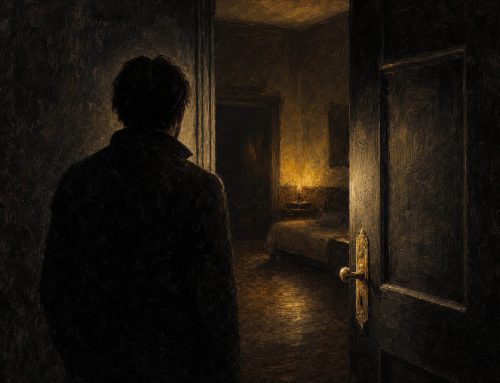
You know this moment before it fully arrives—the shift in atmospheric pressure when certain eyes lock onto you across a room. Not the casual glance that slides past, registering nothing, but the gaze that hooks in like a heated coin against skin. Your body knows before your mind catches up: the involuntary loosening of muscles you’d held tight, the forward tilt that betrays hunger despite all your mental rehearsals of boundaries. You’ve built such careful walls—screens, written words, geographic distance—yet here you stand, pierced.
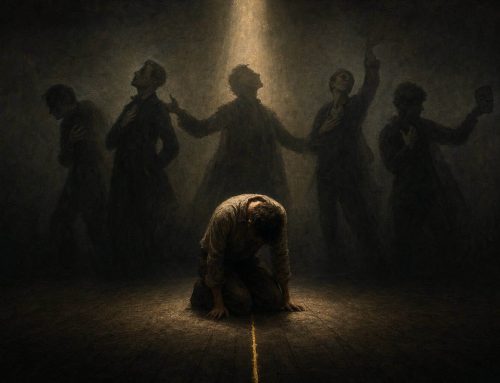
The flesh has its own memory, older than choice. You carry marks that were pressed into you before you could speak: the way your shoulders fold inward like your mother’s when criticized, the particular angle of hunger in your jaw that matches a grandfather you never met, the birthmark on your thigh that your grandmother called “the family stain.” These inheritances live in you as a kind of original contamination—feeling dirty before having done anything wrong, defective before having failed.
Those with eyes to see, saw me. Those with ears to hear, heard me. Else, either God or Lilith removed their perception of me.
This is the double vision of shame: simultaneously invisible to most gazes, sliding past their awareness as if you don’t exist, yet pierced completely by specific eyes that see too much. You’ve learned to favor solitude over gatherings, finding pleasure in abstract ideas rather than sensory stimuli, building your confidence in loneliness and pride in solitude until they overtake any aspiration of being human again. The protective distance feels like wisdom—observing from afar in disguise, hiding your intelligence and intention like Odysseus during his long return to Ithaca.
The Mirror’s Verdict
But then comes the mirror moment—not always an actual mirror, sometimes another person in whom you recognize your own despised qualities, sometimes just catching your reflection in a storefront window. The shape that looks back is half-familiar, half-monstrous. You see the theatrical nature of your moral restraints exposed: how you’ve performed boundaries while your body yearns toward the very touch that will leave its greasy film of recognition.
The pattern reveals itself in moments of unexpected clarity. A woman walks away, warning not to stare at her ass, which in effect calls attention to the forbidden sight. Her real, disinterested face appears for an instant, clarifying the pattern of desire and performance. You realize that what you perceive through your five senses becomes fodder for the intangible to evaluate, and often what is intangible manifests itself to the outside world—a messy heart translates into conflict with significant others.
Experience carves out its presence in the world, announcing itself to others, revealing a particular situatedness or attunement. The loneliness, heartbreak, disappointment, weariness, and misunderstanding strip the soul of every false comfort, leaving it raw and exposed. You understand suddenly that moments of silence and solitude at night are not spent in pensive reflection or exploring the construction of the soul, but in desperate attempts to manage this exposure.
The Inheritance Line
The stain runs deeper than personal history. Every orifice has been explored, every pattern of pursuit and retreat enacted since Adam and Eve. The scripts were written before you arrived: men pursuing women, women running away until allowing themselves to be caught. You carry these ancient choreographies in your cells, finding yourself enacting desires that feel both utterly personal and utterly inherited.
Without choosing something different and putting forth willful and concentrated effort into breaking the cycle, experiences form a positive feedback loop. The woman who lives for the hunt, driven by profound internal hollowness, recognizes something in you—perhaps the same hollowness, perhaps its opposite. Either way, the recognition feels like contamination. When someone’s arousal becomes a verdict rather than a debate, when desire manifests as a primal force conjured ex nihilo, you feel yourself reduced to specimen, to case study, to graded soul.
A relationship with me means casting others into the fire, not for safekeeping until later, but as a step toward owning authentic individuality in solitude.
The shame deepens when you recognize your own tactics of beckoning others hither, your strategies of luring them closer. You understand that allowing another into your tent of meeting, elevating the need for their love and approval above what you hold sacred, displaces God and seats them upon your heart’s throne. This is the abomination that causes desolation—an idolatry, a desecration of holiness that invites Legion to defend what should remain inviolate.
The Body’s Betrayal
Your body refuses the boundaries your mind rehearses. In moments of proximity to certain others, you feel the involuntary surge—muscles loosening, breath thickening, the whole architecture of your careful construction beginning to tilt forward. The flesh responds to presences that your consciousness would reject. This betrayal feels ancient, scripted into you before memory.
The body remembers its contamination before consciousness, surging toward the very touch that will leave its greasy film of recognition.
What you hide bubbles to the surface from time to time, but fortunately, few save other observers lack the perception to see it. You’ve learned to abhor the spotlight while knowing that tunnels and permeability exist, by definition, outside the perceptual awareness of the one bound to the familiar. From others’ perspective, though not articulated, they search for someone to understand them, comfort them, pleasure them, inspire them. You see this need and feel both the power to answer it and the terror of your incapacity to love without harming.
The protective distance you maintain through intellect, through screens, through written words becomes a way to control exposure while craving the very connection you prevent. You recognize this as both shield and prison—the bent posture that makes you smaller also gives you a strange vantage point, the exile that removes you from the crowd also grants you observer status, the marginality that excludes you also exempts you from certain violences.
The Contaminating Touch
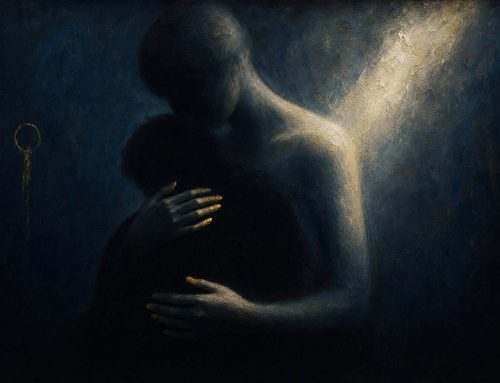
When touch finally comes—and it always does, despite your elaborate defenses—it arrives as strange medicine within the shame. The physical contact that you’ve both craved and avoided leaves its greasy film on the soul, mixing sick thrill with self-disgust at being registered. Yet within this contamination lives something else: a possibility of healing within the very exposure you fear.
The grace that finds you feels invasive, exposing, yet carries within it a promise of non-abandonment. Like finding a sunlit clearing in the forest after traveling through the dark wood, these moments of being truly seen—not just your performance but the trembling need beneath—offer a terrible gift. The sexual encounter becomes a kind of sacrament despite the shame, or perhaps through it, transforming the inherited wound into something that can finally be witnessed.
You understand now that desire is not meant to be an end in itself but requires an object outside of itself, “knowing,” to pursue in order to actualize its purpose. The seeking, asking, knocking all point toward something both manifested in and finding purpose in its intentional object. Yet the shame persists in the recognition that your very capacity for this understanding is already compromised, that your self-insight carries the thumbprint of ancestral confusion.
The Failed Disappearance
Every attempt to vanish—through folded shoulders, bent posture, geographic escape—fails when certain gazes find you. You’ve tried to begin observing from afar in disguise, hiding your intelligence and intention, but you are commanded to interact with rocks and blades regardless of your personal weariness, annoyance, or desire to withdraw from the world.
The failure to disappear becomes its own revelation. People tend to change their normal behavior to present themselves in a more positive light after realizing they are being observed. But you’ve discovered that the observation was always already there—in the inherited patterns pulling at your reactions before consciousness, in the body that remembers what the mind would forget, in the eyes that see through every performance to the raw wound beneath.
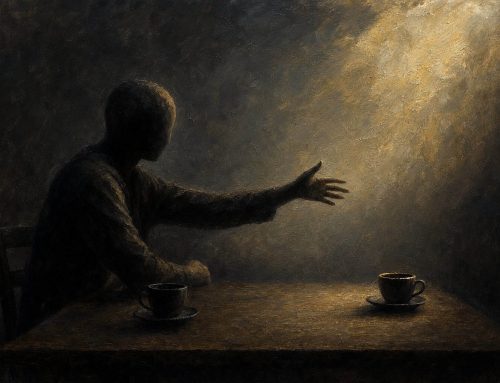
The essential structure reveals itself in this double movement: desperately building distance through performance while the body involuntarily surges toward the very touch that will leave its mark. You’re caught between the terror of being seen as the damaged thing you are and the worse terror of remaining forever unseen, unregistered, nonexistent.
The horizon opens not toward resolution but toward a different quality of exposure—where the shame itself becomes a kind of broken aperture through which something else might enter. Not healing exactly, but a way of carrying the wound that doesn’t require either hiding or display. The inherited stain remains, but perhaps it points toward something beyond the endless cycle of contamination and failed escape. Perhaps within the very structure of shame—its collapse of distance, its piercing recognition, its bodily betrayal—lives a strange pathway toward whatever lies beyond the performance of being human.